


A meteor shower was reported in the skies over Abu Dhabi on Monday night, and astronomers say a much bigger cosmic spectacle may be on its way to the capital on Tuesday evening.
The Tau Herculids shower is debris from a comet known as 73P/Schwassmann-Wachmann, or SW3, that split in 1995.
Astronomers based in the UAE reported that 11 meteors were caught by their cameras over Abu Dhabi on Monday.
They may be followed by a meteor storm which could be visible from the Emirates on Tuesday night, possibly after 7pm.
A storm is a very intense shower, producing at least 1,000 meteors an hour.
“The UAE Meteor Monitoring Network of the International Astronomy Centre in Abu Dhabi observed [detected] 11 meteors last night that belong to the Tau Hercules shower,” the International Astronomy Centre tweeted.
“A resulting meteor storm is expected the following night.”
The comet was discovered in 1930 by two German astronomers. It was so faint that it was not seen again until the late 1970s.
It was in the 1990s when astronomers realised that the comet had become about 600 times brighter and very visible to the naked eye.
It split into several pieces and is littering its orbit with debris. That is what is creating the meteor shower that is now visible for the first time from Earth.
Nasa said the debris from the comet will strike Earth’s atmosphere very slowly, at about 16 kilometres a second.
The agency said the showers could be clearly visible in North America.
“A possible newcomer this year is the Tau Herculid shower, forecast to peak on the night of May 30 and early morning of May 31,” Nasa's website said.
“North American stargazers are taking particular note this year because the Tau Herculid radiant will be high in the night sky at the forecast peak time.
“Even better, the Moon is new, so there will be no moonlight to wash out the faint meteors.”
There are many astronomers who are live streaming the showers on YouTube.
Meteors light up skies across the globe — in pictures
-

-
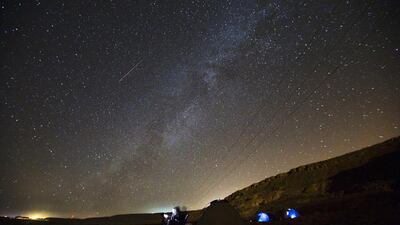
A meteor near the town of Mitzpe Ramon, southern Israel, August 13, 2015. Amir Cohen / Reuters -

A meteor passes above the village of Rievaulx, northern England. Oli Scarff / AFP Photo -
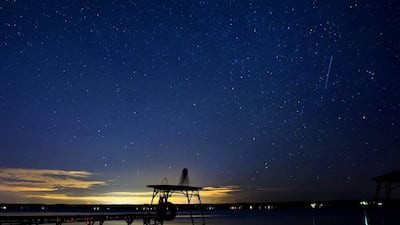
A meteor from the west side of Seneca Lake in Penn Yan, New York. Lauren Long / The Syracuse Newspapers via AP -
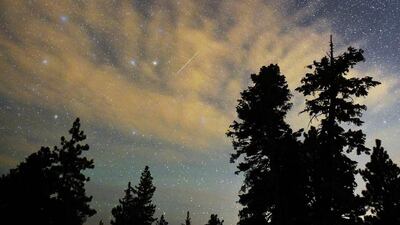
Meteors above the Spring Mountains National Recreation Area, Nevada. Ethan Miller / Getty Images / AFP -
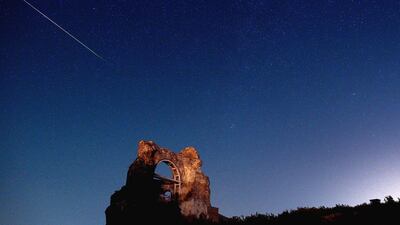
A long exposure image showing a meteor over the early Byzantine Christian basilica ‘Red Church’ near the town of Perushtitsa, some 120 kilometers from Sofia, Bulgaria. Vassil Donev / EPA -
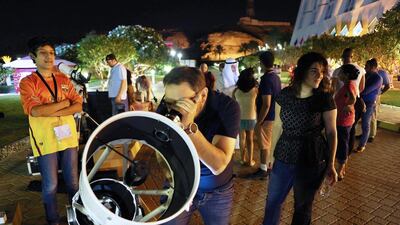
People looking stars through telescope during the Perseid meteor shower at Mercure Grand hotel Jebel Hafeet in Al Ain. Pawan Singh / The National -
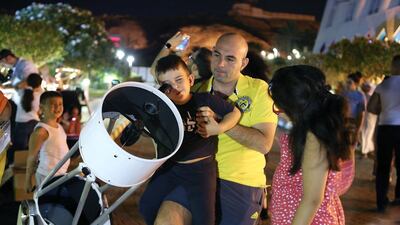
A young boy looks at the stars through a telescope in Al Ain. Pawan Singh / The National -
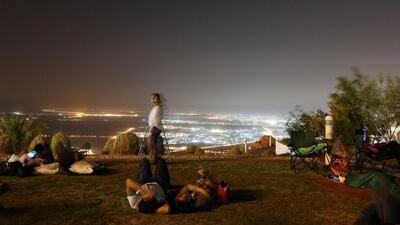
Stargazers in Al Ain. Pawan Singh / The National -
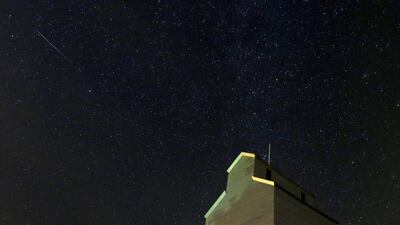
In this photo taken with long exposure, a meteor streaks across the sky behind a grain elevator in Baxter, Iowa. Charlie Riedel / AP Photo -
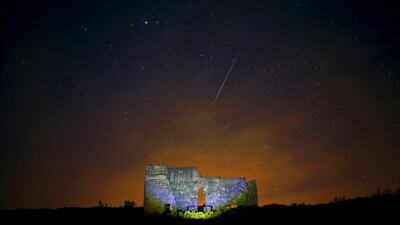
Meteors streak across the sky over a Roman theatre in the ruins of Acinipio near Ronda, southern Spain. Jon Nazca / Reuters -
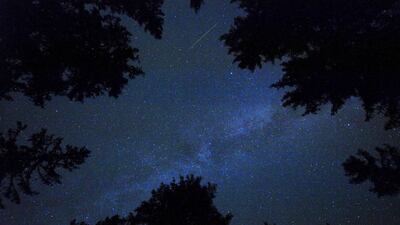
The annual Perseid meteor shower near Rogla, Slovenia. Srdjan Zivulovic / Reuters -
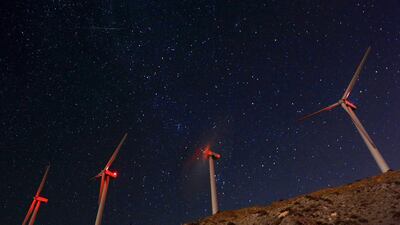
The San Gregornio Pass Wind Farm near Whitewater, California. Sam Mircovich / Reuters -

Hasan Ahmad Al Hariri from thee Dubai Astronomy Group sets up his telescope. Pawan Singh / The National -
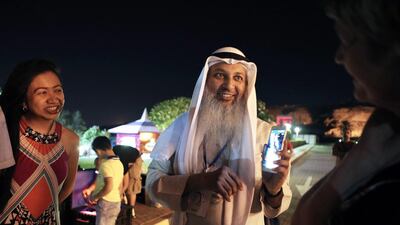
Mr Al Hariri explains the Perseid meteor shower spectacle to hotel guests. Pawan Singh / The National



