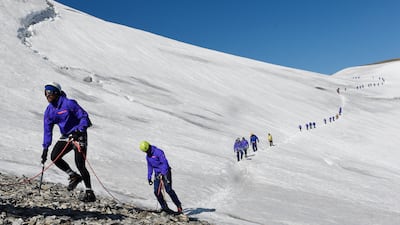
A young sustainability leader from the UAE spoke about witnessing the devastating effects of climate change in Antarctica after visiting the continent during a heatwave.
Emirati Athra Khamis, 24, spent three weeks on the frozen continent in mid-March when Concordia Station, located high on the Antarctic Plateau, hit a record temperature of -11.8ºC, more than 40ºC above the annual average.
She said the experience was emotional because of the breathtaking beauty, but also because of the very obvious negative effect human beings are having on the continent.
“The heat was extreme, unusual,” said the Emirati from Dubai, who is a Youth 4 Sustainability (Y4S) Future Sustainability Leader for Masdar.
“We experienced rain. At that moment, I felt terrified about what is happening. I have spent a couple of years in the climate change field but being there in the centre of it was different.”
When it rains in Antarctica, it is too dangerous for planes to land.
Ms Khamis was one of four people from the UAE, including the programme’s director, Winston Cowie, who took part in the 2041 ClimateForce: Antarctica Expedition from March 16 to 29.
The trip was organised by the 2041 Foundation, as part of a group of global youth leaders to witness first hand the effects of climate change on the continent and raise awareness of the issue.
Members of the 177-strong expedition, who came from 37 countries, visited Deception Island, an active volcano in the South Shetland Islands.
The island, one of the only places in the world where ships can sail into the centre of a volcano, was once home to a whaling station. It closed in 1931 but its footprint remains.
“There was a massive amount of whale bones still on the shore,” Ms Khamis said.
“And on another island we saw oil tanks, processing tanks, from the 19th century when they extracted the oil from the whale bones,” she said.
At the time, the practice devastated the whale population in Antarctica, although it has since recovered.
An expedition led by the British Antarctic Survey in 2020 counted 55 blue Antarctic whales.
“We saw some whales. It was just incredible. There were two sleeping on the surface next to the boat,” said Mr Cowie, who is marine policy manager at Environment Agency Abu Dhabi.
The expedition was led by Sir Robert Swan, the first man, 30 years ago, to walk to both poles, which included a 900 mile journey to the south pole, the longest unassisted walk ever made on earth.
“Our team from the UAE – Athra, Mahra [Al Murawwi] and Sayesha [Dogra] – once again contributed hugely to the expedition,” he said.
“I am really proud of all of them and the UAE for its vision in being at the forefront of climate action – pursuing net-zero and hosting COP28. Over the years I think we have had 27 people from the UAE on our expeditions.
“I am really proud of all of them and what the future holds.”
UAE currency: the story behind the money in your pockets
2018 ICC World Twenty20 Asian Western Sub Regional Qualifier
Event info: The tournament in Kuwait is the first phase of the qualifying process for sides from Asia for the 2020 World T20 in Australia. The UAE must finish within the top three teams out of the six at the competition to advance to the Asia regional finals. Success at regional finals would mean progression to the World T20 Qualifier.
Teams: UAE, Bahrain, Saudi Arabia, Kuwait, Maldives, Qatar
Friday fixtures: 9.30am (UAE time) - Kuwait v Maldives, Qatar v UAE; 3pm - Saudi Arabia v Bahrain
Ten tax points to be aware of in 2026
1. Domestic VAT refund amendments: request your refund within five years
If a business does not apply for the refund on time, they lose their credit.
2. E-invoicing in the UAE
Businesses should continue preparing for the implementation of e-invoicing in the UAE, with 2026 a preparation and transition period ahead of phased mandatory adoption.
3. More tax audits
Tax authorities are increasingly using data already available across multiple filings to identify audit risks.
4. More beneficial VAT and excise tax penalty regime
Tax disputes are expected to become more frequent and more structured, with clearer administrative objection and appeal processes. The UAE has adopted a new penalty regime for VAT and excise disputes, which now mirrors the penalty regime for corporate tax.
5. Greater emphasis on statutory audit
There is a greater need for the accuracy of financial statements. The International Financial Reporting Standards standards need to be strictly adhered to and, as a result, the quality of the audits will need to increase.
6. Further transfer pricing enforcement
Transfer pricing enforcement, which refers to the practice of establishing prices for internal transactions between related entities, is expected to broaden in scope. The UAE will shortly open the possibility to negotiate advance pricing agreements, or essentially rulings for transfer pricing purposes.
7. Limited time periods for audits
Recent amendments also introduce a default five-year limitation period for tax audits and assessments, subject to specific statutory exceptions. While the standard audit and assessment period is five years, this may be extended to up to 15 years in cases involving fraud or tax evasion.
8. Pillar 2 implementation
Many multinational groups will begin to feel the practical effect of the Domestic Minimum Top-Up Tax (DMTT), the UAE's implementation of the OECD’s global minimum tax under Pillar 2. While the rules apply for financial years starting on or after January 1, 2025, it is 2026 that marks the transition to an operational phase.
9. Reduced compliance obligations for imported goods and services
Businesses that apply the reverse-charge mechanism for VAT purposes in the UAE may benefit from reduced compliance obligations.
10. Substance and CbC reporting focus
Tax authorities are expected to continue strengthening the enforcement of economic substance and Country-by-Country (CbC) reporting frameworks. In the UAE, these regimes are increasingly being used as risk-assessment tools, providing tax authorities with a comprehensive view of multinational groups’ global footprints and enabling them to assess whether profits are aligned with real economic activity.
Contributed by Thomas Vanhee and Hend Rashwan, Aurifer
Dhadak 2
Director: Shazia Iqbal
Starring: Siddhant Chaturvedi, Triptii Dimri
Rating: 1/5
Our legal consultant
Name: Hassan Mohsen Elhais
Position: legal consultant with Al Rowaad Advocates and Legal Consultants.
The years Ramadan fell in May
The%20specs
%3Cp%3E%3Cstrong%3EEngine%3A%20%3C%2Fstrong%3E2.3-litre%20turbo%204-cyl%3Cbr%3E%3Cstrong%3ETransmission%3A%20%3C%2Fstrong%3E10-speed%20auto%3Cbr%3E%3Cstrong%3EPower%3A%20%3C%2Fstrong%3E298hp%3Cbr%3E%3Cstrong%3ETorque%3A%20%3C%2Fstrong%3E452Nm%3Cbr%3E%3Cstrong%3ETowing%20capacity%3A%20%3C%2Fstrong%3E3.4-tonne%3Cbr%3E%3Cstrong%3EPayload%3A%20%3C%2Fstrong%3E4WD%20%E2%80%93%20776kg%3B%20Rear-wheel%20drive%20819kg%3Cbr%3E%3Cstrong%3EPrice%3A%20%3C%2Fstrong%3EPrice%3A%20Dh138%2C945%20(XLT)%20Dh193%2C095%20(Wildtrak)%3Cbr%3E%3Cstrong%3EDelivery%3A%3C%2Fstrong%3E%20from%20August%3C%2Fp%3E%0A
Veere di Wedding
Dir: Shashanka Ghosh
Starring: Kareena Kapoo-Khan, Sonam Kapoor, Swara Bhaskar and Shikha Talsania
Verdict: 4 Stars
Polarised public
31% in UK say BBC is biased to left-wing views
19% in UK say BBC is biased to right-wing views
19% in UK say BBC is not biased at all
Source: YouGov
Anghami
Started: December 2011
Co-founders: Elie Habib, Eddy Maroun
Based: Beirut and Dubai
Sector: Entertainment
Size: 85 employees
Stage: Series C
Investors: MEVP, du, Mobily, MBC, Samena Capital
Trump v Khan
2016: Feud begins after Khan criticised Trump’s proposed Muslim travel ban to US
2017: Trump criticises Khan’s ‘no reason to be alarmed’ response to London Bridge terror attacks
2019: Trump calls Khan a “stone cold loser” before first state visit
2019: Trump tweets about “Khan’s Londonistan”, calling him “a national disgrace”
2022: Khan’s office attributes rise in Islamophobic abuse against the major to hostility stoked during Trump’s presidency
July 2025 During a golfing trip to Scotland, Trump calls Khan “a nasty person”
Sept 2025 Trump blames Khan for London’s “stabbings and the dirt and the filth”.
Dec 2025 Trump suggests migrants got Khan elected, calls him a “horrible, vicious, disgusting mayor”
Mobile phone packages comparison
THE SPECS
Engine: 4.4-litre V8
Transmission: eight-speed automatic
Power: 523hp
Torque: 750Nm
Price: Dh469,000
Mercer, the investment consulting arm of US services company Marsh & McLennan, expects its wealth division to at least double its assets under management (AUM) in the Middle East as wealth in the region continues to grow despite economic headwinds, a company official said.
Mercer Wealth, which globally has $160 billion in AUM, plans to boost its AUM in the region to $2-$3bn in the next 2-3 years from the present $1bn, said Yasir AbuShaban, a Dubai-based principal with Mercer Wealth.
“Within the next two to three years, we are looking at reaching $2 to $3 billion as a conservative estimate and we do see an opportunity to do so,” said Mr AbuShaban.
Mercer does not directly make investments, but allocates clients’ money they have discretion to, to professional asset managers. They also provide advice to clients.
“We have buying power. We can negotiate on their (client’s) behalf with asset managers to provide them lower fees than they otherwise would have to get on their own,” he added.
Mercer Wealth’s clients include sovereign wealth funds, family offices, and insurance companies among others.
From its office in Dubai, Mercer also looks after Africa, India and Turkey, where they also see opportunity for growth.
Wealth creation in Middle East and Africa (MEA) grew 8.5 per cent to $8.1 trillion last year from $7.5tn in 2015, higher than last year’s global average of 6 per cent and the second-highest growth in a region after Asia-Pacific which grew 9.9 per cent, according to consultancy Boston Consulting Group (BCG). In the region, where wealth grew just 1.9 per cent in 2015 compared with 2014, a pickup in oil prices has helped in wealth generation.
BCG is forecasting MEA wealth will rise to $12tn by 2021, growing at an annual average of 8 per cent.
Drivers of wealth generation in the region will be split evenly between new wealth creation and growth of performance of existing assets, according to BCG.
Another general trend in the region is clients’ looking for a comprehensive approach to investing, according to Mr AbuShaban.
“Institutional investors or some of the families are seeing a slowdown in the available capital they have to invest and in that sense they are looking at optimizing the way they manage their portfolios and making sure they are not investing haphazardly and different parts of their investment are working together,” said Mr AbuShaban.
Some clients also have a higher appetite for risk, given the low interest-rate environment that does not provide enough yield for some institutional investors. These clients are keen to invest in illiquid assets, such as private equity and infrastructure.
“What we have seen is a desire for higher returns in what has been a low-return environment specifically in various fixed income or bonds,” he said.
“In this environment, we have seen a de facto increase in the risk that clients are taking in things like illiquid investments, private equity investments, infrastructure and private debt, those kind of investments were higher illiquidity results in incrementally higher returns.”
The Abu Dhabi Investment Authority, one of the largest sovereign wealth funds, said in its 2016 report that has gradually increased its exposure in direct private equity and private credit transactions, mainly in Asian markets and especially in China and India. The authority’s private equity department focused on structured equities owing to “their defensive characteristics.”