• Abu Dhabi’s recycling station at Khalidiya. The emirate is trying to encourage more people to go green. Victor Besa / The National
    Abu Dhabi’s recycling station at Khalidiya. The emirate is trying to encourage more people to go green. Victor Besa / The National
  • Sunil Thawani, an Al Khalidiya resident does his part in recycling his trash during the opening of the first civic amenity in Abu Dhabi to promote waste segregation at source. Victor Besa / The National
    Sunil Thawani, an Al Khalidiya resident does his part in recycling his trash during the opening of the first civic amenity in Abu Dhabi to promote waste segregation at source. Victor Besa / The National
  • Rubbish is sorted at the Bee'ah Waste Recovery Facility at the Sharjah Landfill. Jeff Topping / The National
    Rubbish is sorted at the Bee'ah Waste Recovery Facility at the Sharjah Landfill. Jeff Topping / The National
  • Some of 120 separators, look for aluminum , plastic, paper and cardboard, amidst garbage traveling on a conveyer belt in Bee'ah's Waste Recovery Facility at the Sharjah Landfill. Jeff Topping / The National
    Some of 120 separators, look for aluminum , plastic, paper and cardboard, amidst garbage traveling on a conveyer belt in Bee'ah's Waste Recovery Facility at the Sharjah Landfill. Jeff Topping / The National
  • Bales of aluminum inside Bee'ah's Waste Recovery Facility at the Sharjah Landfill. Jeff Topping / The National
    Bales of aluminum inside Bee'ah's Waste Recovery Facility at the Sharjah Landfill. Jeff Topping / The National
  • A truck dumps waste at the Material Recovery Facility during its opening ceremony in Ras Al Khaimah in 2019. Shruti Jain The National
    A truck dumps waste at the Material Recovery Facility during its opening ceremony in Ras Al Khaimah in 2019. Shruti Jain The National
  • View of the garbage at the Material Recovery Facility during its opening ceremony in Ras Al Khaimah in 2019. Shruti Jain The National
    View of the garbage at the Material Recovery Facility during its opening ceremony in Ras Al Khaimah in 2019. Shruti Jain The National
  • Sonia Nasser explains how waste is segregated at the recycling facility in Ras Al Khaimah. Shruti Jain / The National
    Sonia Nasser explains how waste is segregated at the recycling facility in Ras Al Khaimah. Shruti Jain / The National
  • Household waste that can be recycled is separated by hand at RAK's sorting plant. It is hoped an education drive and financial incentives will get residents to separate their own waste and packaging and deliver it to drop-off points. Shruti Jain / The National
    Household waste that can be recycled is separated by hand at RAK's sorting plant. It is hoped an education drive and financial incentives will get residents to separate their own waste and packaging and deliver it to drop-off points. Shruti Jain / The National
  • A landfill site in Dubai. Christopher Pike and Pawan Singh / The National
    A landfill site in Dubai. Christopher Pike and Pawan Singh / The National

Abu Dhabi plans to stop sending waste to landfill by 2071


Gillian Duncan
  • English
  • Arabic

Abu Dhabi has plans to ensure no waste is sent to landfill after 2071.

The zero waste proposal, made on Thursday at an online roundtable discussion on Abu Dhabi’s conservation plans, is part of the emirate’s Environmental Centennial 2071, a 50-year timetable launched by the Environment Agency Abu Dhabi.

Officials said they planned to use satellite technology to track the location of waste, open sorting centres that use artificial intelligence to separate waste from recyclables and use unmanned vehicles to clean the emirate’s streets.

They said they hoped the ­target could be met before 2071.

Tadweer - Abu Dhabi's Centre for Waste Management - keeps the emirate's cities clean. Victor Besa / The National

“Our ambition is to become zero waste in all of our cities,” Sara Al Mazrouei, lead analyst for performance with the agency, said at the event.

"Maybe we will do it before, maybe we will do it after, depending on the action plans and when we will start implementing them.

“We can say by 2050 or maybe before we would like to be zero waste.”

Much of the waste generated across the UAE currently ends up in landfill. In Abu Dhabi about 30 per cent of waste generated is currently recycled or composted but authorities are tying to ramp up this amount.

Tadweer – Abu Dhabi's Centre for Waste Management – is aiming to divert 80 per cent of waste from landfills by 2030.

And the new proposals follow other initiatives in Abu Dhabi over the past few years to boost recycling, encourage sustainability and protect the environment.

More recycling stations have been built, a ban on single-use plastic bags is coming in June, while the EAD said it plans to gradually reduce the amount of single-use plastic products in the emirate and encourage the use of reusable products.

Authorities said they will also implement measures to reduce demand for about 16 single-use plastic products, including cups, stirrers, lids and cutlery.

It will also phase out single-use styrofoam cups, plates and food containers by 2024.

The EAD's 50-year plan, meanwhile, aims to make Abu Dhabi the world’s best in environmental conservation. More information about the strategy is expected soon.

How Abu Dhabi turns construction waste into stone for the UAE's roads - in pictures

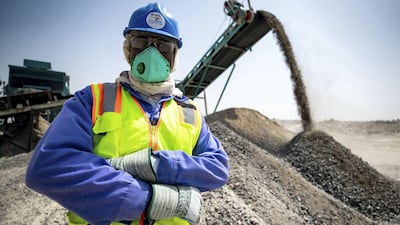
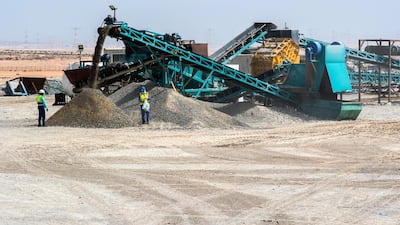
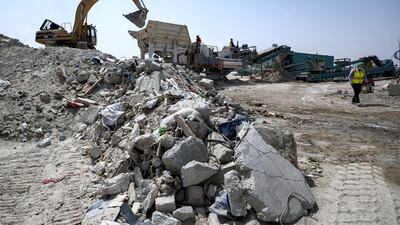
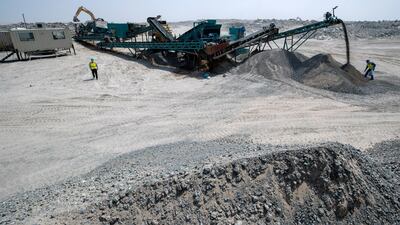
  • The Ghayathi crusher in Al Dhafra, Abu Dhabi. All photos by Victor Besa / The National
    The Ghayathi crusher in Al Dhafra, Abu Dhabi. All photos by Victor Besa / The National
  • About 2,000 tonnes of construction waste are recycled every day here.
    About 2,000 tonnes of construction waste are recycled every day here.
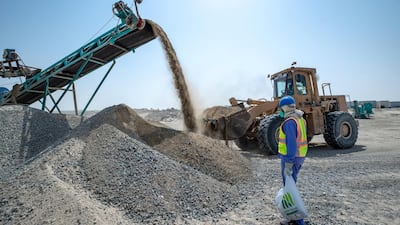
  • The 60-metre long crusher turns huge stones into gravel that can be used on the country's roads.
    The 60-metre long crusher turns huge stones into gravel that can be used on the country's roads.
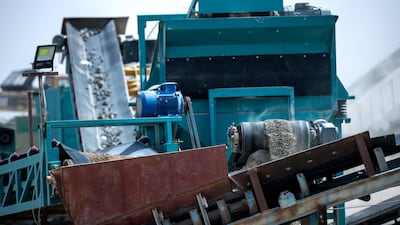
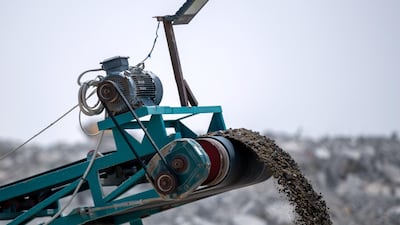
  • The waste travels on a magnetic conveyer belt where any metals or contaminated material is removed.
    The waste travels on a magnetic conveyer belt where any metals or contaminated material is removed.
  • The material is sold for use in infrastructure projects.
    The material is sold for use in infrastructure projects.
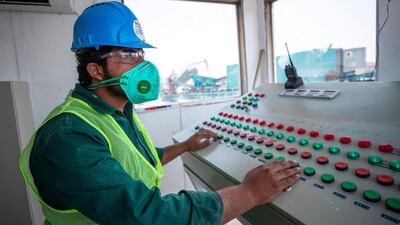
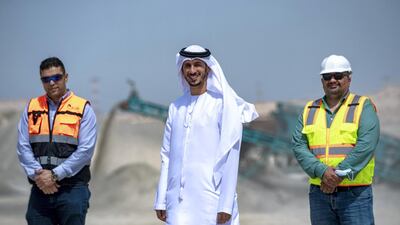
  • From left: Mohannad Raouf, plant manager; Khalid Al Khanbashi, Khalid Al Khanbashi, senior waste officer at Tadweer; and Ahmed Nour Gamil, operations director.
    From left: Mohannad Raouf, plant manager; Khalid Al Khanbashi, Khalid Al Khanbashi, senior waste officer at Tadweer; and Ahmed Nour Gamil, operations director.
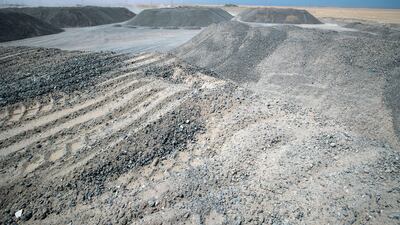
  • The material is screened to ensure it has been crushed to the right size – between 0 and 37.5mm.
    The material is screened to ensure it has been crushed to the right size – between 0 and 37.5mm.
  • All stone from construction sites and demolished buildings in Al Dhafra is recycled, reused and sold to boost the economy.
    All stone from construction sites and demolished buildings in Al Dhafra is recycled, reused and sold to boost the economy.
  • Previously the waste was brought to landfill, which damaged the environment.
    Previously the waste was brought to landfill, which damaged the environment.
  • Hundreds of thousands of tonnes of waste this year could be processed at the plant.
    Hundreds of thousands of tonnes of waste this year could be processed at the plant.
  • The crusher is part of Tadweer's plant to limit waste and pollution and encourage industrial recycling.
    The crusher is part of Tadweer's plant to limit waste and pollution and encourage industrial recycling.
The biog

Favourite Emirati dish: Fish machboos

Favourite spice: Cumin

Family: mother, three sisters, three brothers and a two-year-old daughter

World record transfers

1. Kylian Mbappe - to Real Madrid in 2017/18 - €180 million (Dh770.4m - if a deal goes through)
2. Paul Pogba - to Manchester United in 2016/17 - €105m
3. Gareth Bale - to Real Madrid in 2013/14 - €101m
4. Cristiano Ronaldo - to Real Madrid in 2009/10 - €94m
5. Gonzalo Higuain - to Juventus in 2016/17 - €90m
6. Neymar - to Barcelona in 2013/14 - €88.2m
7. Romelu Lukaku - to Manchester United in 2017/18 - €84.7m
8. Luis Suarez - to Barcelona in 2014/15 - €81.72m
9. Angel di Maria - to Manchester United in 2014/15 - €75m
10. James Rodriguez - to Real Madrid in 2014/15 - €75m

The%20specs%3A%202024%20Mercedes%20E200
%3Cp%3E%3Cstrong%3EEngine%3A%20%3C%2Fstrong%3E2.0-litre%20four-cyl%20turbo%20%2B%20mild%20hybrid%0D%3Cbr%3E%3Cstrong%3EPower%3A%20%3C%2Fstrong%3E204hp%20at%205%2C800rpm%20%2B23hp%20hybrid%20boost%0D%3Cbr%3E%3Cstrong%3ETorque%3A%20%3C%2Fstrong%3E320Nm%20at%201%2C800rpm%20%2B205Nm%20hybrid%20boost%0D%3Cbr%3E%3Cstrong%3ETransmission%3A%20%3C%2Fstrong%3E9-speed%20auto%0D%3Cbr%3E%3Cstrong%3EFuel%20consumption%3A%20%3C%2Fstrong%3E7.3L%2F100km%0D%3Cbr%3E%3Cstrong%3EOn%20sale%3A%20%3C%2Fstrong%3ENovember%2FDecember%0D%3Cbr%3E%3Cstrong%3EPrice%3A%20%3C%2Fstrong%3EFrom%20Dh205%2C000%20(estimate)%3C%2Fp%3E%0A
The burning issue

The internal combustion engine is facing a watershed moment – major manufacturer Volvo is to stop producing petroleum-powered vehicles by 2021 and countries in Europe, including the UK, have vowed to ban their sale before 2040. The National takes a look at the story of one of the most successful technologies of the last 100 years and how it has impacted life in the UAE.

Part three: an affection for classic cars lives on

Read part two: how climate change drove the race for an alternative 

Read part one: how cars came to the UAE

Traces%20of%20Enayat
%3Cp%3E%3Cstrong%3EAuthor%3A%3C%2Fstrong%3E%20Iman%20Mersal%3Cbr%3E%3Cstrong%3EPublisher%3A%3C%2Fstrong%3E%20And%20Other%20Stories%3Cbr%3E%3Cstrong%3EPages%3A%3C%2Fstrong%3E%20240%3C%2Fp%3E%0A
Ten tax points to be aware of in 2026

1. Domestic VAT refund amendments: request your refund within five years

If a business does not apply for the refund on time, they lose their credit.

2. E-invoicing in the UAE

Businesses should continue preparing for the implementation of e-invoicing in the UAE, with 2026 a preparation and transition period ahead of phased mandatory adoption. 

3. More tax audits

Tax authorities are increasingly using data already available across multiple filings to identify audit risks. 

4. More beneficial VAT and excise tax penalty regime

Tax disputes are expected to become more frequent and more structured, with clearer administrative objection and appeal processes. The UAE has adopted a new penalty regime for VAT and excise disputes, which now mirrors the penalty regime for corporate tax.

5. Greater emphasis on statutory audit

There is a greater need for the accuracy of financial statements. The International Financial Reporting Standards standards need to be strictly adhered to and, as a result, the quality of the audits will need to increase.

6. Further transfer pricing enforcement

Transfer pricing enforcement, which refers to the practice of establishing prices for internal transactions between related entities, is expected to broaden in scope. The UAE will shortly open the possibility to negotiate advance pricing agreements, or essentially rulings for transfer pricing purposes. 

7. Limited time periods for audits

Recent amendments also introduce a default five-year limitation period for tax audits and assessments, subject to specific statutory exceptions. While the standard audit and assessment period is five years, this may be extended to up to 15 years in cases involving fraud or tax evasion. 

8. Pillar 2 implementation 

Many multinational groups will begin to feel the practical effect of the Domestic Minimum Top-Up Tax (DMTT), the UAE's implementation of the OECD’s global minimum tax under Pillar 2. While the rules apply for financial years starting on or after January 1, 2025, it is 2026 that marks the transition to an operational phase.

9. Reduced compliance obligations for imported goods and services

Businesses that apply the reverse-charge mechanism for VAT purposes in the UAE may benefit from reduced compliance obligations. 

10. Substance and CbC reporting focus

Tax authorities are expected to continue strengthening the enforcement of economic substance and Country-by-Country (CbC) reporting frameworks. In the UAE, these regimes are increasingly being used as risk-assessment tools, providing tax authorities with a comprehensive view of multinational groups’ global footprints and enabling them to assess whether profits are aligned with real economic activity. 

Contributed by Thomas Vanhee and Hend Rashwan, Aurifer

Tomb%20Raider%20I%E2%80%93III%20Remastered
%3Cp%3EDeveloper%3A%20Aspyr%0D%3Cbr%3EPublisher%3A%20Aspyr%0D%3Cbr%3EConsole%3A%20Nintendo%20Switch%2C%20PlayStation%204%26amp%3B5%2C%20PC%20and%20Xbox%20series%20X%2FS%0D%3Cbr%3ERating%3A%203%2F5%3C%2Fp%3E%0A
What can victims do?

Always use only regulated platforms

Stop all transactions and communication on suspicion

Save all evidence (screenshots, chat logs, transaction IDs)

Report to local authorities

Warn others to prevent further harm

Courtesy: Crystal Intelligence

Name: Peter Dicce

Title: Assistant dean of students and director of athletics

Favourite sport: soccer

Favourite team: Bayern Munich

Favourite player: Franz Beckenbauer

Favourite activity in Abu Dhabi: scuba diving in the Northern Emirates 


COMPANY%20PROFILE
%3Cp%3E%3Cstrong%3ECompany%20name%3A%3C%2Fstrong%3E%20OneOrder%3Cbr%3E%3Cstrong%3EStarted%3A%3C%2Fstrong%3E%20March%202022%3Cbr%3E%3Cstrong%3EFounders%3A%3C%2Fstrong%3E%20Tamer%20Amer%20and%20Karim%20Maurice%3Cbr%3E%3Cstrong%3EBased%3A%3C%2Fstrong%3E%20Cairo%3Cbr%3E%3Cstrong%3ENumber%20of%20staff%3A%20%3C%2Fstrong%3E82%3Cbr%3E%3Cstrong%3EInvestment%20stage%3A%3C%2Fstrong%3E%20Series%20A%3C%2Fp%3E%0A
Lexus LX700h specs

Engine: 3.4-litre twin-turbo V6 plus supplementary electric motor

Power: 464hp at 5,200rpm

Torque: 790Nm from 2,000-3,600rpm

Transmission: 10-speed auto

Fuel consumption: 11.7L/100km

On sale: Now

Price: From Dh590,000

Ferrari 12Cilindri specs

Engine: naturally aspirated 6.5-liter V12

Power: 819hp

Torque: 678Nm at 7,250rpm

Price: From Dh1,700,000

Available: Now

What is the Supreme Petroleum Council?

The Abu Dhabi Supreme Petroleum Council was established in 1988 and is the highest governing body in Abu Dhabi’s oil and gas industry. The council formulates, oversees and executes the emirate’s petroleum-related policies. It also approves the allocation of capital spending across state-owned Adnoc’s upstream, downstream and midstream operations and functions as the company’s board of directors. The SPC’s mandate is also required for auctioning oil and gas concessions in Abu Dhabi and for awarding blocks to international oil companies. The council is chaired by Sheikh Khalifa, the President and Ruler of Abu Dhabi while Sheikh Mohamed bin Zayed, Abu Dhabi’s Crown Prince and Deputy Supreme Commander of the Armed Forces, is the vice chairman.

Notable Yas events in 2017/18

October 13-14 KartZone (complimentary trials)

December 14-16 The Gulf 12 Hours Endurance race

March 5 Yas Marina Circuit Karting Enduro event

March 8-9 UAE Rotax Max Challenge

Profile of Hala Insurance

Date Started: September 2018

Founders: Walid and Karim Dib

Based: Abu Dhabi

Employees: Nine

Amount raised: $1.2 million

Funders: Oman Technology Fund, AB Accelerator, 500 Startups, private backers


Profile Box

Company/date started: 2015

Founder/CEO: Mohammed Toraif

Based: Manama, Bahrain

Sector: Sales, Technology, Conservation

Size: (employees/revenue) 4/ 5,000 downloads

Stage: 1 ($100,000)

Investors: Two first-round investors including, 500 Startups, Fawaz Al Gosaibi Holding (Saudi Arabia)

Updated: April 14, 2022, 7:36 PM