

Ireland's healthcare system underwent major changes during the pandemic that the country's Minister of Health has likened to what happened when Sars plagued Asia more than two decades ago.
Ireland has scrapped most of its pandemic restrictions after two years of rolling lockdowns, including strict measures introduced in early December, when bars and restaurants had to close at 8pm throughout the festive season.
Minister of Health
Its healthcare system came under considerable pressure at various stages of the pandemic, particularly in the early days when the vaccine campaign was in its infancy, which led to a higher number of people in intensive care.
Strong uptake in vaccinations and boosters in the past six months has meant lower numbers in ICU and led to the eventual lifting of most restrictions on January 22.
Stephen Donnelly, Minister of Health, said the country's healthcare system has rapidly evolved and improved to cope with Covid-19.
"What we had to do is exactly what some of the Asian countries did after Sars," he told The National.
"They got hit quite badly with Sars and at the time they said ‘OK, we're going to have a state of the art public health system in place’. We're doing the same.
________________________________________
Expo 2020's striking medallion collection: in pictures
-

The day the UAE won the bid to host Expo 2020 Dubai is marked on a bronze medallion that can be found alongside 41 others at Al Wasl Plaza. 'On 27 November 2013, the UAE celebrated its victorious bid to host the 2020 World Expo in Dubai,' it reads. 'The win, a first for the region, sparked years of innovative development, bringing people from the Middle East, North Africa and South Asia together to create this unforgettable global event. All photos: Pawan Singh / The National -

Space exploration has long been on the UAE's agenda and in 2019 the country's space programme sent its first astronaut into the beyond, 'the opening step in an ambitious quest to explore our universe'. -

Education is the focus here. It reads: 'To the UAE’s founding fathers, education was vitally important - a lantern to light our way in the dark.' -

A map made of cogs, showing how we all work together to make the world go round. 'The UAE believes that co-operation is crucial to creating a better world for everyone. From supporting the United Nations’ Sustainable Development Goals to providing humanitarian aid where it is needed most, the UAE utilises international partnerships to promote opportunity and human growth around the globe.' -

This medallion is inspired by the Emirati succulent plant called salicornia that is helping to reimagine the future of aviation by offering a green alternative to jet fuel. -

This one marks the discovery of oil at Murban Bab field in Abu Dhabi in 1958. The medallion says the discovery 'changed the UAE forever, igniting rapid economic growth and reshaping Emirati society'. -

Connecting cultures: 'The UAE invited all nations to come togethers at Expo 2020 Dubai between October 2021 and 31 March 2022, to showcase their unique cultures, insights and innovations on a global stage. This historical moment demonstrates how interconnection and collaboration can help the world overcome its greatest challenges.' -
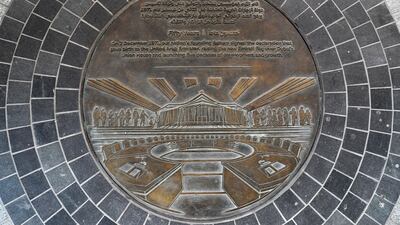
Last year marked the UAE's 50th anniversary, and the milestone is commemorated on this medallion. 'On 2 December 1971, our nation’s founding fathers signed the declaration that gave birth to the United Arab Emirates, raising the new Emirati flag over Dubai’s Union House and launching five decades of development and growth.' -

An homage to the UAE's ports: 'Forward-thinking investment in ports has made the UAE a global shipping hub. Beginning with 1959’s dredging of Dubai Creek and continuing through today’s bustling ports at Fujairah, Kizad and Jebel Ali - the world’s largest man-made harbour - cutting-edge infrastructure has driven the UAE’s maritime ascent.' -

Pearls and pearl diving are the subject of this medallion. -

Expo Tribe: 'In the pursuit of progress and understanding through partnership and co-operation, we are one Tribe, inspired by the spirit of the United Arab Emirates and honoured to deliver the first World Exposition in the rich history of the Arab region.' -

Mobility is a central theme at Expo 2020 Dubai, referring to everything from the global movement of people to data transmission. 'With its world-class digital infrastructure and diverse, innovative culture, the UAE continually blazes new paths to advance human mobility.’ -

The majlis: 'A space of openness and dialogue, the majlis - or “Sitting place” - is the vibrant cornerstone of Emirati social life. Characterised by constructive, tolerant conversations, members of the community come together in the majlis to share news, discuss issues and ideas.'


________________________________________
"We moved last year for the first time to a consultant-led public health system. The public health doctors in Ireland didn't have consultant status. It’s always been a bit of a poor cousin in terms of a healthcare speciality, which it can't be and it isn't in other countries.
"We're moving to a fundamentally new model."
In addition to recruiting more staff, Mr Donnelly said the IT system used by the Health Service Executive has been upgraded. He said it had been "not fit for purpose for the pandemic" and said "patches had to be put in place" between the various systems.
“The way I look at this is we needed to put in place a state-of-the-art missile defence system. You hope you're not going to have to use it. But if you do have to use it, it better be really good,” he said.
Quicker uptake of technology
Like many countries, he said the pandemic has accelerated innovation and technology, with many doctors keen to retain telemedicine that became available during the past two years.
"Some of the medics who would have been very nervous about it have really embraced this and are very keen that we keep it on," he said.
“If there is a silver lining from a health perspective, it's technology-enabled innovation pushing the patients closer to their home and closer to their community."
He said advanced nursing and advanced midwifery practitioners are now seeing, diagnosing, treating and discharging more than 70 per cent of the patients who were waiting to see a consultant.
During his visit to the Emirates, Mr Donnelly met Abdulrahman Al Owais, Minister of Health and Prevention, and Awadh Al Ketbi, Director General of Dubai Health Authority, to discuss opportunities for co-operation and joint work.

