• The first full-color image from Nasa's James Webb Space Telescope shows the galaxy cluster SMACS 0723. Photo: Nasa
    The first full-color image from Nasa's James Webb Space Telescope shows the galaxy cluster SMACS 0723. Photo: Nasa
  • This image made available by Nasa on March 16, 2022 shows star 2MASS J17554042+6551277 used to align the mirrors of the James Webb Space Telescope, with galaxies and stars surrounding it. The hexagonal shape of Webb’s mirrors and its filters made the shimmering star look more red and spiky. The first science images aren't expected until July 12. Photo: Nasa
    This image made available by Nasa on March 16, 2022 shows star 2MASS J17554042+6551277 used to align the mirrors of the James Webb Space Telescope, with galaxies and stars surrounding it. The hexagonal shape of Webb’s mirrors and its filters made the shimmering star look more red and spiky. The first science images aren't expected until July 12. Photo: Nasa
  • This photo provided by NASA shows a “selfie” created using a specialized pupil imaging lens inside of the NIRCam instrument that was designed to take images of the primary mirror segments instead of images of space. (NASA via AP)
    This photo provided by NASA shows a “selfie” created using a specialized pupil imaging lens inside of the NIRCam instrument that was designed to take images of the primary mirror segments instead of images of space. (NASA via AP)
  • Webb is able to look back in time 13 billion years, a mere 100 million years after the Big Bang. AP
    Webb is able to look back in time 13 billion years, a mere 100 million years after the Big Bang. AP
  • The James Webb Space Telescope separates from Arianespace's Ariane 5 rocket. AFP
    The James Webb Space Telescope separates from Arianespace's Ariane 5 rocket. AFP
  • Arianespace's Ariane 5 rocket, with Nasa's James Webb Space Telescope on board, takes off from the Guiana Space Centre in Kourou, French Guiana, on December 25, 2021. Reuters
    Arianespace's Ariane 5 rocket, with Nasa's James Webb Space Telescope on board, takes off from the Guiana Space Centre in Kourou, French Guiana, on December 25, 2021. Reuters
  • The James Webb Space Telescope will help answer fundamental questions about the universe, peering back in time 13 billion years. AFP
    The James Webb Space Telescope will help answer fundamental questions about the universe, peering back in time 13 billion years. AFP
  • Three decades and billions of dollars in the making, the world's most powerful space telescope will take up its position 1.5 million kilometres from the Earth. AFP
    Three decades and billions of dollars in the making, the world's most powerful space telescope will take up its position 1.5 million kilometres from the Earth. AFP
  • Nasa's James Webb Space Telescope is carried by rocket from Europe's Spaceport in French Guiana. AFP
    Nasa's James Webb Space Telescope is carried by rocket from Europe's Spaceport in French Guiana. AFP
  • This combination of images from an animation made available by Nasa shows the unfolding of the components of the James Webb Space Telescope. Webb is so big that it had to be folded origami-style to fit into the nose cone of the Ariane rocket. AP
    This combination of images from an animation made available by Nasa shows the unfolding of the components of the James Webb Space Telescope. Webb is so big that it had to be folded origami-style to fit into the nose cone of the Ariane rocket. AP

How to track James Webb Space Telescope on its 30-day journey to orbit


Sarwat Nasir
  • English
  • Arabic

After its flawless launch into space on Christmas Day, the James Webb Space Telescope is on its way to a unique orbit that will allow it to capture images of the early universe.

It will take about a month for the world’s most powerful telescope to reach a position in space, called Lagrange Point 2, where it will orbit the Sun in line with the Earth.

A European rocket, Ariane 5, successfully launched the $10 billion ‘time travel machine’ into space on Saturday from Europe's Spaceport in Kourou, French Guiana.

It had been in development by Nasa, the European Space Agency and the Canadian Space Agency for more than two decades and faced several delays.

The US space agency has made live tracking of the telescope available on its website.

US President Joe Biden congratulated Nasa on launching the telescope that is expected to create a revolution in astronomy, astrophysics and planetary science research.

“Congratulations Nasa and all who made today’s launch of the James Webb telescope possible,” he tweeted.

“Webb is a shining example of the power of what we can accomplish when we dream big. We've always known that this project would be a risky endeavour, but with big risk comes big rewards.”

Researchers all over the world are set to benefit from the telescope once it becomes operational next year.

It is 100 times more powerful than the Hubble Space Telescope, which has provided millions of images of planets, galaxies, nebulas and stars for 32 years.

The James Webb telescope would be able to see more than 13.5 billion light years away and capture data around the ‘birth of the universe’.

This will help researchers study the very first stars and galaxies that may have formed within the first few hundred million years of when the universe came into existence.

It will also study the atmospheres of planets, black holes, the evolution of stars and planetary systems.

Nasa administrator Bill Nelson said that the telescope would “help discover incredible things that we never imagined”.

“Now we have to realise there is still innumerable things that have to work perfectly. We know that in great reward, there is great risk, and that’s what this business is all about,” he said.

“That’s why we dare to explore. The James Webb Space Telescope is very much part of that exploration.

“It’s significant that we had the delays and it kept us all the way to today – Christmas Day.”

The telescope’s journey to Lagrange Point 2, which is 1.5 million kilometres away from Earth, has been smooth so far.

About 12.5 hours after launch, one course correction manoeuvre had already been performed successfully.

Nasa said there are three mid-course correction manoeuvres in total, with the first one being the most important and time-critical.

The telescope was named after James Webb, who led Nasa during the 1960s and was one of the architects of the Apollo moon programme.

Wonders of space - in pictures

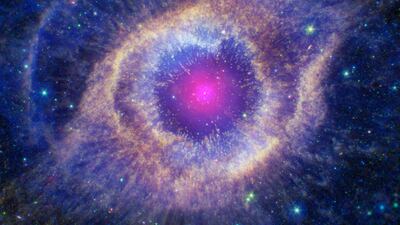
  • Helix Nebula is a phase when a star like the Sun runs out of fuel, it expands and its outer layers puff off, and then the core of the star shrinks. All photos: Nasa
    Helix Nebula is a phase when a star like the Sun runs out of fuel, it expands and its outer layers puff off, and then the core of the star shrinks. All photos: Nasa
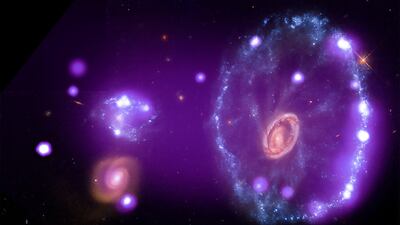
  • This Cartwheel Galaxy resembles a bull's eye, which is appropriate because its appearance is partly due to a smaller galaxy that passed through the middle of this object.
    This Cartwheel Galaxy resembles a bull's eye, which is appropriate because its appearance is partly due to a smaller galaxy that passed through the middle of this object.
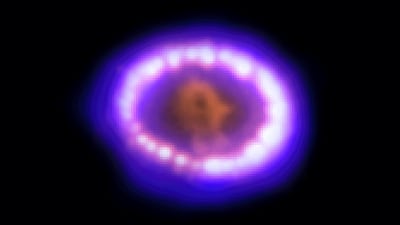
  • On February 24, 1987, observers in the southern hemisphere saw a new object in a nearby galaxy called the Large Magellanic Cloud. This was one of the brightest supernova explosions in centuries and soon became known as Supernova 1987A.
    On February 24, 1987, observers in the southern hemisphere saw a new object in a nearby galaxy called the Large Magellanic Cloud. This was one of the brightest supernova explosions in centuries and soon became known as Supernova 1987A.
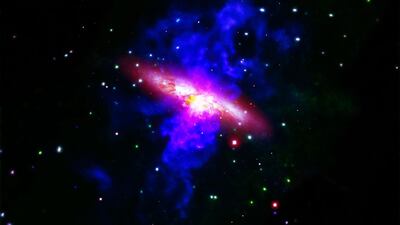
  • Messier 82, or M82, is a galaxy that is oriented edge-on to Earth. This gives astronomers an interesting view of what happens as this galaxy undergoes bursts of star formations.
    Messier 82, or M82, is a galaxy that is oriented edge-on to Earth. This gives astronomers an interesting view of what happens as this galaxy undergoes bursts of star formations.
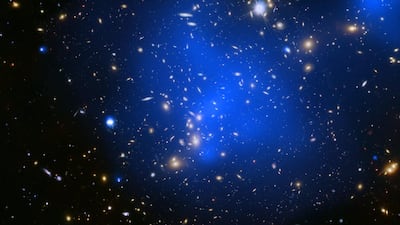
  • Galaxy clusters are the largest objects in the universe held together by gravity. They contain enormous amounts of superheated gas, with temperatures of tens of millions of degrees, which glow brightly in X-rays and can be observed across millions of light years between galaxies.
    Galaxy clusters are the largest objects in the universe held together by gravity. They contain enormous amounts of superheated gas, with temperatures of tens of millions of degrees, which glow brightly in X-rays and can be observed across millions of light years between galaxies.
  • What will be the next star in our Milky Way galaxy to explode as a supernova? Astronomers aren't certain, but one candidate is in Eta Carinae, a volatile system containing two massive stars that closely orbit each other.
    What will be the next star in our Milky Way galaxy to explode as a supernova? Astronomers aren't certain, but one candidate is in Eta Carinae, a volatile system containing two massive stars that closely orbit each other.
Bawaal%20
%3Cp%3E%3Cstrong%3EDirector%3A%3C%2Fstrong%3E%20Nitesh%20Tiwari%3C%2Fp%3E%0A%3Cp%3E%3Cstrong%3EStars%3A%3C%2Fstrong%3E%20Varun%20Dhawan%2C%20Janhvi%20Kapoor%3C%2Fp%3E%0A%3Cp%3E%3Cstrong%3ERating%3A%3C%2Fstrong%3E%201%2F5%3C%2Fp%3E%0A
Updated: December 26, 2021, 4:22 PM