
Police in Dubai have confiscated more than 9,000 bicycles in the last ten months in a safety push.
Brig Saif Muhair Al Mazrouei, director-general of the Dubai Police traffic department, said cyclists had their bikes seized for breaking traffic laws and endangering the lives of road users.
He said the officers had intensified their traffic patrols in the Deira and Bur Dubai areas, where many people use bicycles, in the past months.
“The aim is to reduce deaths, disabilities and injuries caused by bicycle-related accidents,” he said.
Between January and October this year, officers confiscated 9,886 bicycles of riders who were caught breaking traffic and safety rules.
“Bicycle-related accidents can be fatal, especially when cyclists are recklessly driving or riding against the flow of traffic,” he said.
“Some cyclists break traffic laws and endanger their lives and others’ lives by cycling on pavements in commercial markets and narrow alleys.”
Accidents involving bicycles can be serious, he said.
“Bicycles have minimum protection, so a simple collision could have serious consequences,” Brig Al Mazrouei said.
The senior officer said cyclists must stop at red lights, be careful near busy intersections, and always use crosswalks.
“Cyclists need to wear a properly fitted bicycle helmet and a high visibility vest, always ride in the same direction as other vehicles and never ride against traffic,” he said.
New eletronic permit for amateur cyclists in Abu Dhabi - in pictures
-

Cyclists on the Corniche in Abu Dhabi. A new permit system allows cyclists in the capital to ride over long distances in large groups. -

A woman walks along a cycling track on the Corniche in Abu Dhabi. Authorities called on cyclists to adhere to public safety regulations. -

Individual cyclists do not require a licence. -
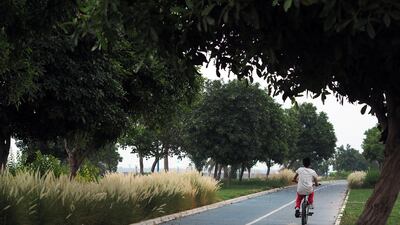
The new measures complement various projects and rules introduced to ensure the safety of cyclists and motorists across the emirate. -

Cyclist Kevin Duell rides on a road in Abu Dhabi. -

People exercising along the corniche in Abu Dhabi. -
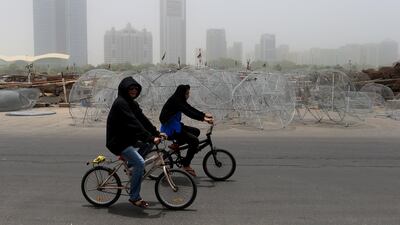
Cyclists near the fishing harbour in Abu Dhabi.
Brief scores:
Toss: Nepal, chose to field
UAE 153-6: Shaiman (59), Usman (30); Regmi 2-23
Nepal 132-7: Jora 53 not out; Zahoor 2-17
Result: UAE won by 21 runs
Series: UAE lead 1-0
Bundesliga fixtures
Saturday, May 16 (kick-offs UAE time)
Borussia Dortmund v Schalke (4.30pm)
RB Leipzig v Freiburg (4.30pm)
Hoffenheim v Hertha Berlin (4.30pm)
Fortuna Dusseldorf v Paderborn (4.30pm)
Augsburg v Wolfsburg (4.30pm)
Eintracht Frankfurt v Borussia Monchengladbach (7.30pm)
Sunday, May 17
Cologne v Mainz (4.30pm),
Union Berlin v Bayern Munich (7pm)
Monday, May 18
Werder Bremen v Bayer Leverkusen (9.30pm)
First Person
Richard Flanagan
Chatto & Windus
Kill%20Bill%20Volume%201
Muslim Council of Elders condemns terrorism on religious sites
The Muslim Council of Elders has strongly condemned the criminal attacks on religious sites in Britain.
It firmly rejected “acts of terrorism, which constitute a flagrant violation of the sanctity of houses of worship”.
“Attacking places of worship is a form of terrorism and extremism that threatens peace and stability within societies,” it said.
The council also warned against the rise of hate speech, racism, extremism and Islamophobia. It urged the international community to join efforts to promote tolerance and peaceful coexistence.
How to wear a kandura
Dos
- Wear the right fabric for the right season and occasion
- Always ask for the dress code if you don’t know
- Wear a white kandura, white ghutra / shemagh (headwear) and black shoes for work
- Wear 100 per cent cotton under the kandura as most fabrics are polyester
Don’ts
- Wear hamdania for work, always wear a ghutra and agal
- Buy a kandura only based on how it feels; ask questions about the fabric and understand what you are buying
Company%C2%A0profile
More from Firas Maksad
FROM%20THE%20ASHES
Who was Alfred Nobel?
The Nobel Prize was created by wealthy Swedish chemist and entrepreneur Alfred Nobel.
- In his will he dictated that the bulk of his estate should be used to fund "prizes to those who, during the preceding year, have conferred the greatest benefit to humankind".
- Nobel is best known as the inventor of dynamite, but also wrote poetry and drama and could speak Russian, French, English and German by the age of 17. The five original prize categories reflect the interests closest to his heart.
- Nobel died in 1896 but it took until 1901, following a legal battle over his will, before the first prizes were awarded.
Explained
Ten tax points to be aware of in 2026
1. Domestic VAT refund amendments: request your refund within five years
If a business does not apply for the refund on time, they lose their credit.
2. E-invoicing in the UAE
Businesses should continue preparing for the implementation of e-invoicing in the UAE, with 2026 a preparation and transition period ahead of phased mandatory adoption.
3. More tax audits
Tax authorities are increasingly using data already available across multiple filings to identify audit risks.
4. More beneficial VAT and excise tax penalty regime
Tax disputes are expected to become more frequent and more structured, with clearer administrative objection and appeal processes. The UAE has adopted a new penalty regime for VAT and excise disputes, which now mirrors the penalty regime for corporate tax.
5. Greater emphasis on statutory audit
There is a greater need for the accuracy of financial statements. The International Financial Reporting Standards standards need to be strictly adhered to and, as a result, the quality of the audits will need to increase.
6. Further transfer pricing enforcement
Transfer pricing enforcement, which refers to the practice of establishing prices for internal transactions between related entities, is expected to broaden in scope. The UAE will shortly open the possibility to negotiate advance pricing agreements, or essentially rulings for transfer pricing purposes.
7. Limited time periods for audits
Recent amendments also introduce a default five-year limitation period for tax audits and assessments, subject to specific statutory exceptions. While the standard audit and assessment period is five years, this may be extended to up to 15 years in cases involving fraud or tax evasion.
8. Pillar 2 implementation
Many multinational groups will begin to feel the practical effect of the Domestic Minimum Top-Up Tax (DMTT), the UAE's implementation of the OECD’s global minimum tax under Pillar 2. While the rules apply for financial years starting on or after January 1, 2025, it is 2026 that marks the transition to an operational phase.
9. Reduced compliance obligations for imported goods and services
Businesses that apply the reverse-charge mechanism for VAT purposes in the UAE may benefit from reduced compliance obligations.
10. Substance and CbC reporting focus
Tax authorities are expected to continue strengthening the enforcement of economic substance and Country-by-Country (CbC) reporting frameworks. In the UAE, these regimes are increasingly being used as risk-assessment tools, providing tax authorities with a comprehensive view of multinational groups’ global footprints and enabling them to assess whether profits are aligned with real economic activity.
Contributed by Thomas Vanhee and Hend Rashwan, Aurifer
Killing of Qassem Suleimani
National Editorial: Suleimani has been killed, now we must de-escalate
Jack Moore: Why the assassination is such a monumental gamble
Matthew Levitt: Iran retains its ability to launch terror attacks
Damien McElroy: A CEO tasked with spreading Iran's influence
Hussein Ibish: Trump's order on solid constitutional ground
Simon Waldman: Cautious Israel keeping a low profile
KILLING OF QASSEM SULEIMANI
National Editorial: Suleimani has been killed, now we must de-escalate
Mina Al Oraibi: Air strike casts a long shadow over the decade ahead
Jack Moore: Why the assassination is such a monumental gamble
Matthew Levitt: Iran retains its ability to launch terror attacks
Damien McElroy: A CEO tasked with spreading Iran's influence
Hussein Ibish: Trump's order on solid constitutional ground
Simon Waldman: Cautious Israel keeping a low profile
Rashmee Roshan Lall: Sound of silence in South Asia
Fanar Haddad: The Iranian response will be gradual
While you're here
Samanth Subramanian: Imposing Hindi could undermine India's linguistic diversity
Phil Mercer: Aboriginal musicians are struggling to be heard
Gavin Esler: What we lose when we allow languages to die
More coverage from the Future Forum
• Remittance charges will be tackled by blockchain
• UAE's monumental and risky Mars Mission to inspire future generations, says minister
• Could the UAE drive India's economy?
• News has a bright future and the UAE is at the heart of it
• Architecture is over - here's cybertecture
• The National announces Future of News journalism competition
• Round up: Experts share their visions of the world to come
Fund-raising tips for start-ups
Develop an innovative business concept
Have the ability to differentiate yourself from competitors
Put in place a business continuity plan after Covid-19
Prepare for the worst-case scenario (further lockdowns, long wait for a vaccine, etc.)
Have enough cash to stay afloat for the next 12 to 18 months
Be creative and innovative to reduce expenses
Be prepared to use Covid-19 as an opportunity for your business
* Tips from Jassim Al Marzooqi and Walid Hanna



