


A Jewish dating website has launched in the UAE to pair up single people looking to make the emirates their long-term home.
Matchmakers from the Association of Gulf Jewish Communities (AGJC) established the service to create a support network for young people moving to the region for work.
president of the AGJC
As the Jewish community expands on the back of a new era of relations with Israel and GCC nations, the region is a growing area of interest for young professionals.
“In the Gulf, we have a lot of Jewish singles who were relocated here to work by their companies,” said AGJC Rabbi Dr Elie Abadie.
“Others decided to come here as the UAE is considered an exotic place, and since the Abraham Accords, they want to explore new horizons in their lives.
“They find themselves alone, so we are trying to help those Jewish singles to find their spouse via this platform.”
The platform, JSG — which stands for “Jewish Singles in the Gulf” — has a website where participants are encouraged to fill out a questionnaire, and then a group of matchmakers recommends potential partners.
Those wishing to join the website must first apply so they can be vetted and approved by a panel of matchmakers.
Once the application is completely filled out, two Jewish people with a history of matchmaking experience look at the application and then interview applicants.
-
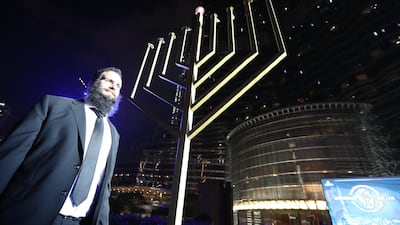
Rabbi Levi Duchman leads the celebration of the Jewish holiday of Hanukkah for the first time in Dubai on December 10, 2020. EPA -

A sukkah, a temporary hut constructed for the week-long Jewish festival of Sukkot, stands in front of the Kaf Armani hotel in Dubai weeks after the UAE normalised ties with Israel. AFP -

People attend the ignition a menorah during the celebration of Hanukkah in Dubai. EPA -

Members of the Jewish community gather for a service of gratitude to the UAE government for the formal recognition Mini Miracles nursery, the Beit Tefillah Synagogue and the induction of Levi Duchman as the Rabbi of Emirates. EPA -

A Torah scroll brought to Abu Dhabi to mark the arrival of Israeli and US delegations as the UAE agreed to normalise ties with Israel. AFP -

Israeli businessman Gil Gurevitch chants religious hymns as he lights a Hanukkah menorah at a hotel in Dubai. AFP


Questions include name, age, what they are looking for in a partner and their degree of religiosity.
“There are not a lot of Jews around the region, so it is much more difficult for singles to find each other,” said Dr Abadie.
“It can be hard to establish a relationship when there are so few in number.
“Matchmakers can answer questions the couples may be embarrassed to ask each other.
“Couples will be coached and supported through the process, and we can help with any religious or spiritual issues they may have.
“We hope to be celebrating a first wedding from this very soon.”
Noah, who did not want to reveal his real name, joined the site when it launched on Monday. He moved to Dubai from London in 2019 to take a job in finance.
“The experience of living in Dubai has been overwhelmingly positive, but Jewish dating can be tricky at the best of times,” the 28-year-old said.
“That became particularly challenging during Covid and being outside of traditional Jewish centres like London, Paris and New York.”
Noah, who is British, hopes to find the right person to settle down with and start a new life in the UAE.
He said the questionnaire took about 15 minutes to complete and asked general questions about background, likes and dislikes and hobbies, as well as his level of religious devotion.
“Living in the Gulf has added complexity and we have had to travel elsewhere to meet people in the past as most people living here are families,” he said.
The Accords gave an emphatic boost to Jewish life in the region and opened people’s eyes to the opportunities here.
“To cater for the growing population, this is an example of how services are expanding and this should make it easier to meet like-minded people who are closer geographically.
“There are a lot of preconceptions about what it is like to be a Jew in the Gulf but I can categorically say I have always been made welcome here and have always felt great hospitality.

“Like anyone, I’m looking for a long-term partner with a shared interest and values.
“I moved to Dubai purely for work, but now I realise it offers an amazing quality of life that is hard to find elsewhere.”
Bahrain hosted the first Jewish wedding in 52 years in October at the Ritz Carlton Manama.
The event was also the first strictly kosher wedding in the kingdom’s history and was arranged by the Orthodox Union, the world’s largest kosher certification agency.
The weekend included two additional ceremonies, a Shabbat Chatan and a Henna ceremony, the latter of which is customary in Sephardic Jewish communities.
Dubai hosted its first Orthodox Jewish wedding in December 2020, when a couple from New York exchanged vows at the Park Hyatt hotel in front of about 150 guests.
The AGJC, the umbrella organisation for the Jewish communities of the GCC, expects Jewish weddings to become more common in the years ahead.
Although still in its infancy, the JSG matchmaking site has already attracted dozens of applicants.
“By helping these singles find their partners in the GCC, they are more likely to get married here and establish their families,” said AGJC President Ebrahim Dawood Nonoo.
“This in turn grows Jewish communal life and the need for more Jewish institutions like schools and kosher food.”

