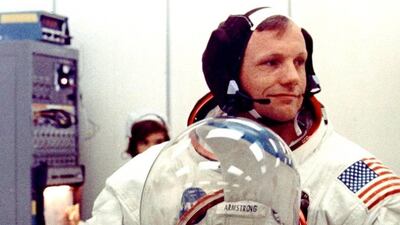
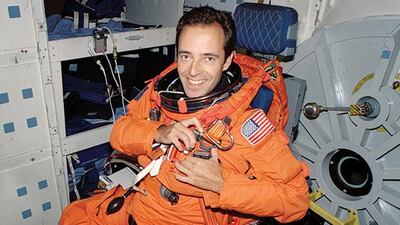
Elon Musk and Jeff Bezos are both exploring the realm of space tourism. Photo: AFP/ Getty Images

Jeff Bezos and Elon Musk's space adventures aren't a waste of cash, says UN space chief


Sarwat Nasir
  • English
  • Arabic

Space tourism has a lot of positives and can help inspire humanity to protect their planet, says UN space chief Simonetta Di Pippo.

The director of the United Nations Office for Outer Space Affairs, Ms Di Pippo said increased access to space would make it 'a part of our lives'.

The comments were made days after Prince William, the Duke of Cambridge, suggested saving the Earth should come before space tourism. He told the BBC: “Great brains and minds should be trying to repair this planet, not trying to find the next place to go and live”.

Ms Di Pippo, who was visiting the Italian pavilion at Expo 2020 Dubai on Monday, told The National that space tourism could benefit humanity in many ways.

“It's really the attempt of bringing space closer to humanity and humanity closer to space.

"Space would become something that’s outside, dark, cold and far away, but part of our lives."

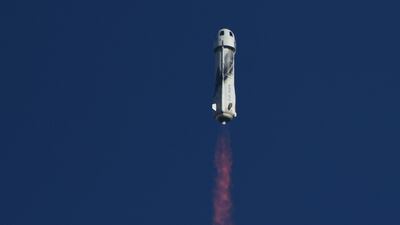
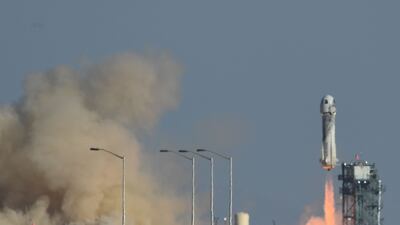
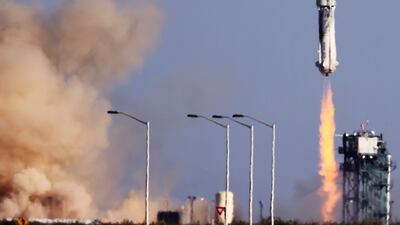
  • The New Shepard rocket carrying 'Star Trek' actor William Shatner launches from West Texas on October 13, 2021. AFP
    The New Shepard rocket carrying 'Star Trek' actor William Shatner launches from West Texas on October 13, 2021. AFP
  • The New Shepard launch was the rocket's second manned voyage into space. AFP
    The New Shepard launch was the rocket's second manned voyage into space. AFP
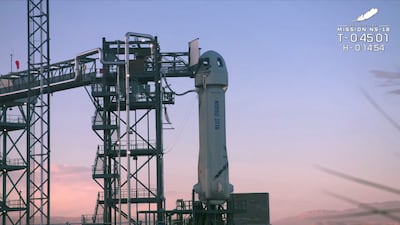
  • Blue Origin’s New Shepard rocket is being prepared for mission NS-18 in October 2021. Reuters
    Blue Origin’s New Shepard rocket is being prepared for mission NS-18 in October 2021. Reuters
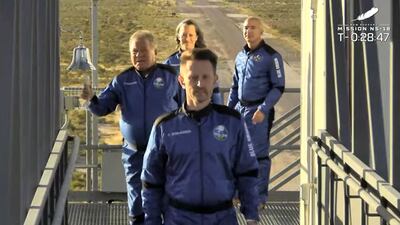
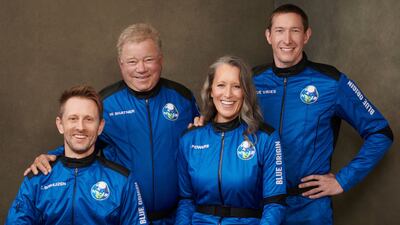
  • New Shepard NS-18 mission crew member William Shatner rings the bell before lift-off. Accompanying the 'Star Trek' actor are Blue Origin founder Jeff Bezos, in rear, and crew members Chris Boshuizen, front, the co-founder of Planet Labs, and Blue Origin’s vice president of mission and flight operations, Audrey Powers. The fourth member of the crew, who is not pictured, is Medidata Solutions co-founder Glen de Vries. AFP
    New Shepard NS-18 mission crew member William Shatner rings the bell before lift-off. Accompanying the 'Star Trek' actor are Blue Origin founder Jeff Bezos, in rear, and crew members Chris Boshuizen, front, the co-founder of Planet Labs, and Blue Origin’s vice president of mission and flight operations, Audrey Powers. The fourth member of the crew, who is not pictured, is Medidata Solutions co-founder Glen de Vries. AFP
  • Blue Origin’s New Shepard rocket is prepared for mission NS-18 in a still image from video. Reuters
    Blue Origin’s New Shepard rocket is prepared for mission NS-18 in a still image from video. Reuters
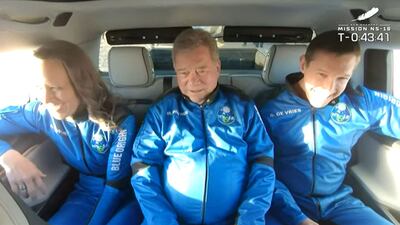
  • The New Shepard NS-18 mission flight team, Audrey Powers, William Shatner and Glen de Vries ride to the launchpad. AFP
    The New Shepard NS-18 mission flight team, Audrey Powers, William Shatner and Glen de Vries ride to the launchpad. AFP
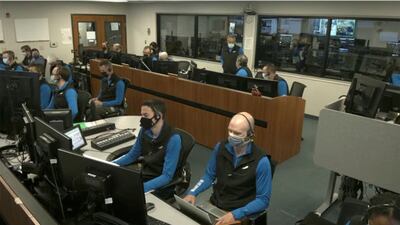
  • Staff monitor Blue Origin’s New Shepard rocket as it is prepared for mission NS-18. Reuters
    Staff monitor Blue Origin’s New Shepard rocket as it is prepared for mission NS-18. Reuters
  • Onlookers assemble to watch the Blue Origin New Shepard rocket blast off. Reuters
    Onlookers assemble to watch the Blue Origin New Shepard rocket blast off. Reuters
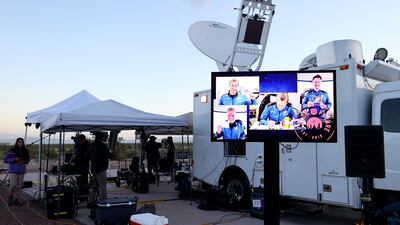
  • Members of the media gather before Blue Origin’s New Shepard lifts off from the launchpad. AFP
    Members of the media gather before Blue Origin’s New Shepard lifts off from the launchpad. AFP
  • Chris Boshuizen, Glen de Vries, Audrey Powers and William Shatner are presented with commemorative coins before their suborbital flight. Reuters
    Chris Boshuizen, Glen de Vries, Audrey Powers and William Shatner are presented with commemorative coins before their suborbital flight. Reuters
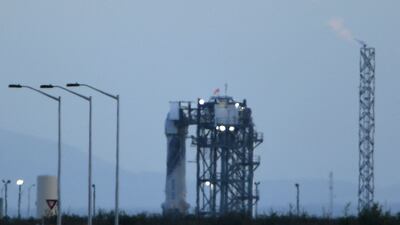
  • The New Shepard rocket sits at the launchpad. AFP
    The New Shepard rocket sits at the launchpad. AFP
  • From left: Chris Boshuizen, William Shatner, Audrey Powers and Glen de Vries. Their launch is Blue Origin’s second passenger flight, using the same capsule and rocket that Jeff Bezos used for his own trip in July 2021. AP
    From left: Chris Boshuizen, William Shatner, Audrey Powers and Glen de Vries. Their launch is Blue Origin’s second passenger flight, using the same capsule and rocket that Jeff Bezos used for his own trip in July 2021. AP
  • Blue Origin’s New Shepard lifts off from the launchpad carrying 90-year-old 'Star Trek' star William Shatner and three other civilians near Van Horn, Texas. AFP
    Blue Origin’s New Shepard lifts off from the launchpad carrying 90-year-old 'Star Trek' star William Shatner and three other civilians near Van Horn, Texas. AFP
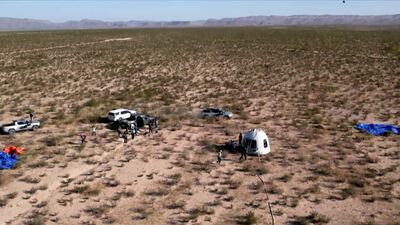
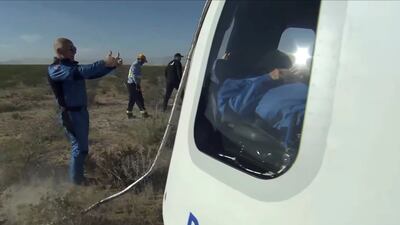
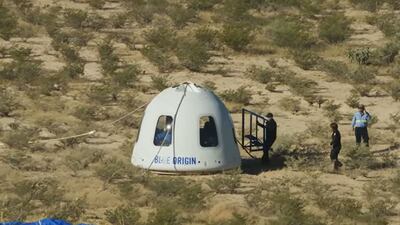
  • The capsule of Blue Origin’s New Shepard mission NS-18 is surrounded by ground crew after landing by parachute near Van Horn, Texas, in a still image captured from video. Reuters
    The capsule of Blue Origin’s New Shepard mission NS-18 is surrounded by ground crew after landing by parachute near Van Horn, Texas, in a still image captured from video. Reuters
  • Billionaire Jeff Bezos gives a thumbs-up outside the capsule of Blue Origin’s New Shepard mission NS-18 after it landed by parachute near Van Horn, Texas. Reuters
    Billionaire Jeff Bezos gives a thumbs-up outside the capsule of Blue Origin’s New Shepard mission NS-18 after it landed by parachute near Van Horn, Texas. Reuters
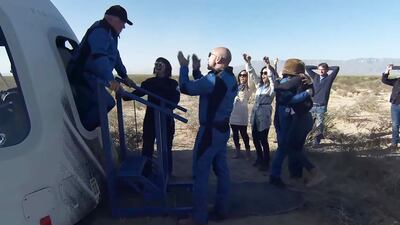
  • Billionaire Jeff Bezos welcomes the four passengers on Blue Origin’s New Shepard mission NS-18 after landing near Van Horn, Texas. Reuters
    Billionaire Jeff Bezos welcomes the four passengers on Blue Origin’s New Shepard mission NS-18 after landing near Van Horn, Texas. Reuters
  • Jeff Bezos, third left, greets Canadian actor William Shatner as he emerges from the capsule after landing near Van Horn, Texas, on October 13. The mission carried Shatner, Audrey Powers, Blue Origin's vice president of mission and flight operations, and customers Chris Boshuizen and Glen de Vries. EPA
    Jeff Bezos, third left, greets Canadian actor William Shatner as he emerges from the capsule after landing near Van Horn, Texas, on October 13. The mission carried Shatner, Audrey Powers, Blue Origin's vice president of mission and flight operations, and customers Chris Boshuizen and Glen de Vries. EPA
  • William Shatner, who at 90 years of age became the oldest person to travel to space, discusses the suborbital flight with Jeff Bezos. EPA
    William Shatner, who at 90 years of age became the oldest person to travel to space, discusses the suborbital flight with Jeff Bezos. EPA
  • William Shatner and Jeff Bezos after New Shepard's NS-18 mission. EPA
    William Shatner and Jeff Bezos after New Shepard's NS-18 mission. EPA
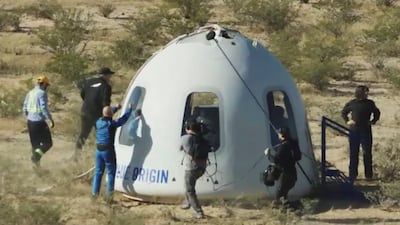
  • Recovery crews reach the New Shepard NS-18 mission capsule after landing on October 13. 'Star Trek' actor Shatner went where no nonagenarian has been before. AFP
    Recovery crews reach the New Shepard NS-18 mission capsule after landing on October 13. 'Star Trek' actor Shatner went where no nonagenarian has been before. AFP
  • The moment of lift-off as William Shatner and his fellow travellers aboard the New Shepard headed for a brief visit to space. EPA
    The moment of lift-off as William Shatner and his fellow travellers aboard the New Shepard headed for a brief visit to space. EPA

On October 13, Star Trek actor William Shatner became the oldest person to go into space aboard a Blue Origin tourism flight.

Richard Branson and Elon Musk are also working on businesses that would take humans to space recreationally.

When asked about space tourism flights by billionaires Ms Di Pippo said she sees a lot of positives to the progress being made in space exploration, and that it will allow people to look back on Earth and recognise its fragility.

“So, we have to work a lot in terms of the sustainability in space, but also on earth. We have [to] try and work on issues related to climate and help the planet survive in the best way possible.

“We can really improve the quality of life for people on Earth, thanks to space.

"I believe that if we have more and more people experiencing what space means, it can also help in policy and decision-making processes towards supporting space.”

Science experiments could also become a regular part of space tourism flights.

Sirisha Bandla, an aeronautical engineer, took a plant experiment with her when she flew on board a Virgin Galactic space tourism flight in July.

The experiment helped to measure how well passengers would be able to perform scientific activities during the 90-minute flight.

“Bandla will activate three plant-filled tubes to release a preservative at critical data-collection stages during the flight: at 1g (Earth gravity level) before the rocket boost, just before entering microgravity, and after the conclusion of microgravity,” Nasa said.

Ms Di Pippo also believes space tourism could help inspire people to create more spin-off technologies.

  • With countries investing billions in space exploration, 'The National' looks at 10 inventions on Earth made possible because of space research and technology. Courtesy: US space agency Nasa
    With countries investing billions in space exploration, 'The National' looks at 10 inventions on Earth made possible because of space research and technology. Courtesy: US space agency Nasa
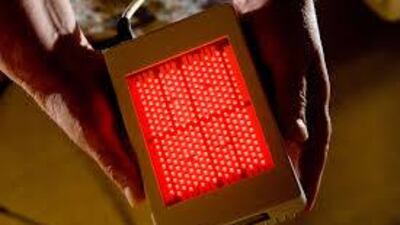
  • After Nasa used red LED to grow plants during the Space Shuttle missions, the technology became part of a two-year clinical trials that found that the light reduced painful side effects caused by chemotherapy and radiation treatment in bone marrow and stem cell transplant patients. The WARP 75 medical device became commercially available in 2009. Courtesy: Nasa
    After Nasa used red LED to grow plants during the Space Shuttle missions, the technology became part of a two-year clinical trials that found that the light reduced painful side effects caused by chemotherapy and radiation treatment in bone marrow and stem cell transplant patients. The WARP 75 medical device became commercially available in 2009. Courtesy: Nasa
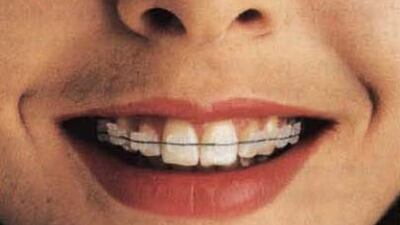
  • Nasa’s technology transfer programme helped one company create invisible braces. In 1989, It worked with Ceradyne Inc to develop translucent polycrustalline alumina, a ceramic that is stronger than steel. Nasa originally used it as a protection tool for infrared antennae on missile trackers. Courtesy: Nasa
    Nasa’s technology transfer programme helped one company create invisible braces. In 1989, It worked with Ceradyne Inc to develop translucent polycrustalline alumina, a ceramic that is stronger than steel. Nasa originally used it as a protection tool for infrared antennae on missile trackers. Courtesy: Nasa
  • In the 1960s, Nasa invented an electrolytic silver ion generator to purify water on the Apollo missions. The technology electronically released silver and copper ions into the water, which helped neutralise bacteria and viruses, and then filtered it. Courtesy: Nasa
    In the 1960s, Nasa invented an electrolytic silver ion generator to purify water on the Apollo missions. The technology electronically released silver and copper ions into the water, which helped neutralise bacteria and viruses, and then filtered it. Courtesy: Nasa
  • A team at Nasa’s Jet Propulsion Lab (JPL) invented the complementary metal-oxide semiconductor active-pixel sensor in the 1990s – a type of image sensor that improved picture quality using a tiny camera. The same team formed a company called Photobit. By 2000, they had shipped one million sensors, which were used in web cameras, dental radiography and automotive applications. Stock image
    A team at Nasa’s Jet Propulsion Lab (JPL) invented the complementary metal-oxide semiconductor active-pixel sensor in the 1990s – a type of image sensor that improved picture quality using a tiny camera. The same team formed a company called Photobit. By 2000, they had shipped one million sensors, which were used in web cameras, dental radiography and automotive applications. Stock image
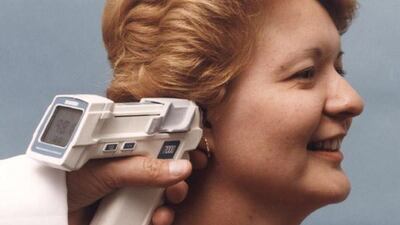
  • After Nasa invented infrared technology to measure the temperature of stars, a company called Diatek partnered with the space agency in 1991 to use the tech in thermometers. The creation helped measure the temperature inside the eardrum. Courtesy: Nasa
    After Nasa invented infrared technology to measure the temperature of stars, a company called Diatek partnered with the space agency in 1991 to use the tech in thermometers. The creation helped measure the temperature inside the eardrum. Courtesy: Nasa
  • Salmonella bacteria was flown to space in hopes to create a vaccine. The Recombinant Attenuated Salmonella Vaccine was developed, but was never distributed to public. Scientists, however, are adding on to the existing research to produce a vaccine. Kobi Wolf/Bloomberg
    Salmonella bacteria was flown to space in hopes to create a vaccine. The Recombinant Attenuated Salmonella Vaccine was developed, but was never distributed to public. Scientists, however, are adding on to the existing research to produce a vaccine. Kobi Wolf/Bloomberg
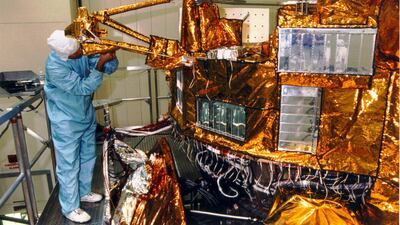
  • Commonly known as the space blanket, Mylar was invented in the 1950s to protect Nasa’s space crafts from the sun’s heat. Now, the aluminum-coated plastic material, which traps and reflects heat, is used in nearly all space crafts, satellites and for those with hypothermia. Courtesy: Nasa
    Commonly known as the space blanket, Mylar was invented in the 1950s to protect Nasa’s space crafts from the sun’s heat. Now, the aluminum-coated plastic material, which traps and reflects heat, is used in nearly all space crafts, satellites and for those with hypothermia. Courtesy: Nasa
  • Nasa invented wireless headsets in the 1950s for astronauts, but they did not become popular until Neil Armstrong used them during the 1969 Moon landing. The headset was called the MS-50 and was developed by Plantronics within 11 days in partnership with Nasa. Courtesy: Nasa
    Nasa invented wireless headsets in the 1950s for astronauts, but they did not become popular until Neil Armstrong used them during the 1969 Moon landing. The headset was called the MS-50 and was developed by Plantronics within 11 days in partnership with Nasa. Courtesy: Nasa
  • Aeronautical engineer Charles Yost created memory foam in partnership with Nasa while trying to develop comfortable airline seating. The soft material was also used during the Space Shuttle era and is now widely available in the form of mattresses, pillows and rugs. Courtesy: Nasa
    Aeronautical engineer Charles Yost created memory foam in partnership with Nasa while trying to develop comfortable airline seating. The soft material was also used during the Space Shuttle era and is now widely available in the form of mattresses, pillows and rugs. Courtesy: Nasa
  • In the 1990s, Nasa researchers accidently discovered how to make baby formula more nutritious. They found that some algae contains fatty acids that are also in human breast milk, specifically docosahexaenoic acid and arachidonic acid. The researchers went on to work for Martek Biosciences Corporation, which developed and manufactured the vegetable oil-like ingredient called Formulaid. EPA
    In the 1990s, Nasa researchers accidently discovered how to make baby formula more nutritious. They found that some algae contains fatty acids that are also in human breast milk, specifically docosahexaenoic acid and arachidonic acid. The researchers went on to work for Martek Biosciences Corporation, which developed and manufactured the vegetable oil-like ingredient called Formulaid. EPA

Space research and tech have helped advance many vital sectors, particularly in medicine and science.

From vaccine development and purifying water to improving baby formula, space technologies and research have been a huge benefit to life on Earth.

Since 1976, Nasa has recorded more than 2,000 space-related projects that have been commercialised and brought to the market.

These include creations such as invisible braces, water purification systems, ear thermometers and wireless headphones.

“The number of satellites that each of us is using every day is really huge - when we check the weather in the morning, access the Global Navigation Satellite Systems to move from point A to point B, develop smart agricultural procedures, do telemedicine or biodiversity – everything [involves] space,” said Ms Di Pippo.


KINGDOM%20OF%20THE%20PLANET%20OF%20THE%20APES
%3Cp%3E%3Cstrong%3EDirector%3A%3C%2Fstrong%3E%20Wes%20Ball%3C%2Fp%3E%0A%3Cp%3E%3Cstrong%3EStarring%3A%3C%2Fstrong%3E%20Owen%20Teague%2C%20Freya%20Allen%2C%20Kevin%20Durand%3C%2Fp%3E%0A%3Cp%3E%3Cstrong%3ERating%3A%20%3C%2Fstrong%3E3.5%2F5%3C%2Fp%3E%0A
Classification of skills

A worker is categorised as skilled by the MOHRE based on nine levels given in the International Standard Classification of Occupations (ISCO) issued by the International Labour Organisation. 

A skilled worker would be someone at a professional level (levels 1 – 5) which includes managers, professionals, technicians and associate professionals, clerical support workers, and service and sales workers.

The worker must also have an attested educational certificate higher than secondary or an equivalent certification, and earn a monthly salary of at least Dh4,000. 

Leap of Faith

Michael J Mazarr

Public Affairs

Dh67
 

Mercer, the investment consulting arm of US services company Marsh & McLennan, expects its wealth division to at least double its assets under management (AUM) in the Middle East as wealth in the region continues to grow despite economic headwinds, a company official said.

Mercer Wealth, which globally has $160 billion in AUM, plans to boost its AUM in the region to $2-$3bn in the next 2-3 years from the present $1bn, said Yasir AbuShaban, a Dubai-based principal with Mercer Wealth.

Within the next two to three years, we are looking at reaching $2 to $3 billion as a conservative estimate and we do see an opportunity to do so,” said Mr AbuShaban.

Mercer does not directly make investments, but allocates clients’ money they have discretion to, to professional asset managers. They also provide advice to clients.

“We have buying power. We can negotiate on their (client’s) behalf with asset managers to provide them lower fees than they otherwise would have to get on their own,” he added.

Mercer Wealth’s clients include sovereign wealth funds, family offices, and insurance companies among others.

From its office in Dubai, Mercer also looks after Africa, India and Turkey, where they also see opportunity for growth.

Wealth creation in Middle East and Africa (MEA) grew 8.5 per cent to $8.1 trillion last year from $7.5tn in 2015, higher than last year’s global average of 6 per cent and the second-highest growth in a region after Asia-Pacific which grew 9.9 per cent, according to consultancy Boston Consulting Group (BCG). In the region, where wealth grew just 1.9 per cent in 2015 compared with 2014, a pickup in oil prices has helped in wealth generation.

BCG is forecasting MEA wealth will rise to $12tn by 2021, growing at an annual average of 8 per cent.

Drivers of wealth generation in the region will be split evenly between new wealth creation and growth of performance of existing assets, according to BCG.

Another general trend in the region is clients’ looking for a comprehensive approach to investing, according to Mr AbuShaban.

“Institutional investors or some of the families are seeing a slowdown in the available capital they have to invest and in that sense they are looking at optimizing the way they manage their portfolios and making sure they are not investing haphazardly and different parts of their investment are working together,” said Mr AbuShaban.

Some clients also have a higher appetite for risk, given the low interest-rate environment that does not provide enough yield for some institutional investors. These clients are keen to invest in illiquid assets, such as private equity and infrastructure.

“What we have seen is a desire for higher returns in what has been a low-return environment specifically in various fixed income or bonds,” he said.

“In this environment, we have seen a de facto increase in the risk that clients are taking in things like illiquid investments, private equity investments, infrastructure and private debt, those kind of investments were higher illiquidity results in incrementally higher returns.”

The Abu Dhabi Investment Authority, one of the largest sovereign wealth funds, said in its 2016 report that has gradually increased its exposure in direct private equity and private credit transactions, mainly in Asian markets and especially in China and India. The authority’s private equity department focused on structured equities owing to “their defensive characteristics.”

How to donate

Text the following numbers:

2289 - Dh10

6025 - Dh 20

2252 - Dh 50

2208 - Dh 100

6020 - Dh 200 

*numbers work for both Etisalat and du

SPECS
%3Cp%3E%3Cstrong%3EEngine%3A%20%3C%2Fstrong%3E2-litre%204-cylinder%20petrol%20(V%20Class)%3B%20electric%20motor%20with%2060kW%20or%2090kW%20powerpack%20(EQV)%0D%3Cbr%3E%3Cstrong%3EPower%3A%3C%2Fstrong%3E%20233hp%20(V%20Class%2C%20best%20option)%3B%20204hp%20(EQV%2C%20best%20option)%0D%3Cbr%3E%3Cstrong%3ETorque%3A%3C%2Fstrong%3E%20350Nm%20(V%20Class%2C%20best%20option)%3B%20TBA%20(EQV)%0D%3Cbr%3E%3Cstrong%3EOn%20sale%3A%20%3C%2Fstrong%3EMid-2024%0D%3Cbr%3E%3Cstrong%3EPrice%3A%20%3C%2Fstrong%3ETBA%0D%3C%2Fp%3E%0A
Most sought after workplace benefits in the UAE
  • Flexible work arrangements
  • Pension support
  • Mental well-being assistance
  • Insurance coverage for optical, dental, alternative medicine, cancer screening
  • Financial well-being incentives 
What is Reform?

Reform is a right-wing, populist party led by Nigel Farage, a former MEP who won a seat in the House of Commons last year at his eighth attempt and a prominent figure in the campaign for the UK to leave the European Union.

It was founded in 2018 and originally called the Brexit Party.

Many of its members previously belonged to UKIP or the mainstream Conservatives.

After Brexit took place, the party focused on the reformation of British democracy.

Former Tory deputy chairman Lee Anderson became its first MP after defecting in March 2024.

The party gained support from Elon Musk, and had hoped the tech billionaire would make a £100m donation. However, Mr Musk changed his mind and called for Mr Farage to step down as leader in a row involving the US tycoon's support for far-right figurehead Tommy Robinson who is in prison for contempt of court.

The specs

Engine: 2.0-litre 4cyl turbo

Power: 261hp at 5,500rpm

Torque: 405Nm at 1,750-3,500rpm

Transmission: 9-speed auto

Fuel consumption: 6.9L/100km

On sale: Now

Price: From Dh117,059

First Person
Richard Flanagan
Chatto & Windus 

FIXTURES

Monday, January 28
Iran v Japan, Hazza bin Zayed Stadium (6pm)

Tuesday, January 29
UAEv Qatar, Mohamed Bin Zayed Stadium (6pm)

Friday, February 1
Final, Zayed Sports City Stadium (6pm)

PROFILE BOX

Company name: Overwrite.ai

Founder: Ayman Alashkar

Started: Established in 2020

Based: Dubai International Financial Centre, Dubai

Sector: PropTech

Initial investment: Self-funded by founder

Funding stage: Seed funding, in talks with angel investors

Washmen Profile

Date Started: May 2015

Founders: Rami Shaar and Jad Halaoui

Based: Dubai, UAE

Sector: Laundry

Employees: 170

Funding: about $8m

Funders: Addventure, B&Y Partners, Clara Ventures, Cedar Mundi Partners, Henkel Ventures

UAE currency: the story behind the money in your pockets
Tamkeen's offering
  • Option 1: 70% in year 1, 50% in year 2, 30% in year 3
  • Option 2: 50% across three years
  • Option 3: 30% across five years 
EVIL%20DEAD%20RISE
%3Cp%3E%3Cstrong%3EDirector%3A%20%3C%2Fstrong%3ELee%20Cronin%3Cbr%3E%3Cstrong%3EStars%3A%20%3C%2Fstrong%3EAlyssa%20Sutherland%2C%20Morgan%20Davies%2C%20Lily%20Sullivan%3Cbr%3E%3Cstrong%3ERating%3A%3C%2Fstrong%3E%205%2F5%3C%2Fp%3E%0A
Infiniti QX80 specs

Engine: twin-turbocharged 3.5-liter V6

Power: 450hp

Torque: 700Nm

Price: From Dh450,000, Autograph model from Dh510,000

Available: Now

The years Ramadan fell in May

1987

1954

1921

1888

Who was Alfred Nobel?

The Nobel Prize was created by wealthy Swedish chemist and entrepreneur Alfred Nobel.

  • In his will he dictated that the bulk of his estate should be used to fund "prizes to those who, during the preceding year, have conferred the greatest benefit to humankind".
  • Nobel is best known as the inventor of dynamite, but also wrote poetry and drama and could speak Russian, French, English and German by the age of 17. The five original prize categories reflect the interests closest to his heart.
  • Nobel died in 1896 but it took until 1901, following a legal battle over his will, before the first prizes were awarded.
Updated: October 20, 2021, 9:10 AM