



India hopes to send three astronauts into space on a locally built rocket by 2023, after delays caused by the Covid-19 pandemic pushed back the initial target of 2022.
The astronauts, believed to be an all-man crew, will take off from India on the Gaganyaan spacecraft, which was built for the nation's human spaceflight programme.
If successful, the mission will propel India’s space programme to new heights, helping the country to become part of an elite group of nations that can send people into space.
Dr R Umamaheswaran, scientific secretary at the Indian Space Research Organisation, spoke exclusively to The National during Space Week at Expo 2020 Dubai.
Indian Space Research Organisation
“Unlike other industries where, to a large extent, work from home is possible, the space industry has to work on site to build things,” he said.
“Many of the industries who are making 80 to 90 per cent of our systems were made in the [space] industry and they were totally closed, so they were not in a position to do anything.
“We were really tied down by the pandemic. The prime minister wanted to have the first manned mission by August 2022, but we’ve missed that. Now, the first unmanned mission should go much before that and we are attempting for 2023 for the manned mission.”
Two unmanned missions, one in December and another next year, are planned before the astronauts can go into space.
India was one of the countries hit hardest by the pandemic, with the Delta variant — a highly infectious version of the coronavirus — spreading rapidly nationwide.
There have been more than 34 million Covid-19 cases in India since the pandemic began. More than 452,000 people have died.

Earlier this year, the astronauts completed their general spaceflight training in Russia.
India wants to develop a self-reliant space programme, using domestically made rockets and satellites.
In 2014, India became the first country to reach Mars orbit in a first attempt, with one of the world’s lowest budgets for a Red Planet mission. The Mangalyaan mission was achieved at a cost of $74 million.
“We have got wonderful information regarding the atmosphere of the planet and its surface,” Dr Umamaheswaran said.
“We are still trying to extract more information on that and pictures on the terrain. We’re still getting a lot of images.”
India also reached the Moon with its Chandrayaan-1 mission in 2008. The orbiter captured data for a year and gleaned vital information on water molecules on the lunar surface.
However, the country’s attempt to land on the Moon with its Chandrayaan-2 mission failed in 2019 when the spacecraft crashed on the surface.
Delays caused by the pandemic postponed India’s third attempt to land a craft on the Moon. Its Chandrayaan-3 mission is planned for a launch next year.
India also has eyes on Venus and plans to launch its Shukrayaan-1 orbiter in 2024.
The four-year mission will orbit the hottest planet in the solar system, collecting data on its mysterious atmosphere.
“The studies are extremely hard because of the hostile atmosphere. Getting the instruments to work there is a big deal in itself. So that way it’s a challenge. We’re trying to understand the upper crust of the planet,” Dr Umamaheswaran said.
Dr Umamaheswaran and other members of the Indian space agency are visiting the India pavilion at Expo for Space Week.
Taking part in the event will be Emirati, American, Italian and Japanese astronauts, as well as leading scientists and engineers.
India pavilion at Expo — in pictures
-
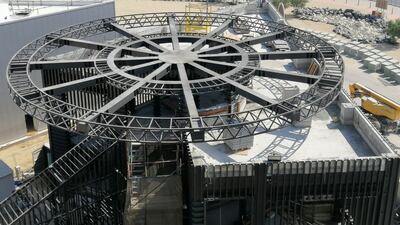
A spinning wheel or chakra made from steel and red sandstone is at the entrance of the India Pavilion. All photos: India Pavilion Expo 2020 Dubai -
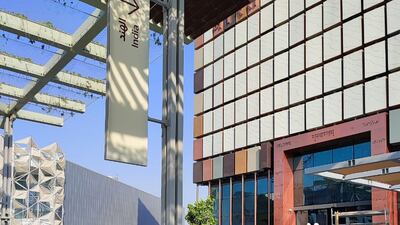
Hundreds of earthy-toned blocks make up the facade of the pavilion. -
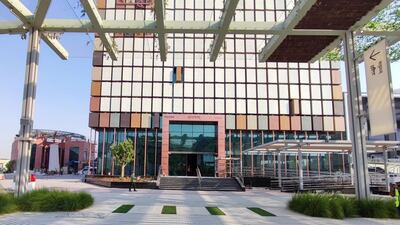
The blocks will serve as a sunshade and a screen on which video projections will be beamed. -

Computers control the movement and rotation of each of the 600 blocks on the exterior of the building. -

The four-storey pavilion will be among three structures that will remain after the Expo 2020 ends. -
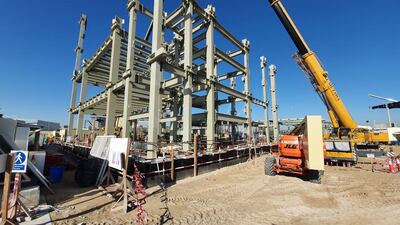
The glass and steel interior of the pavilion has been designed to last after the Expo ends. -

The 600 blocks of the India pavilion constantly move to reflect transformation and change. -
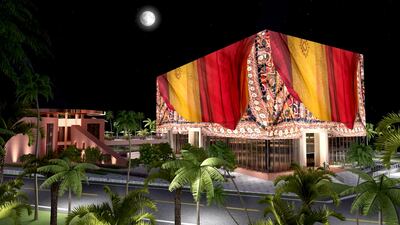
Video footage will be beamed on to the structure. -
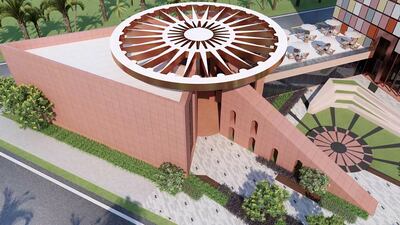
The spinning wheel or chakra will be the roof of a plaza where people will be encouraged to explore. -
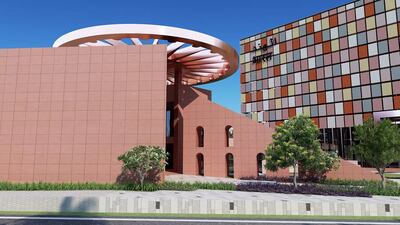
The spinning wheel was inspired by India's independence struggle, and an 18th century astronomical observatory in India’s capital New Delhi also inspired the design. -

Sketches of the pavilion were selected after a competition in India. -

An initial sketch of the pavilion. -

The architect who designed the India pavilion said his aim was to capture constant change in the country.



