

Nestled amid rolling hills and sparkling waterfalls, The Belgadia Palace is a charming Victorian-era property in the princely province of Mayurbhanj, in India’s eastern Odisha state.
Still home to the Bhanjas, one of the country's oldest living royal families, the 200-year-old manor has welcomed international royalty and foreign dignitaries. The late Indian Nobel laureate Rabindranath Tagore’s family, Mark Shand (late brother of Camilla, Duchess of Cornwall), Gyanendra Shah, former king of Nepal and billionaire tycoons have all converged at the property. As the longest-reigning clan of the kings of Mayurbhanj, the Bhanjas ruled for more than 1,000 years until their kingdom's merger, after the Indian Union in January 1949.
After a makeover in 2019, the palace has now opened its doors to travellers as a boutique heritage hotel. On offer are nine rooms brimming with jewel tones and vintage furniture, overlooking landscaped gardens filled with the woody scent of tropical blooms. Doric-Corinthian columns, hand-painted verandas, beautiful patios and lush mango orchards add to the regal aesthetic.
-
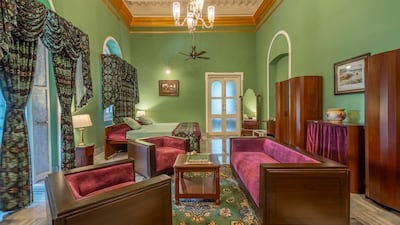
Jewel tones and vintage furniture dominate in the rooms. All photos: The Belgadia Palace -
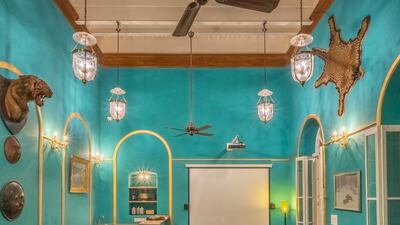
The boutique property has nine rooms -
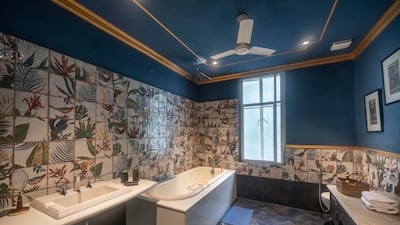
Many of the 200-year-old property's original decorative features have been maintained -
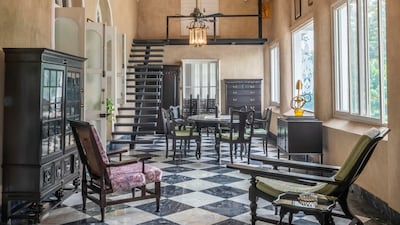
In its heyday, the manor would welcome international royalty and foreign dignitaries -

Akshita Bhanj Deo, right, and Mrinalika Bhanj Deo, the royal sisters responsible for transforming The Belgadia Palace into a boutique heritage hotel


The estate is also home to 15 species of birds, including black drongos, which can often be spotted perched on the pristine white building, while Simlipal National Park, an elephant and tiger Unesco Biosphere Reserve, is located nearby.
The credit for the palace’s restoration goes to sisters Akshita, 28, and Mrinalika Bhanj Deo, 32, the second and third daughters of Praveen Chandra Bhanj Deo, the 47th ruler of the Bhanja dynasty. Their mother is Rashmi Rajya Laxmi Bhanj Deo, from the royal family of Jaisalmer, and their grandmother, Maharani Bharati Rajya Lakshmi Devi, is the daughter of Nepal’s late King Tribhuvan.
As social entrepreneurs and directors of The Belgadia Palace and its philanthropic arm, The Mayurbhanj Foundation, the siblings say they became hoteliers “to allow people to experience the magic of living in a palace, as well as the intangible heritage Mayurbhanj has to offer in terms of its unique art and culture, food, architecture and people”.
“[The] Belgadia Palace is a living museum. Nothing has changed here for the past 200 years and we want people to partake of this unique and timeless experience,” says Akshita.
Born and raised in Kolkata, the sisters studied at the United World College of South East Asia in Singapore, after their initial schooling in India. Their interest in international affairs, sustainability and tourism helped them attain a scholarship for higher studies in the US.
The entrepreneurial bug hit in 2015 when the duo decided to put Mayurbhanj on the global tourism map. “Mayurbhanj has such an illustrious history. It was a creative crucible where our ancestors invited European and American artists, scholars, writers and poets to live and work,” says Mrinalika.
Mayurbhanj was a constitutional monarchy, elaborates Akshita, but was operated as a democracy where “our forefathers encouraged mutually enriching interactions between the palace residents and locals”. Patronage was extended to talented artists and performers. “We were always taught to be accessible to people and keep the palace gates open for all. Having memories of that culture as a child sowed the seeds in our minds to create an inclusive and empowered community with no barriers of caste, creed, gender or religion,” says Akshita.
After travelling to palaces and heritage homestays in Europe and South America, the sisters decided to embrace the idea of a palace being more of a platform than a property. “So we thought, what better place than our own ancestral home to host guests and then reinvest profits back into the region?” says Mrinalika.
India's royals lost their official ruling powers in 1947, and the privy purses they were paid by the central government were abolished in 1971. But the Bhanjas continued to leverage their centuries-old familial contacts across the world to promote local art and culture in the region, while embracing eco-tourism. This had a multiplier effect on the region’s economy, helping poorer families to earn livelihoods.
The duo’s parents are also actively involved in The Mayurbhanj Foundation, which supports local communities. “As an extension, we curate special experiences for our guests encompassing heritage, arts and culture, culinary experiences and wildlife. Broadly, we’re promoting rural tourism to help people discover what country living actually means. It is immersive and responsible travel,” says Akshita.
There’s plenty to see and do at the palace hotel. You can learn about exotic and endangered crafts such as dokra (an ancient wax casting art form) or Mayurbhanj Chhau (a martial arts dance form). For culture buffs, excursions can be organised to nearby Sitakund waterfall, where, according to local folklore, the Hindu goddess Sita bathed. Arts and culture aficionados can visit centuries-old villages where generations of artisans have lived and worked. These include craftspeople specialising in items made from sabai grass, which was brought back to Odisha from Madagascar at the turn of the century to act as a cash crop during famines.
“We also organise tours to villagers’ homes, encourage guests to cook and eat with the locals, and shop locally. The adventurous can walk with our guides through paddy fields, help sow and learn tribal songs passed down orally by farmers through generations,” says Akshita.
The Mayurbhanj Foundation conducts various activities to resuscitate the rural economy. “We hire and skill local youth, which helps retain the economic benefits of tourists coming in to stay with us,” explains Mrinalika. “We also try to create synergies between community organisations and small and medium-sized enterprises that can mentor our youth to make them employable. Guest interactions with local craftsmen are also facilitated, to explore how the former can help augment market links for tribal communities.”
In the dokra village, guests can purchase goods directly from artisans. “We have tie-ups with local community non-profits, to promote local businesses and provide an alternative livelihood from eco-tourism to locals without any middlemen, with 100 per cent profits channelled back to communities,” says Akshita.
“Through the foundation, we also hope to sustain Mayurbhanj Chhau and help in the sports education of young girls,” says Mrinalika.
The sisters’ passion for sports stems from their own love of the outdoors. Both are national-level equestrians, competing in dressage and showjumping, and are also proficient swimmers and basketballers. Mrinalika is a yoga practitioner and facilitates spiritual retreats in India and abroad.
The duo’s love for the environment is reflected in the various sustainable initiatives they have adopted at the hotel. Single-use plastic is banned. Only glass bottles, ceramic mugs and refillable containers are used on palace grounds. Refillable toiletry containers, low-flush toilets, and grass-woven dustbins, bags and doormats further promote sustainability. In addition, composting sites have been created on-site and eco-friendly waste management techniques are employed to further whittle down the property’s carbon footprint.
“The idea is to invite guests to take a trip down memory lane and experience purposeful travel," Akshita says. "In the process, if they can also engage with the local tribal community and get a taste of real India, all the better.”

