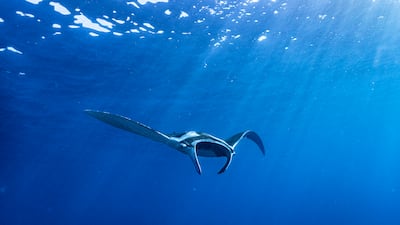

I’m squinting through my goggles as I spot a dark shadow in the distance. The plankton-rich waters of the Maldives’ Hanifaru Bay are murky, so I can’t tell what I’m looking at, but I can see it coming closer. Soon enough, the creature emerges from the blue and I can make out the features of a reef manta ray. It’s at least three metres across, gliding through the water to its so-called “cleaning station” below, its distinctive head fins leading the way.
Then two more swerve into view, each one gracefully following the other as they swoop down over the coral reef, where they hover while small cleaner fish groom them, feasting on the rays’ parasites, dead skin and bacteria. It only takes a few seconds for the rays to circle back on themselves. One glides upwards, getting so close I could reach out and touch it if I wanted to. But I’m under strict instructions not to do so, because this is their territory, and interfering with wildlife in their own environment is against the rules.
It’s officially manta ray season, which runs from May to November, and I’m a guest of the Four Seasons Landaa Giraavaru, which sits on its own small island in the Unesco-protected Baa Atoll. As part of its marine conservation work, the hotel has partnered with UK-based non-profit Manta Trust, whose team have taken us out on the boat today after mantas were spotted that morning.


It’s part of the Manta On Call programme, an optional add-on for hotel guests. When you check in, you’re given a mobile phone and told that if it rings, you’re meant to drop everything and head to the marine centre within 30 minutes, hop on a boat and get to Hanifaru Bay.
And that’s exactly what happens. Of course, I happen to be in the middle of a 60-minute massage when the phone rings. But the heads-up gives me enough time to wrap up the last 20 minutes and get to the briefing before heading out to sea. The bay is about 20 minutes away from the resort’s island. Baa Atoll is a hotspot for five-star hospitality, so we’re not the only boat there, but our guide manages to spot a couple of mantas a few hundred metres away from anyone else, so we have them all to ourselves.
We drop anchor and don our snorkels, masks and flippers. Then, as quietly as possible, trying not to splash and scare the gentle creatures away, we slip into the water.
We’re welcome to swim around them, even near them if they decide to get up close themselves, but meddling in any real way in this natural yet fragile marine ecosystem is a big no-no. If anyone touches one, we’d have to pack up immediately and go back to the resort. We’re also told not to make too much noise and certainly not to chase the creatures for want of a better look. There are already so many factors that need to align in order to even see one of these creatures today – never mind three swimming one after the other.
As the friendly one swims away, I poke my head back up above the water. “Did you see that?” I say breathlessly to anyone listening. But all I can see are the tips of snorkels cutting through the ocean’s surface, with everyone still mesmerised by the scene playing out beneath our flippered feet. A few metres away, I catch sight of another two rays barrel rolling and splashing around as they feed on plankton and other small fish. By the end of the excursion, I count seven reef manta rays in total, as well as a much smaller stingray that has been consistently circling beneath us.
Considering only that morning, I didn’t know whether I’d see any mantas at all; I’m pleased to have spotted seven. That is until I hear others’ stories of being surrounded by dozens at one time. A sighting is never guaranteed, though. This is nature, after all.
The Manta On Call programme builds that uncertainty into the experience itself. There's no performance here, no animatronic reef or safely staged encounter. When the phone rings, it means the mantas are actually out there. When they don't show, you don't go. This makes spotting seven rays feel considerably more meaningful than it might otherwise be.

The Four Seasons has been partnering with Guy Stevens of the Manta Trust since 2006; its 20th anniversary is being celebrated in time for World Manta Day on September 17.
All that time, the hotel group has been funding research that extends well beyond the guest experience. Scientists use photo ID to track individual rays across years, recognising them by the unique spot patterns on their underbellies.
Hanifaru Bay, part of the Baa Atoll – which was designated a Unesco Biosphere Reserve in 2011 – is one of the most significant manta aggregation sites on the planet. During the right tidal conditions, typically around the new and full moon, the bay can fill with hundreds of rays at once. Seven, as our guide points out on the boat back, is a quiet day, especially since it is a full moon.
Swimming with these gentle giants is an experience that’s hard to put into words, as you move through a world you only glimpse briefly, careful not to disturb. The mantas are simply going about their business, as they would be whether you were there or not. Each encounter lasts maybe five seconds.
It’s a joy, but also, if you really think about it, a thing that might not always be possible since reef manta rays are classified as vulnerable on the IUCN Red List. They're targeted in some parts of the world for their gill plates, which are sold into traditional medicine markets. They get caught as by-catch in fishing nets. And, like so much marine life, they're at the mercy of what happens to ocean temperatures and the plankton they depend on. The Maldives, barely a metre above sea level on average and the world’s lowest-lying country, faces its own existential reckoning with rising seas.
But there is hope. The 2025 manta season brought sightings of 4,265 reef manta rays, 28 whale sharks, 16 devil rays and 10 oceanic mantas. The Manta Trust conducted 1,282 manta surveys over 143 research days and, through this dedicated work, was able to get all 10 manta and devil ray species uplisted to the CITES Appendix I, which means they now have the highest level of protection in place.
Ecotourism is a phrase that gets thrown around so liberally it's nearly meaningless. But there's a version of it that actually works, where the science is real, the protocols are strict and the wildlife remains genuinely wild. What Landaa Giraavaru and Manta Trust have built at Hanifaru Bay comes as close as possible to that version.

