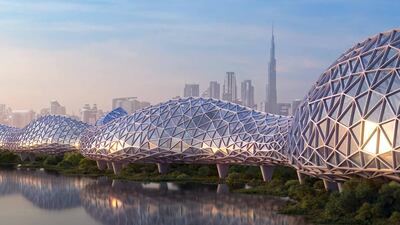
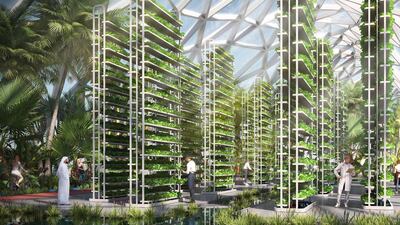
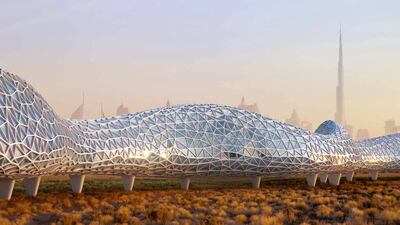
Plans for what could be the world’s largest ocean restoration and ecotourism project in Dubai have been revealed.
Dubai Reefs would be a floating living lab for marine restoration and ecotourism, said developer URB.
At the heart of the futuristic project is a sprawling marine institute, where scientists and researchers could work towards greater protection of Dubai’s marine and coastal regions.
The project, which is currently only in the research and development stage, would support the building of an artificial reef, spanning approximately 200 square kilometres across the Dubai coastline. This would help regenerate the city's coastal ecosystem and provide protection from storms and habitats for fish and marine life.
Responsible tourism is a major part of the plans. Tourists would travel by electric boat shuttles to Dubai Reefs for unique marine ecotourism experiences.
Staying in floating eco resorts and lodges, all of which would be powered by 100 per cent renewable energy, travellers would have first-hand access to the marine projects at the site, which include creating a habitat for more than a billion corals and the planting of more than 100 million mangrove trees.
Unique eco activities on offer would include underwater “forest bathing”, similar to the ancient Japanese wellness practice that promotes calm and quiet among the trees. At Dubai Reefs, the corals would act as the trees of the ocean. Tourists would also have “edutainment” classes at The Marine Institute, to help visitors better understand the ecosystem connecting people with the ocean.
The project would also include residential properties, retail outlets, educational facilities and research hubs, with a total built-up area of about 80,000 square metres and a target of creating more than 30,000 green jobs.
If realised, Dubai Reefs could also house wave farms which would be used to produce additional clean energy for the city’s growing population. And climate-friendly food production could be produced at the floating site via regenerative ocean farming.
“The health of our cities is intrinsically tied to the health of our oceans. The ocean is the source of life controlling everything. Given that everything on our planet is connected, a healthy ocean is a healthy city,” said Baharash Bagherian, chief executive of URB.
“We need an entrepreneurial spirit in the planning of coastal cities and the types of infrastructure as well as developments that are linked to the ocean. As an innovative coastal city, Dubai is best positioned to lead such a transformation. Beyond creating a unique resilient destination for eco-tourism and marine research, Dubai Reefs aims to become a blueprint for ocean living, while mitigating the impacts of climate change,” added Bagherian.
Depending on when the project is funded, the first phase could be realised by 2025 to 2030, and Dubai Reefs could be the project Dubai needs to transform it into a world-recognised eco-destination. With travellers in the UAE increasingly prioritising sustainable travel, it could be a timely initiative.
At present, URB is addressing several challenges for the project, the primary one being commercial viability.
“The main challenge is the commercial viability, to ensure that the entire initiative can be funded privately and that all assets are revenue-generating assets. We are looking to develop the best balance between built-to-lease assets and built-to-sell assets that are in line with the project mission. Any built-to-sell assets will provide the revenue for funding the additional phases of the project, thus not requiring any public funding,” Bagherian told The National.
Other factors still being considered during the research phase are ways to ensure that all aspects of sustainability are considered by the operators, and that the project, if realised, is entirely inclusive and accessible to all.
URB has had a busy year so far. In February, the developer announced plans for The Loop — a sustainable 93km cycling and wellness highway in Dubai.
Housing a zero-emissions transport system, The Loop would be powered by kinetic flooring, allowing it to operate on 100 per cent renewable energy, and the aim is to offer leisure options for residents and visitors.
Scroll through the gallery below for more pictures of The Loop
The%20Mother%20
%3Cp%3E%3Cstrong%3EDirector%3A%3C%2Fstrong%3E%20Niki%20Caro%26nbsp%3B%3C%2Fp%3E%0A%3Cp%3E%3Cstrong%3EStars%3A%3C%2Fstrong%3E%20Jennifer%20Lopez%2C%20Joseph%20Fiennes%2C%20Gael%20Garcia%20Bernal%2C%20Omari%20Hardwick%20and%20Lucy%20Paez%3C%2Fp%3E%0A%3Cp%3E%3Cstrong%3ERating%3A%3C%2Fstrong%3E%203%2F5%3C%2Fp%3E%0A
Mohammed bin Zayed Majlis
Company profile
Name: Oulo.com
Founder: Kamal Nazha
Based: Dubai
Founded: 2020
Number of employees: 5
Sector: Technology
Funding: $450,000
The candidates
Dr Ayham Ammora, scientist and business executive
Ali Azeem, business leader
Tony Booth, professor of education
Lord Browne, former BP chief executive
Dr Mohamed El-Erian, economist
Professor Wyn Evans, astrophysicist
Dr Mark Mann, scientist
Gina MIller, anti-Brexit campaigner
Lord Smith, former Cabinet minister
Sandi Toksvig, broadcaster
Tomb%20Raider%20I%E2%80%93III%20Remastered
%3Cp%3EDeveloper%3A%20Aspyr%0D%3Cbr%3EPublisher%3A%20Aspyr%0D%3Cbr%3EConsole%3A%20Nintendo%20Switch%2C%20PlayStation%204%26amp%3B5%2C%20PC%20and%20Xbox%20series%20X%2FS%0D%3Cbr%3ERating%3A%203%2F5%3C%2Fp%3E%0A
COMPANY%20PROFILE
%3Cp%3E%3Cstrong%3ECompany%3A%3C%2Fstrong%3E%20Eco%20Way%3Cbr%3E%3Cstrong%3EStarted%3A%3C%2Fstrong%3E%20December%202023%3Cbr%3E%3Cstrong%3EFounder%3A%3C%2Fstrong%3E%20Ivan%20Kroshnyi%3Cbr%3E%3Cstrong%3EBased%3A%3C%2Fstrong%3E%20Dubai%2C%20UAE%3Cbr%3E%3Cstrong%3EIndustry%3A%3C%2Fstrong%3E%20Electric%20vehicles%3Cbr%3E%3Cstrong%3EInvestors%3A%3C%2Fstrong%3E%20Bootstrapped%20with%20undisclosed%20funding.%20Looking%20to%20raise%20funds%20from%20outside%3Cbr%3E%3C%2Fp%3E%0A
COMPANY%20PROFILE%20
%3Cp%3E%3Cstrong%3ECompany%20name%3A%20%3C%2Fstrong%3ENomad%20Homes%3Cbr%3E%3Cstrong%3EStarted%3A%20%3C%2Fstrong%3E2020%3Cbr%3E%3Cstrong%3EFounders%3A%20%3C%2Fstrong%3EHelen%20Chen%2C%20Damien%20Drap%2C%20and%20Dan%20Piehler%3Cbr%3E%3Cstrong%3EBased%3A%3C%2Fstrong%3E%20UAE%20and%20Europe%3Cbr%3E%3Cstrong%3EIndustry%3C%2Fstrong%3E%3A%20PropTech%3Cbr%3E%3Cstrong%3EFunds%20raised%20so%20far%3A%3C%2Fstrong%3E%20%2444m%3Cbr%3E%3Cstrong%3EInvestors%3A%3C%2Fstrong%3E%20Acrew%20Capital%2C%2001%20Advisors%2C%20HighSage%20Ventures%2C%20Abstract%20Ventures%2C%20Partech%2C%20Precursor%20Ventures%2C%20Potluck%20Ventures%2C%20Knollwood%20and%20several%20undisclosed%20hedge%20funds%3C%2Fp%3E%0A
Tips for newlyweds to better manage finances
All couples are unique and have to create a financial blueprint that is most suitable for their relationship, says Vijay Valecha, chief investment officer at Century Financial. He offers his top five tips for couples to better manage their finances.
Discuss your assets and debts: When married, it’s important to understand each other’s personal financial situation. It’s necessary to know upfront what each party brings to the table, as debts and assets affect spending habits and joint loan qualifications. Discussing all aspects of their finances as a couple prevents anyone from being blindsided later.
Decide on the financial/saving goals: Spouses should independently list their top goals and share their lists with one another to shape a joint plan. Writing down clear goals will help them determine how much to save each month, how much to put aside for short-term goals, and how they will reach their long-term financial goals.
Set a budget: A budget can keep the couple be mindful of their income and expenses. With a monthly budget, couples will know exactly how much they can spend in a category each month, how much they have to work with and what spending areas need to be evaluated.
Decide who manages what: When it comes to handling finances, it’s a good idea to decide who manages what. For example, one person might take on the day-to-day bills, while the other tackles long-term investments and retirement plans.
Money date nights: Talking about money should be a healthy, ongoing conversation and couples should not wait for something to go wrong. They should set time aside every month to talk about future financial decisions and see the progress they’ve made together towards accomplishing their goals.
Guns N’ Roses’s last gig before Abu Dhabi was in Hong Kong on November 21. We were there – and here’s what they played, and in what order. You were warned.
- It’s So Easy
- Mr Brownstone
- Chinese Democracy
- Welcome to the Jungle
- Double Talkin’ Jive
- Better
- Estranged
- Live and Let Die (Wings cover)
- Slither (Velvet Revolver cover)
- Rocket Queen
- You Could Be Mine
- Shadow of Your Love
- Attitude (Misfits cover)
- Civil War
- Coma
- Love Theme from The Godfather (movie cover)
- Sweet Child O’ Mine
- Wichita Lineman (Jimmy Webb cover)
- Wish You Were Here (instrumental Pink Floyd cover)
- November Rain
- Black Hole Sun (Soundgarden cover)
- Knockin’ on Heaven’s Door (Bob Dylan cover)
- Nightrain
Encore:
- Patience
- Don’t Cry
- The Seeker (The Who cover)
- Paradise City
The%20specs
%3Cp%3E%3Cstrong%3EEngine%3A%3C%2Fstrong%3E%201.8-litre%204-cyl%20turbo%0D%3Cbr%3E%3Cstrong%3EPower%3A%20%3C%2Fstrong%3E190hp%20at%205%2C200rpm%0D%3Cbr%3E%3Cstrong%3ETorque%3A%3C%2Fstrong%3E%20320Nm%20from%201%2C800-5%2C000rpm%0D%3Cbr%3E%3Cstrong%3ETransmission%3A%20%3C%2Fstrong%3ESeven-speed%20dual-clutch%20auto%0D%3Cbr%3E%3Cstrong%3EFuel%20consumption%3A%3C%2Fstrong%3E%206.7L%2F100km%0D%3Cbr%3E%3Cstrong%3EPrice%3A%3C%2Fstrong%3E%20From%20Dh111%2C195%0D%3Cbr%3E%3Cstrong%3EOn%20sale%3A%20%3C%2Fstrong%3ENow%3C%2Fp%3E%0A
Moonfall
Director: Rolan Emmerich
Stars: Patrick Wilson, Halle Berry
Rating: 3/5
The specs
Engine: four-litre V6 and 3.5-litre V6 twin-turbo
Transmission: six-speed and 10-speed
Power: 271 and 409 horsepower
Torque: 385 and 650Nm
Price: from Dh229,900 to Dh355,000
Mercer, the investment consulting arm of US services company Marsh & McLennan, expects its wealth division to at least double its assets under management (AUM) in the Middle East as wealth in the region continues to grow despite economic headwinds, a company official said.
Mercer Wealth, which globally has $160 billion in AUM, plans to boost its AUM in the region to $2-$3bn in the next 2-3 years from the present $1bn, said Yasir AbuShaban, a Dubai-based principal with Mercer Wealth.
“Within the next two to three years, we are looking at reaching $2 to $3 billion as a conservative estimate and we do see an opportunity to do so,” said Mr AbuShaban.
Mercer does not directly make investments, but allocates clients’ money they have discretion to, to professional asset managers. They also provide advice to clients.
“We have buying power. We can negotiate on their (client’s) behalf with asset managers to provide them lower fees than they otherwise would have to get on their own,” he added.
Mercer Wealth’s clients include sovereign wealth funds, family offices, and insurance companies among others.
From its office in Dubai, Mercer also looks after Africa, India and Turkey, where they also see opportunity for growth.
Wealth creation in Middle East and Africa (MEA) grew 8.5 per cent to $8.1 trillion last year from $7.5tn in 2015, higher than last year’s global average of 6 per cent and the second-highest growth in a region after Asia-Pacific which grew 9.9 per cent, according to consultancy Boston Consulting Group (BCG). In the region, where wealth grew just 1.9 per cent in 2015 compared with 2014, a pickup in oil prices has helped in wealth generation.
BCG is forecasting MEA wealth will rise to $12tn by 2021, growing at an annual average of 8 per cent.
Drivers of wealth generation in the region will be split evenly between new wealth creation and growth of performance of existing assets, according to BCG.
Another general trend in the region is clients’ looking for a comprehensive approach to investing, according to Mr AbuShaban.
“Institutional investors or some of the families are seeing a slowdown in the available capital they have to invest and in that sense they are looking at optimizing the way they manage their portfolios and making sure they are not investing haphazardly and different parts of their investment are working together,” said Mr AbuShaban.
Some clients also have a higher appetite for risk, given the low interest-rate environment that does not provide enough yield for some institutional investors. These clients are keen to invest in illiquid assets, such as private equity and infrastructure.
“What we have seen is a desire for higher returns in what has been a low-return environment specifically in various fixed income or bonds,” he said.
“In this environment, we have seen a de facto increase in the risk that clients are taking in things like illiquid investments, private equity investments, infrastructure and private debt, those kind of investments were higher illiquidity results in incrementally higher returns.”
The Abu Dhabi Investment Authority, one of the largest sovereign wealth funds, said in its 2016 report that has gradually increased its exposure in direct private equity and private credit transactions, mainly in Asian markets and especially in China and India. The authority’s private equity department focused on structured equities owing to “their defensive characteristics.”
Rebel%20Moon%20%E2%80%93%20Part%20Two%3A%20The%20Scargiver%20review%20
%3Cp%3E%3Cstrong%3EDirector%3A%3C%2Fstrong%3E%20Zack%20Snyder%3Cbr%3E%3Cstrong%3EStarring%3A%3C%2Fstrong%3E%20Sofia%20Boutella%2C%20Charlie%20Hunnam%2C%20Ed%20Skrein%2C%20Sir%20Anthony%20Hopkins%3Cbr%3E%3Cstrong%3ERating%3A%3C%2Fstrong%3E%202%2F5%3Cbr%3E%3Cbr%3E%3C%2Fp%3E%0A