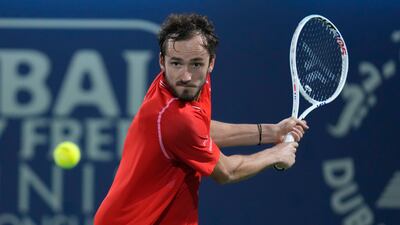
Daniil Medvedev’s title defence at the Dubai Duty Free Tennis Championships will begin with a tricky opener against 23-year-old Alexander Shevchenko, the draw revealed on Saturday.
Making his first appearance since losing the Australian Open final from two-sets-to-love up against Jannik Sinner, Medvedev is familiar with the danger posed by Shevchenko, who extended the Russian to three sets in their sole previous meeting in the Madrid Masters third round last year.
Shevchenko arrives in Dubai at a career-high ranking of 45 and was present at the draw ceremony when his name was announced as Medvedev’s first-round opponent.
“Basically, I thought it’s better to redo the draw,” joked Shevchenko, who changed his citizenship at the start of the 2024 season from Russia to Kazakhstan.
“Obviously it’s different playing here (compared to Madrid); he won last year, he’s the defending champion and just a great player. To beat him you have to play your best and hopefully he plays a little bit below his average. Let’s see, let’s hope.”
Medvedev could take on No 8 seed Alejandro Davidovich Fokina in the quarter-finals, with the likes of third-seeded Hubert Hurkacz, fifth-seeded Ugo Humbert, French wildcard Gael Monfils, and former champion Andy Murray, all possible semi-final opponents for the world No 4.
Andrey Rublev, 2022 Dubai champion and last year’s runner-up, is seeded No 2 and will take on China’s Zhang Zhizhen in the first round.
Rublev shares the same quarter of the draw with No 6 seed Adrian Mannarino and could square off with No 4 seed Karen Khachanov or No 7 seed Alexander Bublik in the semi-finals.
Joining Monfils as wildcards in the main draw are Jordanian Abdullah Shelbayh and India’s Sumit Nagal.
Nagal will open against Lorenzo Sonego and could face Medvedev in the second round while Shelbayh will make his Dubai debut against Dutch world No 28 Tallon Griekspoor.
Three-time Grand Slam champion Murray has an intriguing opening clash with former world No 10 Denis Shapovalov, who is making his way back up the rankings after spending six months on the sidelines nursing a knee injury.
In qualifying action on Saturday, Tunisia’s Aziz Dougaz led 3-1 and held three set points at 5-4 in the opening frame before succumbing 7-6(3), 6-1 to 63rd-ranked Frenchman Luca van Assche.
Main draw matches kick off on Monday at Dubai Duty Free Tennis Stadium, with the final taking place on March 2.
yallacompare profile
Date of launch: 2014
Founder: Jon Richards, founder and chief executive; Samer Chebab, co-founder and chief operating officer, and Jonathan Rawlings, co-founder and chief financial officer
Based: Media City, Dubai
Sector: Financial services
Size: 120 employees
Investors: 2014: $500,000 in a seed round led by Mulverhill Associates; 2015: $3m in Series A funding led by STC Ventures (managed by Iris Capital), Wamda and Dubai Silicon Oasis Authority; 2019: $8m in Series B funding with the same investors as Series A along with Precinct Partners, Saned and Argo Ventures (the VC arm of multinational insurer Argo Group)
Last-16 Europa League fixtures
Wednesday (Kick-offs UAE)
FC Copenhagen (0) v Istanbul Basaksehir (1) 8.55pm
Shakhtar Donetsk (2) v Wolfsburg (1) 8.55pm
Inter Milan v Getafe (one leg only) 11pm
Manchester United (5) v LASK (0) 11pm
Thursday
Bayer Leverkusen (3) v Rangers (1) 8.55pm
Sevilla v Roma (one leg only) 8.55pm
FC Basel (3) v Eintracht Frankfurt (0) 11pm
Wolves (1) Olympiakos (1) 11pm
The stats
Ship name: MSC Bellissima
Ship class: Meraviglia Class
Delivery date: February 27, 2019
Gross tonnage: 171,598 GT
Passenger capacity: 5,686
Crew members: 1,536
Number of cabins: 2,217
Length: 315.3 metres
Maximum speed: 22.7 knots (42kph)
Ten tax points to be aware of in 2026
1. Domestic VAT refund amendments: request your refund within five years
If a business does not apply for the refund on time, they lose their credit.
2. E-invoicing in the UAE
Businesses should continue preparing for the implementation of e-invoicing in the UAE, with 2026 a preparation and transition period ahead of phased mandatory adoption.
3. More tax audits
Tax authorities are increasingly using data already available across multiple filings to identify audit risks.
4. More beneficial VAT and excise tax penalty regime
Tax disputes are expected to become more frequent and more structured, with clearer administrative objection and appeal processes. The UAE has adopted a new penalty regime for VAT and excise disputes, which now mirrors the penalty regime for corporate tax.
5. Greater emphasis on statutory audit
There is a greater need for the accuracy of financial statements. The International Financial Reporting Standards standards need to be strictly adhered to and, as a result, the quality of the audits will need to increase.
6. Further transfer pricing enforcement
Transfer pricing enforcement, which refers to the practice of establishing prices for internal transactions between related entities, is expected to broaden in scope. The UAE will shortly open the possibility to negotiate advance pricing agreements, or essentially rulings for transfer pricing purposes.
7. Limited time periods for audits
Recent amendments also introduce a default five-year limitation period for tax audits and assessments, subject to specific statutory exceptions. While the standard audit and assessment period is five years, this may be extended to up to 15 years in cases involving fraud or tax evasion.
8. Pillar 2 implementation
Many multinational groups will begin to feel the practical effect of the Domestic Minimum Top-Up Tax (DMTT), the UAE's implementation of the OECD’s global minimum tax under Pillar 2. While the rules apply for financial years starting on or after January 1, 2025, it is 2026 that marks the transition to an operational phase.
9. Reduced compliance obligations for imported goods and services
Businesses that apply the reverse-charge mechanism for VAT purposes in the UAE may benefit from reduced compliance obligations.
10. Substance and CbC reporting focus
Tax authorities are expected to continue strengthening the enforcement of economic substance and Country-by-Country (CbC) reporting frameworks. In the UAE, these regimes are increasingly being used as risk-assessment tools, providing tax authorities with a comprehensive view of multinational groups’ global footprints and enabling them to assess whether profits are aligned with real economic activity.
Contributed by Thomas Vanhee and Hend Rashwan, Aurifer
Heather, the Totality
Matthew Weiner,
Canongate
Name: Peter Dicce
Title: Assistant dean of students and director of athletics
Favourite sport: soccer
Favourite team: Bayern Munich
Favourite player: Franz Beckenbauer
Favourite activity in Abu Dhabi: scuba diving in the Northern Emirates