Carlos Alcaraz retained his Madrid Masters title by beating Jan-Lennard Struff in the final. EPA

Carlos Alcaraz the firm favourite for French Open whether Rafael Nadal plays or not


  • English
  • Arabic

He only recently emerged from his teenage years and has only competed full time on the ATP Tour for less than three seasons, but the superlatives are already running low for Carlos Alcaraz.

The Spaniard, who turned 20 on Friday, added to his growing collection of trophies on Sunday, claiming a 10th title by successfully defending his Madrid Masters crown with a 6-4, 3-6, 6-3 victory over Germany's Jan-Lennard Struff, who made history as the first lucky loser to reach a Masters 1000 final.

After missing the start of the season and the Australian Open with a hamstring injury, Alcaraz looks very much back to the peak of his powers. Frighteningly for his rivals, given his age and potential, there is a strong sense that there is still much more to come.

A prodigious, generational Spanish talent, Alcaraz has inevitably drawn comparisons with the great Rafael Nadal, and he emulated his childhood idol by becoming only the second consecutive Madrid champion in the tournament's history. He is also the youngest player to successfully defend a Masters 1000 title since Nadal at Monte Carlo and Rome in 2005-06.

“For me it is so, so special,” Alcaraz said. “To lift the trophy here in Madrid. In my country. In front of my home crowd, my family, my friends. Everyone close to me. For me it is a special feeling that I will never forget.”

Alcaraz, who after winning his maiden Grand Slam title at the US Open last September became the youngest world No 1 in ATP Tour history, is poised to reach the summit for the third time this week.

All he needs to do is play one match on his Rome Masters debut and he will move back to the top again, even if he loses in the first round.

“It's going to be my first time playing Rome. I really want to play there. I missed [it] last year, so this is a tournament that I looking for since I was kid,” said Alcaraz, who has won four of the six tournaments he's entered this year, including a successful defence of his Barcelona title the week before Madrid.

“I feel very proud of the work that I’ve put in and of what I’ve been achieving. I'm an ambitious guy and I’m going for more in Rome.”

Once Rome is done and dusted, it will soon be time for the big one and Alcaraz should be regarded as firm favourite for the French Open, regardless of Nadal's availability. The 22-time major champion has been sidelined with a hip injury since the Australian Open in January and it was announced last Friday that he would also skip the Rome Masters.

Nadal has long cemented himself as the king of Roland Garros, his record 14 titles and ridiculous 112–3 win-loss record on the Parisian clay testament to his dominance.

The 36-year-old Spaniard has overcome plenty of setbacks and obstacles to triumph in Paris in the past, but this latest lengthy layoff combined with the brilliance of Alcaraz could present his toughest ever French Open challenge.

Novak Djokovic will also have something to say, both in Rome and Paris. The world No 1 missed Madrid with a minor injury but will return in the Italian capital. He is the defending and six-time champion in Rome and will be determined to throw down his own gauntlet ahead of his bid for a third French Open crown.

  • Carlos Alcaraz of Spain poses inside the Arthur Ashe Stadium with the championship trophy after defeating Casper Ruud of Norway during the men's final match at the US Open at the USTA National Tennis Center in Flushing Meadows, New York, USA, 11 September 2022. EPA
    Carlos Alcaraz of Spain poses inside the Arthur Ashe Stadium with the championship trophy after defeating Casper Ruud of Norway during the men's final match at the US Open at the USTA National Tennis Center in Flushing Meadows, New York, USA, 11 September 2022. EPA
  • Spain's Carlos Alcaraz celebrates with the trophy after beatings Norway's Casper Ruud to win the 2022 US Open men's final. AFP
    Spain's Carlos Alcaraz celebrates with the trophy after beatings Norway's Casper Ruud to win the 2022 US Open men's final. AFP
  • Spain's Carlos Alcaraz celebrates with the trophy. AFP
    Spain's Carlos Alcaraz celebrates with the trophy. AFP
  • Spain's Carlos Alcaraz and Norway's Casper Ruud pose with their trophies following their 2022 US Open men's final match. AFP
    Spain's Carlos Alcaraz and Norway's Casper Ruud pose with their trophies following their 2022 US Open men's final match. AFP
  • Spain's Carlos Alcaraz celebrates after winning the men's final against Norway's Casper Ruud. Reuters
    Spain's Carlos Alcaraz celebrates after winning the men's final against Norway's Casper Ruud. Reuters
  • Carlos Alcaraz celebrates with the championship trophy. Reuters
    Carlos Alcaraz celebrates with the championship trophy. Reuters
  • Carlos Alcaraz celebrates with his coaching team. Reuters
    Carlos Alcaraz celebrates with his coaching team. Reuters
  • Norway's Casper Ruud, right, congratulates Spain's Carlos Alcaraz after winning the 2022 US Open final. AFP
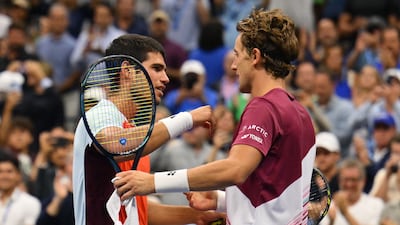
    Norway's Casper Ruud, right, congratulates Spain's Carlos Alcaraz after winning the 2022 US Open final. AFP
  • Spain's Carlos Alcaraz hits a return to Norway's Casper Ruud. AFP
    Spain's Carlos Alcaraz hits a return to Norway's Casper Ruud. AFP
  • Spain's Carlos Alcaraz hits a return to Norway's Casper Ruud. AFP
    Spain's Carlos Alcaraz hits a return to Norway's Casper Ruud. AFP
  • Spain's Carlos Alcaraz celebrates with the trophy. AFP
    Spain's Carlos Alcaraz celebrates with the trophy. AFP

Yet, even with the two greatest ever male players in the field, Alcaraz will still be the man to beat in Paris. His brand of fearless, fast, athletic tennis has taken the game in a new direction, accompanied by an unflappable and steely mentality that belies his age and relative lack of experience.

Whereas other players of his generation have often struggled in the biggest finals against the two giants of the modern game, Alcaraz would undoubtedly raise his level and thrive under the pressure. It would be no surprise if he quietly wants to face Nadal or Djokovic in the French Open final, just to enhance the occasion.

“I know I have an ability to play good in the important moments,” Alcaraz said. “I am a player who grows under pressure, on the big stage, and I like to do different things in those moments. To adapt to what my opponents bring to me.

“I am a finals' player: I played 13 finals and won 10.”

That just about says it all, really.

Mercer, the investment consulting arm of US services company Marsh & McLennan, expects its wealth division to at least double its assets under management (AUM) in the Middle East as wealth in the region continues to grow despite economic headwinds, a company official said.

Mercer Wealth, which globally has $160 billion in AUM, plans to boost its AUM in the region to $2-$3bn in the next 2-3 years from the present $1bn, said Yasir AbuShaban, a Dubai-based principal with Mercer Wealth.

Within the next two to three years, we are looking at reaching $2 to $3 billion as a conservative estimate and we do see an opportunity to do so,” said Mr AbuShaban.

Mercer does not directly make investments, but allocates clients’ money they have discretion to, to professional asset managers. They also provide advice to clients.

“We have buying power. We can negotiate on their (client’s) behalf with asset managers to provide them lower fees than they otherwise would have to get on their own,” he added.

Mercer Wealth’s clients include sovereign wealth funds, family offices, and insurance companies among others.

From its office in Dubai, Mercer also looks after Africa, India and Turkey, where they also see opportunity for growth.

Wealth creation in Middle East and Africa (MEA) grew 8.5 per cent to $8.1 trillion last year from $7.5tn in 2015, higher than last year’s global average of 6 per cent and the second-highest growth in a region after Asia-Pacific which grew 9.9 per cent, according to consultancy Boston Consulting Group (BCG). In the region, where wealth grew just 1.9 per cent in 2015 compared with 2014, a pickup in oil prices has helped in wealth generation.

BCG is forecasting MEA wealth will rise to $12tn by 2021, growing at an annual average of 8 per cent.

Drivers of wealth generation in the region will be split evenly between new wealth creation and growth of performance of existing assets, according to BCG.

Another general trend in the region is clients’ looking for a comprehensive approach to investing, according to Mr AbuShaban.

“Institutional investors or some of the families are seeing a slowdown in the available capital they have to invest and in that sense they are looking at optimizing the way they manage their portfolios and making sure they are not investing haphazardly and different parts of their investment are working together,” said Mr AbuShaban.

Some clients also have a higher appetite for risk, given the low interest-rate environment that does not provide enough yield for some institutional investors. These clients are keen to invest in illiquid assets, such as private equity and infrastructure.

“What we have seen is a desire for higher returns in what has been a low-return environment specifically in various fixed income or bonds,” he said.

“In this environment, we have seen a de facto increase in the risk that clients are taking in things like illiquid investments, private equity investments, infrastructure and private debt, those kind of investments were higher illiquidity results in incrementally higher returns.”

The Abu Dhabi Investment Authority, one of the largest sovereign wealth funds, said in its 2016 report that has gradually increased its exposure in direct private equity and private credit transactions, mainly in Asian markets and especially in China and India. The authority’s private equity department focused on structured equities owing to “their defensive characteristics.”

Results

4.30pm Jebel Jais – Maiden (PA) Dh60,000 (Turf) 1,000m; Winner: MM Al Balqaa, Bernardo Pinheiro (jockey), Qaiss Aboud (trainer)

5pm: Jabel Faya – Maiden (PA) Dh60,000 (T) 1,000m; Winner: AF Rasam, Tadhg O’Shea, Ernst Oertel

5.30pm: Al Wathba Stallions Cup – Handicap (PA) Dh70,000 (T) 2,200m; Winner: AF Mukhrej, Tadhg O’Shea, Ernst Oertel

6pm: The President’s Cup Prep – Conditions (PA) Dh100,000 (T) 2,200m; Winner: Mujeeb, Richard Mullen, Salem Al Ketbi

6.30pm: Abu Dhabi Equestrian Club – Prestige (PA) Dh125,000 (T) 1,600m; Winner: Jawal Al Reef, Antonio Fresu, Abubakar Daud

7pm: Al Ruwais – Group 3 (PA) Dh300,000 (T) 1,200m; Winner: Ashton Tourettes, Pat Dobbs, Ibrahim Aseel

7.30pm: Jebel Hafeet – Maiden (TB) Dh80,000 (T) 1,400m; Winner: Nibraas, Richard Mullen, Nicholas Bachalard

SPECS
%3Cp%3E%3Cstrong%3EEngine%3A%3C%2Fstrong%3E%201.5-litre%204-cylinder%3Cbr%3E%3Cstrong%3EPower%3A%3C%2Fstrong%3E%20101hp%3Cbr%3E%3Cstrong%3ETorque%3A%3C%2Fstrong%3E%20135Nm%3Cbr%3E%3Cstrong%3ETransmission%3C%2Fstrong%3E%3A%20Six-speed%20auto%3Cbr%3E%3Cstrong%3EPrice%3A%3C%2Fstrong%3E%20From%20Dh79%2C900%3Cbr%3E%3Cstrong%3EOn%20sale%3A%3C%2Fstrong%3E%20Now%3C%2Fp%3E%0A
The White Lotus: Season three

Creator: Mike White

Starring: Walton Goggins, Jason Isaacs, Natasha Rothwell

Rating: 4.5/5

Awar Qalb

Director: Jamal Salem

Starring: Abdulla Zaid, Joma Ali, Neven Madi and Khadija Sleiman

Two stars

Best Foreign Language Film nominees

Capernaum (Lebanon)

Cold War (Poland)

Never Look Away (Germany)

Roma (Mexico)

Shoplifters (Japan)

The biog

Mission to Seafarers is one of the largest port-based welfare operators in the world.

It provided services to around 200 ports across 50 countries.

They also provide port chaplains to help them deliver professional welfare services.

ILT20%20UAE%20stars
%3Cp%3E%3Cstrong%3ELEADING%20RUN%20SCORERS%3C%2Fstrong%3E%3Cbr%3E1%20Nicholas%20Pooran%2C%20261%3Cbr%3E%3Cstrong%3E2%20Muhammad%20Waseem%20(UAE)%2C%20248%3C%2Fstrong%3E%3Cbr%3E3%20Chris%20Lynn%2C%20244%3Cbr%3E4%20Johnson%20Charles%2C%20232%3Cbr%3E5%20Kusal%20Perera%2C%20230%3Cbr%3E%3Cbr%3E%3Cstrong%3EBEST%20BOWLING%20AVERAGE%3C%2Fstrong%3E%3Cbr%3E(minimum%2010%20overs%20bowled)%3Cbr%3E%3Cstrong%3E1%20Zuhaib%20Zubair%20(UAE)%2C%209%20wickets%20at%2012.44%3Cbr%3E2%20Mohammed%20Rohid%20(UAE)%2C%207%20at%2013.00%3C%2Fstrong%3E%3Cbr%3E3%20Fazalhaq%20Farooqi%2C%2017%20at%2013.05%3Cbr%3E4%20Waqar%20Salamkheil%2C%2010%20at%2014.08%3Cbr%3E%3Cstrong%3E5%20Aayan%20Khan%20(UAE)%2C%204%20at%2015.50%3C%2Fstrong%3E%3Cbr%3E6%20Wanindu%20Hasaranga%2C%2012%20at%2016.25%3Cbr%3E%3Cstrong%3E7%20Mohammed%20Jawadullah%20(UAE)%2C%2010%20at%2017.00%3C%2Fstrong%3E%3C%2Fp%3E%0A
Ten tax points to be aware of in 2026

1. Domestic VAT refund amendments: request your refund within five years

If a business does not apply for the refund on time, they lose their credit.

2. E-invoicing in the UAE

Businesses should continue preparing for the implementation of e-invoicing in the UAE, with 2026 a preparation and transition period ahead of phased mandatory adoption. 

3. More tax audits

Tax authorities are increasingly using data already available across multiple filings to identify audit risks. 

4. More beneficial VAT and excise tax penalty regime

Tax disputes are expected to become more frequent and more structured, with clearer administrative objection and appeal processes. The UAE has adopted a new penalty regime for VAT and excise disputes, which now mirrors the penalty regime for corporate tax.

5. Greater emphasis on statutory audit

There is a greater need for the accuracy of financial statements. The International Financial Reporting Standards standards need to be strictly adhered to and, as a result, the quality of the audits will need to increase.

6. Further transfer pricing enforcement

Transfer pricing enforcement, which refers to the practice of establishing prices for internal transactions between related entities, is expected to broaden in scope. The UAE will shortly open the possibility to negotiate advance pricing agreements, or essentially rulings for transfer pricing purposes. 

7. Limited time periods for audits

Recent amendments also introduce a default five-year limitation period for tax audits and assessments, subject to specific statutory exceptions. While the standard audit and assessment period is five years, this may be extended to up to 15 years in cases involving fraud or tax evasion. 

8. Pillar 2 implementation 

Many multinational groups will begin to feel the practical effect of the Domestic Minimum Top-Up Tax (DMTT), the UAE's implementation of the OECD’s global minimum tax under Pillar 2. While the rules apply for financial years starting on or after January 1, 2025, it is 2026 that marks the transition to an operational phase.

9. Reduced compliance obligations for imported goods and services

Businesses that apply the reverse-charge mechanism for VAT purposes in the UAE may benefit from reduced compliance obligations. 

10. Substance and CbC reporting focus

Tax authorities are expected to continue strengthening the enforcement of economic substance and Country-by-Country (CbC) reporting frameworks. In the UAE, these regimes are increasingly being used as risk-assessment tools, providing tax authorities with a comprehensive view of multinational groups’ global footprints and enabling them to assess whether profits are aligned with real economic activity. 

Contributed by Thomas Vanhee and Hend Rashwan, Aurifer

Updated: May 08, 2023, 1:23 PM