Women wearing protective face masks walk past the Olympic rings in front of the Japan Olympics Museum. Reuters

British Olympic Association still 'trying to convince' some Team GB athletes to get vaccinated ahead of Tokyo Games


  • English
  • Arabic

The British Olympic Association is still trying to convince some athletes to get vaccinated against Covid-19 before next month's Tokyo Olympics, chief executive Andy Anson said.

The BOA said earlier this month it was on track to ensure all athletes and staff were fully vaccinated before the Olympics.

The Tokyo Games, delayed last year because of the Covid-19 pandemic, will begin on July 23.

"We're trying to convince them it's the right thing to do," Anson told the BBC on Friday. "People have got the right to choose, and we have to respect that. But it's not necessarily that helpful."

Japan has largely avoided the kind of explosive Covid-19 outbreaks that have devastated other countries, but its vaccine roll-out was initially slow and the medical system has been pushed to the brink in some places.

Many Japanese people remain sceptical about the possibility of holding even a scaled-down Games safely during the pandemic. Organisers have excluded foreign spectators and limited the number of domestic ones for the event.

Anson said the Athletes' Village in Tokyo will be "probably the toughest environment in sports at this time".

"We are putting in place very strict protocols along with the organisers to make sure, to the fullest extent possible, we follow the rules of isolation, distancing, and just keeping in our own 'semi bubbles,'" he said.

On Wednesday, a second member of Uganda's Olympic delegation, an athlete, tested positive for Covid-19 after arriving in Japan.

It comes after a first member of Uganda's Olympic team tested positive and was denied entry into Japan, in the first detected infection among arriving athletes for the Games that begin in five weeks.

_____________

Inside the Olympic Games Village in Tokyo

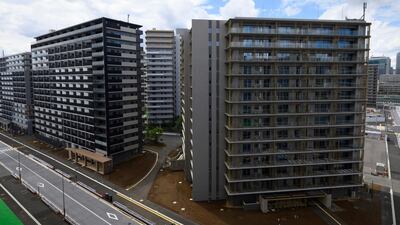
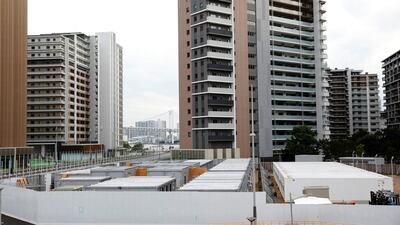
  • Residential buildings for athletes stand during a media tour at the Olympic and Paralympic Village for the Tokyo 2020 Games, constructed in the Harumi waterfront district of Tokyo.
    Residential buildings for athletes stand during a media tour at the Olympic and Paralympic Village for the Tokyo 2020 Games, constructed in the Harumi waterfront district of Tokyo.
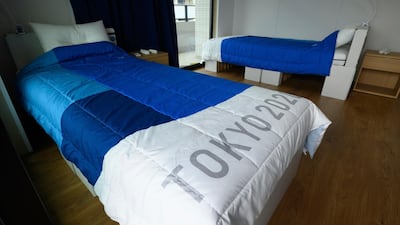
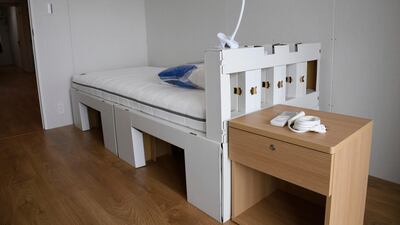
  • Recyclable cardboard beds and mattresses for athletes.
    Recyclable cardboard beds and mattresses for athletes.
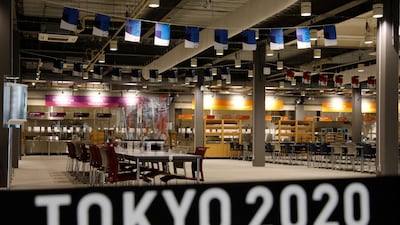
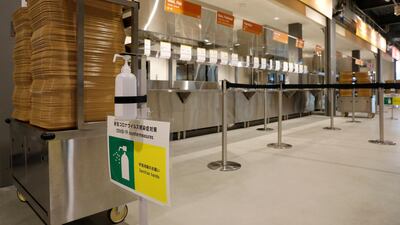
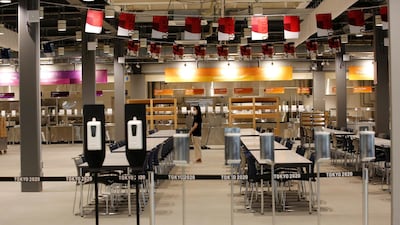
  • The main dining hall.
    The main dining hall.
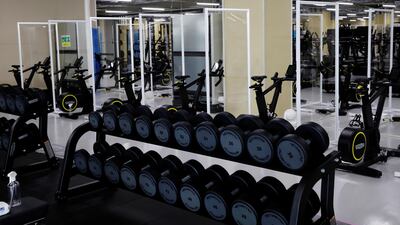
  • Partitions are installed at the fitness centre at the multi-function complex.
    Partitions are installed at the fitness centre at the multi-function complex.
  • A recreation centre is pictured at the multi-function complex of the Tokyo 2020 Olympic and Paralympic Village.
    A recreation centre is pictured at the multi-function complex of the Tokyo 2020 Olympic and Paralympic Village.
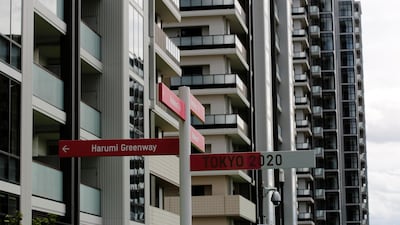
  • Residential buildings are seen behind road signs at the Tokyo 2020 Olympic and Paralympic Village in Tokyo.
    Residential buildings are seen behind road signs at the Tokyo 2020 Olympic and Paralympic Village in Tokyo.
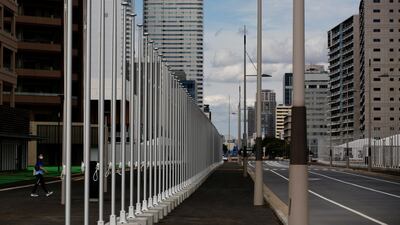
  • Flag poles at the Tokyo 2020 Olympic and Paralympic Village.
    Flag poles at the Tokyo 2020 Olympic and Paralympic Village.
  • A bathroom inside a residential unit for athletes.
    A bathroom inside a residential unit for athletes.
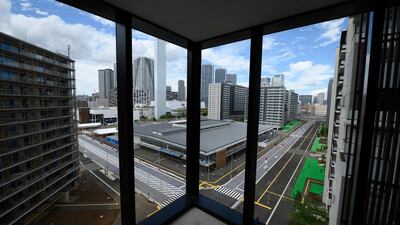
  • A view from residential buildings for athletes.
    A view from residential buildings for athletes.
  • A fountain is pictured at the Tokyo 2020 Olympic and Paralympic Village.
    A fountain is pictured at the Tokyo 2020 Olympic and Paralympic Village.
  • A recyclable cardboard bed and mattress for athletes.
    A recyclable cardboard bed and mattress for athletes.
  • A hand sanitizer and a sign for Covid-19 countermeasures are placed at the main dining hall.
    A hand sanitizer and a sign for Covid-19 countermeasures are placed at the main dining hall.
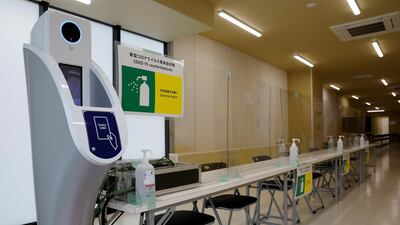
  • A machine to check body temperature and hand sanitizers are placed at the doping control station.
    A machine to check body temperature and hand sanitizers are placed at the doping control station.
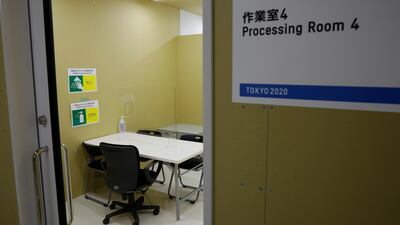
  • A processing room of the doping control station.
    A processing room of the doping control station.
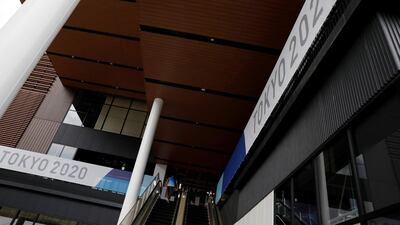
  • A man enters the multi-function complex of the Tokyo 2020 Olympic and Paralympic Village.
    A man enters the multi-function complex of the Tokyo 2020 Olympic and Paralympic Village.
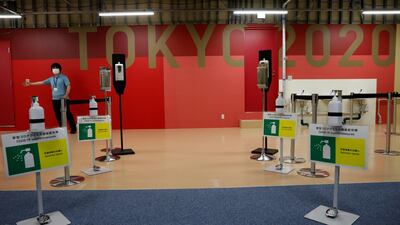
  • Hand sanitizers and signs for Covid-19 countermeasures are placed at the entrance of the fitness centre.
    Hand sanitizers and signs for Covid-19 countermeasures are placed at the entrance of the fitness centre.
  • The main dining hall at the Tokyo 2020 Olympic and Paralympic Village in Tokyo.
    The main dining hall at the Tokyo 2020 Olympic and Paralympic Village in Tokyo.
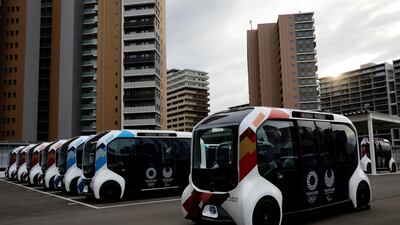
  • Electric vehicles are pictured at an internal shuttle bus station.
    Electric vehicles are pictured at an internal shuttle bus station.
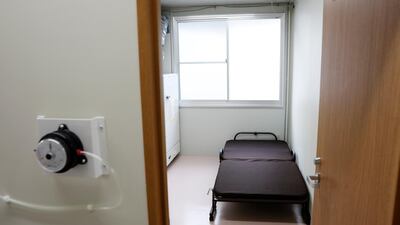
  • A room of the fever clinic isolation area.
    A room of the fever clinic isolation area.
  • The fever clinic (front) at the Tokyo 2020 Olympic and Paralympic Village in Tokyo.
    The fever clinic (front) at the Tokyo 2020 Olympic and Paralympic Village in Tokyo.
What is blockchain?

Blockchain is a form of distributed ledger technology, a digital system in which data is recorded across multiple places at the same time. Unlike traditional databases, DLTs have no central administrator or centralised data storage. They are transparent because the data is visible and, because they are automatically replicated and impossible to be tampered with, they are secure.

The main difference between blockchain and other forms of DLT is the way data is stored as ‘blocks’ – new transactions are added to the existing ‘chain’ of past transactions, hence the name ‘blockchain’. It is impossible to delete or modify information on the chain due to the replication of blocks across various locations.

Blockchain is mostly associated with cryptocurrency Bitcoin. Due to the inability to tamper with transactions, advocates say this makes the currency more secure and safer than traditional systems. It is maintained by a network of people referred to as ‘miners’, who receive rewards for solving complex mathematical equations that enable transactions to go through.

However, one of the major problems that has come to light has been the presence of illicit material buried in the Bitcoin blockchain, linking it to the dark web.

Other blockchain platforms can offer things like smart contracts, which are automatically implemented when specific conditions from all interested parties are reached, cutting the time involved and the risk of mistakes. Another use could be storing medical records, as patients can be confident their information cannot be changed. The technology can also be used in supply chains, voting and has the potential to used for storing property records.

The Lowdown

Kesari

Rating: 2.5/5 stars
Produced by: Dharma Productions, Azure Entertainment
Directed by: Anubhav Singh
Cast: Akshay Kumar, Parineeti Chopra


GULF MEN'S LEAGUE

Pool A Dubai Hurricanes, Bahrain, Dubai Exiles, Dubai Tigers 2

Pool B Abu Dhabi Harlequins, Jebel Ali Dragons, Dubai Knights Eagles, Dubai Tigers


Opening fixtures

Thursday, December 5

6.40pm, Pitch 8, Abu Dhabi Harlequins v Dubai Knights Eagles

7pm, Pitch 2, Jebel Ali Dragons v Dubai Tigers

7pm, Pitch 4, Dubai Hurricanes v Dubai Exiles

7pm, Pitch 5, Bahrain v Dubai Eagles 2


Recent winners

2018 Dubai Hurricanes

2017 Dubai Exiles

2016 Abu Dhabi Harlequins

2015 Abu Dhabi Harlequins

2014 Abu Dhabi Harlequins

BORDERLANDS

Starring: Cate Blanchett, Kevin Hart, Jamie Lee Curtis

Director: Eli Roth

Rating: 0/5

TRAP

Starring: Josh Hartnett, Saleka Shyamalan, Ariel Donaghue

Director: M Night Shyamalan

Rating: 3/5

What it means to be a conservationist

Who is Enric Sala?

Enric Sala is an expert on marine conservation and is currently the National Geographic Society's Explorer-in-Residence. His love of the sea started with his childhood in Spain, inspired by the example of the legendary diver Jacques Cousteau. He has been a university professor of Oceanography in the US, as well as working at the Spanish National Council for Scientific Research and is a member of the World Economic Forum’s Global Future Council on Biodiversity and the Bio-Economy. He has dedicated his life to protecting life in the oceans. Enric describes himself as a flexitarian who only eats meat occasionally.

What is biodiversity?

According to the United Nations Environment Programme, all life on earth – including in its forests and oceans – forms a “rich tapestry of interconnecting and interdependent forces”. Biodiversity on earth today is the product of four billion years of evolution and consists of many millions of distinct biological species. The term ‘biodiversity’ is relatively new, popularised since the 1980s and coinciding with an understanding of the growing threats to the natural world including habitat loss, pollution and climate change. The loss of biodiversity itself is dangerous because it contributes to clean, consistent water flows, food security, protection from floods and storms and a stable climate. The natural world can be an ally in combating global climate change but to do so it must be protected. Nations are working to achieve this, including setting targets to be reached by 2020 for the protection of the natural state of 17 per cent of the land and 10 per cent of the oceans. However, these are well short of what is needed, according to experts, with half the land needed to be in a natural state to help avert disaster.

Veere di Wedding
Dir: Shashanka Ghosh
Starring: Kareena Kapoo-Khan, Sonam Kapoor, Swara Bhaskar and Shikha Talsania ​​​​​​​
Verdict: 4 Stars