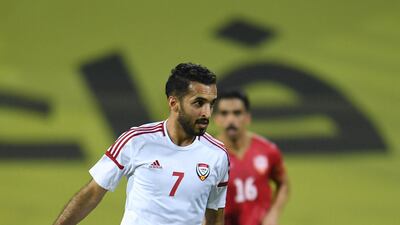
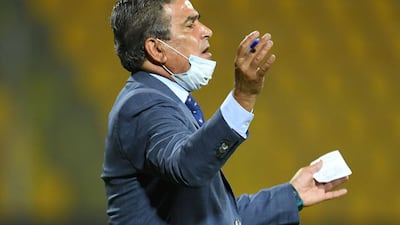
Jorge Luis Pinto at his unveiling as UAE manager in June. Courtesy UAE FA

UAE part ways with manager Jorge Luis Pinto after just five months in job


  • English
  • Arabic

The UAE have parted ways with manager Jorge Luis Pinto just five months after his appointment and before the resumption of qualifying for the 2022 World Cup and 2023 Asian Cup.

Pinto, a 67-year-old Colombian who led Costa Rica to the quarter-finals of the 2014 World Cup, was the UAE's fourth manager since January 2019. He was hired in June on a contract until 2022.

"After long meetings with coach Pinto, we agreed that it was difficult to continue our relationship and we decided to terminate the contract," said the head of the Emirates national teams committee, Youssef Hussein said at a press conference.

"The replacement coach will be announced soon," adding that the new man will be chosen from three people who have worked in the Arabian Gulf League.

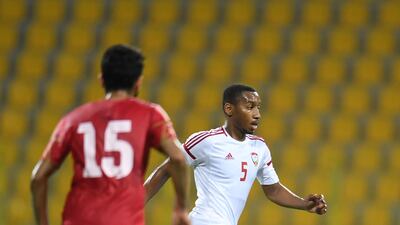
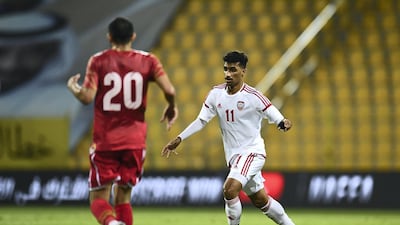
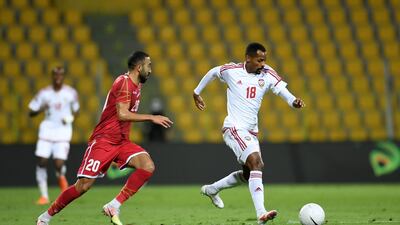
Under Pinto, the Emirates played three friendlies, losing to Uzbekistan (2-1)beating Tajikistan with difficulty (3-2) and most recently, a defeat to Bahrain (3-1).

"It was difficult to carry out my mission with the national team for several reasons, including a difference of views," said Pinto.

"I faced difficult circumstances during the task of assuming responsibility for coaching the Whites, the most important of which was the long suspension of sports activity due to the Corona pandemic, the position of the national team in its group and the short time remaining to prepare for the joint qualifiers for the 2022 World Cup finals and the 2023 AFC Asian Cup finals in good form.

"I had big dreams of reaching the World Cup with the Emirates, and I hope it will happen with another coach.

"I spoke with officials in the Football Association and they understood my position, and it was agreed between us to terminate the contract amicably.

"I wish success to the UAE national team, which has a great place in my heart, and I had the honour to train its first national team.

Pinto succeeded the Serbian Ivan Jovanovic, who was in the job from December 2019 to April 2020, before being dismissed without having played any matches.

Alberto Zaccheroni, who led AC Milan to a Serie A title in 1999 and won the Asian Cup with Japan, quit in January 2019 after leading UAE to the semi-finals of the Asian Cup.

________________________________________________________________________

UAE 1 Bahrain 3: Pinto's last stand

________________________________________________________________________

The Italian was followed by former Netherlands manager Bert van Marwijk who lasted from March 2019 until that December when he was fired following a 4-2 loss to Qatar in the Arabian Gulf Cup.

On his unveiling as manager in June, Pinto made it abundantly clear what his objective was.

“I might be the most passionate coach in the world about reaching the next World Cup," he said. "And I'm very enthusiastic about working with UAE national team.

"Our goal after leading the team from this difficult stage is to transform the thinking of players to dream of the World Cup before entering the third and final stage. I will talk to my players about how serious they are in qualifying to the World Cup finals.

“There is no greater happiness than your arrival at the World Cup and to represent your country in the championship. I lived these moments and wish to convey them to the players.”

The UAE currently sit fourth in Group C of the second round of qualifying, with only the group winners guaranteed passage into the third round alongside the four best runners-up. The Whites are five points behind leaders Vietnam, although they do hold a game in hand.

However, they have been boosted by the naturalisation of Caio, Fabio De Lima, and Sebastian Tagliabue – three of the AGL's best players.

What vitamins do we know are beneficial for living in the UAE

Vitamin D: Highly relevant in the UAE due to limited sun exposure; supports bone health, immunity and mood.Vitamin B12: Important for nerve health and energy production, especially for vegetarians, vegans and individuals with absorption issues.Iron: Useful only when deficiency or anaemia is confirmed; helps reduce fatigue and support immunity.Omega-3 (EPA/DHA): Supports heart health and reduces inflammation, especially for those who consume little fish.

Conflict, drought, famine

Estimates of the number of deaths caused by the famine range from 400,000 to 1 million, according to a document prepared for the UK House of Lords in 2024.
It has been claimed that the policies of the Ethiopian government, which took control after deposing Emperor Haile Selassie in a military-led revolution in 1974, contributed to the scale of the famine.
Dr Miriam Bradley, senior lecturer in humanitarian studies at the University of Manchester, has argued that, by the early 1980s, “several government policies combined to cause, rather than prevent, a famine which lasted from 1983 to 1985. Mengistu’s government imposed Stalinist-model agricultural policies involving forced collectivisation and villagisation [relocation of communities into planned villages].
The West became aware of the catastrophe through a series of BBC News reports by journalist Michael Buerk in October 1984 describing a “biblical famine” and containing graphic images of thousands of people, including children, facing starvation.

Band Aid

Bob Geldof, singer with the Irish rock group The Boomtown Rats, formed Band Aid in response to the horrific images shown in the news broadcasts.
With Midge Ure of the band Ultravox, he wrote the hit charity single Do They Know it’s Christmas in December 1984, featuring a string of high-profile musicians.
Following the single’s success, the idea to stage a rock concert evolved.
Live Aid was a series of simultaneous concerts that took place at Wembley Stadium in London, John F Kennedy Stadium in Philadelphia, the US, and at various other venues across the world.
The combined event was broadcast to an estimated worldwide audience of 1.5 billion.

Mercer, the investment consulting arm of US services company Marsh & McLennan, expects its wealth division to at least double its assets under management (AUM) in the Middle East as wealth in the region continues to grow despite economic headwinds, a company official said.

Mercer Wealth, which globally has $160 billion in AUM, plans to boost its AUM in the region to $2-$3bn in the next 2-3 years from the present $1bn, said Yasir AbuShaban, a Dubai-based principal with Mercer Wealth.

Within the next two to three years, we are looking at reaching $2 to $3 billion as a conservative estimate and we do see an opportunity to do so,” said Mr AbuShaban.

Mercer does not directly make investments, but allocates clients’ money they have discretion to, to professional asset managers. They also provide advice to clients.

“We have buying power. We can negotiate on their (client’s) behalf with asset managers to provide them lower fees than they otherwise would have to get on their own,” he added.

Mercer Wealth’s clients include sovereign wealth funds, family offices, and insurance companies among others.

From its office in Dubai, Mercer also looks after Africa, India and Turkey, where they also see opportunity for growth.

Wealth creation in Middle East and Africa (MEA) grew 8.5 per cent to $8.1 trillion last year from $7.5tn in 2015, higher than last year’s global average of 6 per cent and the second-highest growth in a region after Asia-Pacific which grew 9.9 per cent, according to consultancy Boston Consulting Group (BCG). In the region, where wealth grew just 1.9 per cent in 2015 compared with 2014, a pickup in oil prices has helped in wealth generation.

BCG is forecasting MEA wealth will rise to $12tn by 2021, growing at an annual average of 8 per cent.

Drivers of wealth generation in the region will be split evenly between new wealth creation and growth of performance of existing assets, according to BCG.

Another general trend in the region is clients’ looking for a comprehensive approach to investing, according to Mr AbuShaban.

“Institutional investors or some of the families are seeing a slowdown in the available capital they have to invest and in that sense they are looking at optimizing the way they manage their portfolios and making sure they are not investing haphazardly and different parts of their investment are working together,” said Mr AbuShaban.

Some clients also have a higher appetite for risk, given the low interest-rate environment that does not provide enough yield for some institutional investors. These clients are keen to invest in illiquid assets, such as private equity and infrastructure.

“What we have seen is a desire for higher returns in what has been a low-return environment specifically in various fixed income or bonds,” he said.

“In this environment, we have seen a de facto increase in the risk that clients are taking in things like illiquid investments, private equity investments, infrastructure and private debt, those kind of investments were higher illiquidity results in incrementally higher returns.”

The Abu Dhabi Investment Authority, one of the largest sovereign wealth funds, said in its 2016 report that has gradually increased its exposure in direct private equity and private credit transactions, mainly in Asian markets and especially in China and India. The authority’s private equity department focused on structured equities owing to “their defensive characteristics.”