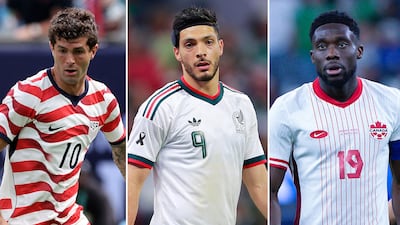
If ever a coach needed a result, it was Mauricio Pochettino on Sunday, as his USA side defeated Senegal 3-2 in Chicago on the eve of hosting the 2026 World Cup.
When the US appointed the Argentine in September 2024, they did so believing they had lured an elite coach from European club football and, just as importantly, one with the charisma and media savvy to be the figurehead of their home World Cup campaign.
US football bosses would have been alarmed then to see Pochettino spend the month before the tournament lurching from one self-inflicted PR disaster to the next. Expectations had already been dampened by demoralising friendly losses to Belgium and Portugal before the manager started creating headlines for all the wrong reasons.

Then came Senegal, the tonic of a win, and even a mood-changing goal for the team's star player 'Captain America' Christian Pulisic, his first for the national team since 2024.
“The good feelings with that victory, I think it's more important for the environment than for us,” said Pochettino. “For us it's important always to win. But it is important also for the environment to trust a little bit after the last two games, against Belgium and Portugal. We saw the commitment of everyone there. We have attitude and commitment, we have the talent, we have players that have enormous talent.”
By “environment”, Pochettino means a sceptical media and a fan base aggravated by a difficult prelude in which he has drawn criticism for dumping surplus players via email, a bizarre dressing down of Tim Weah after the winger criticised Fifa's exorbitant ticket prices, and most egregiously, for holding talks with AC Milan just weeks out from the competition.
Speculation is to be expected given Pochettino's contract expires at the end of July, but direct negotiations with a club is at best an unnecessary distraction and at worst a dereliction of duty. Julen Lopetegui was sacked by Spain in 2018 for similar antics.
The overall picture is one of a manager not fully invested in a project his nervous federation bosses have been crafting for the past eight years.
That, however, is not the case according to midfielder Tyler Adams, who defended his coach's right to explore future employment opportunities even with an opening game against Paraguay looming on the horizon.
“As [with] any manager or player, there’s [players] in contract situations right now that have to figure out what to do, either before the World Cup, after the World Cup,” he told The Athletic. “It’s going to be the same deal with coaches. He’s fully present with us every single day, finding ways to make us better, focusing on the trainings, just as we are.”
Does the US public even care?
One warm-up game remains for the US – against Germany on Saturday – and the standard of opposition means they won't kick off Group A undercooked.
But anything less than a run into the knockout stages this summer will be deemed a failure as the team seeks to engage a domestic audience known for its ingrained apathy towards their sport.
A YouGov survey published on May 29 claimed just 13 per cent of Americans are “very interested” in the World Cup, 16 per cent are “somewhat interested” and 14 per cent “not very interested”. A significant majority of 54 per cent said they are “not at all interested”.

The battle for hearts and minds will take in Group A games against Paraguay, Australia and Turkey, and a strong showing is essential if they are to provoke a response from an ambivalent public.
It's a navigable group, but also one tricky enough for them to fall flat if they aren't at their best. The form of Pulisic will be key, which is why that goal against Senegal was so vital. It was his first for club or country since last December.
The US have ample muscle in midfield through Adams and Weston McKennie, as well as pace and ambition at full-back through Sergino Dest and Antonee Robinson. They even have a couple of serviceable options up front in Ricardo Pepi and Folarin Balogun, but it's Pulisic's guile that gives them a dash of elite quality. Should the AC Milan star deliver for Pochettino this summer, it might even end up helping his club career.
Mexico built in image of Aguirre
In July 2024, with the team at a crossroads after a dismal showing at the Copa America, Mexico went back to what they know best and appointed Javier Aguirre for a third stint in charge of the national team.
It didn't start well. Aguirre was hit in the head by a can thrown from the crowd, leaving him bloodied after a 2–0 loss to Honduras in the Nations League quarter-final. The grizzled veteran barely flinched.
Twelve months later Mexico won the Nations League for the first time and claimed the 2025 Gold Cup, beating the US 2-1 in the final.
Aguirre's Mexico are not exciting, but they are solid and will be hoping to replicate the quarter-finals runs they enjoyed in 1970 and 1986 when they previously hosted the tournament. Unlike the US, the Mexican public is highly engaged, demanding even, and will expect their team to rise to the occasion.
With no qualification campaign required, El Tri have had to rely on friendlies to build momentum. And while the standard of competition has varied considerably, they are unbeaten in seven, keeping six clean sheets. That run included creditable draws with Belgium and Portugal.
A group comprising South Korea, Czech Republic and South Africa looks manageable on home soil and, should both teams win their sections, there is a scenario where Mexico play England in the last 16 at the Azteca Stadium in Mexico City on July 9. The mention of England is pertinent given recent comments made by Aguirre in an interview with ESPN.
“When I saw the schedule and the home games, I told my players, ‘It’s on a silver platter for us [and] to not let it slip away',” Aguirre said. “Playing at home is priceless. England won the championship at home [in 1966]. Never again. They disappeared. But at home, at Wembley, they were lions.”
Canada confident of claiming first win
Despite having never won a World Cup match before, Canada enter the tournament with expectations that they could grab that maiden victory and with it a place in the Round of 32.
Led by former Leeds boss Jesse Marsch, the team has posted solid results for the past couple of years. Their games tend to be low-scoring, with a high number of draws, but the days of them being blown away look to be in the past.
A favourable group alongside Bosnia and Herzegovina, Switzerland and Qatar also gives cause for optimism. With eight of the 12 third-placed teams going through, a single victory – and they will be targeting that second match against Qatar – will likely lead to progress. Take something from either of their other games and they'll be a lock for the knockouts.
Much of the focus has been on the fitness of captain Alphonso Davies, who suffered a hamstring injury while playing for Bayern Munich against PSG in the Champions League earlier this season.
But Marsch has full confidence his squad can deliver on home soil. “I felt this was our current best squad and then, probably, one of the best ever squads, if not the best squad that Canada has ever assembled at any one time,” he said after naming his 26-man party for the tournament.