



I didn’t watch Sunday’s African Confederation Cup final second leg between Egyptian giants Zamalek and Moroccan side RS Berkane from the correct section of Cairo’s packed International Stadium. Here’s why.
On the morning of the game, Zamalek’s manager Jose Gomes and his staff were happy to meet at a hotel close to the stadium, well away from the busy upper class Zamalek district by the river Nile from where the club takes its name.
The team had been there for two nights to concentrate in an oasis of calm amid the frenzy of the final. The mood seemed relaxed and positive, the players friendly to the few fans around the hotel lobby who saw them. It was a huge game, but if they were nervous then they weren’t showing it.
Despite a first-leg defeat and respect for the tactical acumen of his opponents, Gomes was confident in his side’s own technical and physical ability. He likes his players in the hotel, away from what he calls "the big pressures always put on my players here – either to attack them or to make them stars". As his players pass by, he points out key traits for the battle ahead: "Strong character – shows up in the big games. Like tonight."
Whether it’s being overtaken by a camel on his way home from training, or his players’ footballs and boots going missing for two hours ahead of a huge game in Saudi Arabia, the pressure that comes with coaching a huge club is something Gomes takes in his stride. He’s only been at Zamalek for four months, perhaps a mercy given the instability – in August 2023 the entire club board resigned having failed to control its debts.
The 53-year-old Portuguese horse breeder has managed at 19 clubs across seven countries, with a Saudi Arabian Super Cup in 2016 his one trophy so far. Sunday provided a chance to win the most important silverware of his career. His assistant is Andre Bikey, a 39-year-old Cameroonian, who shares an equally well travelled CV as a player including Premier League football at Burnley and Reading before becoming Gomes’ assistant at Almeria in Spain in 2020.

“I’ve played everywhere but, trust me, I’ve never seen anything like the big games here,” Bikey says. “We simply have to win tonight.” Bikey loves watching and learning from Gomes, especially in stressful situations like this.
I received help to secure a ticket, the distribution of which is strict in Egypt, more so since the Port Said Stadium disaster when 74 football fans were killed in 2012 and shut down Egyptian football for the remainder of the season and stopped fans going to games for three years.
The country’s significant match-going support has suffered other tragedies in the past. In 1966, a riot at the derby between Zamalek and Al Ahly saw 300 injuries when the military took control of the stadium. In 1974, a wall collapsed during a Zamalek friendly against Dukla Prague, killing 49.
Then, on February 8, 2015, 28 football fans died in a confrontation with police at the gates of the 30 June Stadium during a game between Zamalek and ENPPI. That came ju.st a week after fans were officially allowed back into stadiums for domestic games after the Port Said disaster. Many lost heart in Egyptian football after the double disaster.
These are among the reasons why I justifiably had to supply my passport before being issued with an ID card and a match ticket. On the morning of the game, I also checked the colours of both teams. Zamalek wore white and red.

Berkane wore orange and black. I figured that there would be almost no travelling fans and wore a red T-shirt since I didn’t want to stand out close to the stadium where a 60,000 crowd was expected. I knew that some fans didn’t have tickets, that it would be hectic with several ticket checks. I was also told to get inside the stadium early since that’s what fans would be doing, despite a heat wave where the temperature hit an unseasonal 41º Celsius.
The gates to the stadium opened six hours before kick off and I walked to the stadium three hours later. That was when I first noticed people double-taking when they saw me. At first, I thought it was because I’m not Egyptian and don’t look like a local. It wasn’t aggressive or unnerving, but I stood out since everyone apart from the police were wearing white. I felt like a speck of blood on a giant, pristine white sheet.
Close to the stadium, I asked an official where my entrance was since the Arabic was hard to decipher on the paper match ticket. He didn’t speak English but kindly offered to show me. Thinking this this would be a five-minute diversion, I instead had a 40 minute hike and a long walk around the vast complex against the flow of a passionate crowd. There were numerous security checks and seven ticket checks in total. At one, I was asked if I had “any fire?” shorthand for pyrotechnics. I did not.
Water bottles were confiscated despite the blazing heat and fans were frisked but the mood remained upbeat. Fans spoke to me to tell me about Zamalek, to ask where I was from and why I was wearing red. And then the penny dropped: red is the colour associated with Al Ahly, Egypt’s biggest and most successful club and long Zamalek’s greatest rivals.

Football arrived in Egypt during the British armed occupation at the turn of the 19th century, with Al Ahly founded in 1907 and Zamalek in 1911. Egypt is often ranked among the best African countries in international football – the Pharaohs are currently ranked 37th in the world by Fifa but rose as high as ninth in 2010. In club football, it’s number one in Africa.
The fans were friendly. Asked to describe their rivalry with Al Ahly, one replied: “We are different, they are not like us. Everything we do is different; from the way we buy players to the way we develop them – we have a very strong youth system.” Another told me: “We are the royal club; we will sing about it today.” Football fanatic King Farouk lent his support and name to the club in 1940 which, when Farouk was deposed in 1952, became Zamalek.
I met Mohamad Abdelghani, a lawyer who has lived in Abu Dhabi for 20 years, part of the large Egyptian diaspora which is strongest in Saudi Arabia and the UAE. He travelled to the game on three chartered flights of Zamalek fans and proudly showed his support. He took his son, now 13, to his first game when he was five days old. And where was his son now?
“In hospital but he insisted I must go to Cairo to see the final.” He showed photos of his two-year daughter wearing a ‘We shall stay loyal’ Zamalek T-shirt.
One of two giants of Egyptian football, Zamalek enjoy the support of tens of millions within the country’s 110 million population (a number which has doubled in the past 35 years) and a large diaspora mainly in the Arab world.
Asking other fans why everyone was entering the stadium so early, I was told: “Egyptians are social and Zamalek is our family. We can spend more time with our family.” Another version is that because of past disasters, there are often rumours that the stadium gates will close two or three hours before kick off.
As traffic gets busier in Africa’s largest city of 20 million and people scream for attention to get whatever point they are trying to make across, the helper and I walked towards the towering floodlights and into the stadium, where there was some confusion over where I should sit.
I didn’t understand the conversations and passed on the kind offer to watch the game with some Zamalek fans who spoke perfect English as I figured I should take my allocated seat. There was more confusion and then someone said, in English, “I am sorry, we thought you were Egyptian.”
That meant little to me, but it soon become apparent as I was led into the only empty part in a stadium already bursting to capacity – the away section. Leaving a tunnel and hitting the light felt like a bull must feel entering an expectant arena.
Four people followed a few minutes later also wearing red like me – the red of the Moroccan national team. Ah, so the officials thought I was Moroccan.
I was handed a small Morocco flag to wave. The few other people in the 2,000-seat section were members of the Moroccan embassy in Cairo, though several hundred more Berkane fans arrived close to kick off, some of whom had travelled across North Africa.
They marvelled at what they saw all around them, the songs and noise from Zamalek fans wanting to help their team reverse a 2-1 defeat in the first leg to win the tie. Away goals still count double in the competition and so a 1-0 win would suffice.
Victory would mean much to Zamalek, who haven’t lifted a continental title in five years, while their rivals Al Ahly remain serial winners and Africa’s top-ranked and most successful club.
The Confederation Cup is the secondary club competition after the Champions League, in which Al Ahly are in the final. They played Tunisia's Esperance to a 0-0 draw in the first leg, with the second leg on Saturday.
With Cairo hosting two continental finals within a week, there was added pressure on Zamalek to get a result when they went first, especially as their league form sees them languishing in midtable, albeit with games in hand.
Music pumps through the speakers in the stadium until an hour before kick off, bass-heavy house music, then Shakira’s Waka Waka (This Time for Africa) – the official song for the 2010 World Cup finals in South Africa.
Morocco, home of the finals' visitors, will stage part of the 2030 World Cup while a new 93,940-seater stadium recently opened near Cairo, the second largest in Africa built with an eye on Egypt hosting a future Olympic Games or World Cup finals.
Egyptian music then takes over on the public address system and the packed crowd sing along heartily. It’s a fantastic spectacle. A Moroccan man asked me why I’m in the section for visiting fans. A Moroccan lady who lives in Boston, Massachusetts, talks of her pride in being Moroccan, while her feelings for neighbouring Algeria are less than complimentary.
Views are entrenched since the two countries have long-standing political tensions over territory in Western Sahara and were at war over it between 1975 and 1991. The border has been closed since 1994 and diplomatic ties cut since 2021.
This spilled over into football and Berkane’s team shirt features a map of the disputed region. When they flew to Algeria to play USM Alger, their shirt was confiscated at the airport customs in Algiers. The Moroccan team refused to leave the airport in protest and some slept there as they waited.
The Algerian Football Federation appealed to the tournament organiser CAF to prohibit the use of the shirt, but the appeal was dismissed. USM, who won the competition last year, did supply replacement shirts for Berkane to wear and hung them in the dressing room, but Berkane’s players refused to put them on or to start the game.
The match was then awarded 3-0 to Berkane as USM had refused to play against a Berkane team wearing their approved shirts – as they did in the return game in Morocco. Another 3-0 win was applied and Berkane reached the final by default.
USM escalated the case to the Court of Arbitration for Sport (CAS) and Confederation of African Football (CAF) who’d made the decision, denied any conflict of interest given one of the organisation’s vice-presidents is also the current president of the Moroccan Football Federation and was formerly president of his hometown club, RS Berkane.
While they didn’t play those two semi-final games, Berkane did top their group with four wins and two draws from six games, before they defeated Libyan team Abu Salim in the quarter-finals.
In the stadium with 30 minutes to kick off, two more Berkane fans, Mehdi and Mohammed, explain how their city of 200,000 is famous for oranges (hence their shirt colour) and its proximity to sea, mountains and desert.
They explain how Berkane has a strong Berber ethnic population indigenous to the Maghreb region, though both fans now live in France, part of the vast Moroccan diaspora. I ask what they think of the incredible din surrounding us.
“This is nothing compared to the noise in a Moroccan derby game,” they say. It’s hard to image how people could be any louder, especially as kick off approaches.
-
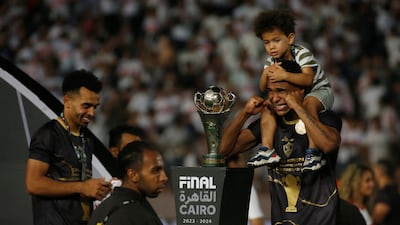
Zamalek's Seifeddine Jaziri celebrates with his son after winning the Confederation Cup at the Cairo International Stadium. Reuters -
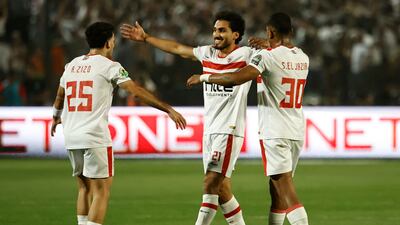
Zamalek midfielder Ahmed Hafez celebrates with teammates after scoring his team's first goal during the second leg of the CAF Confederation Cup final against Morocco's RS Berkane in Cairo on Sunday. AFP -
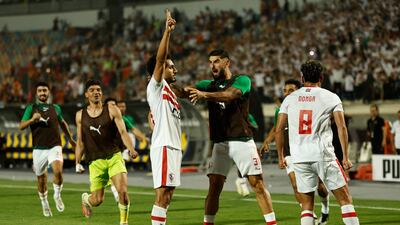
Zamalek won their second CAF Confederation Cup on Sunday. AFP -
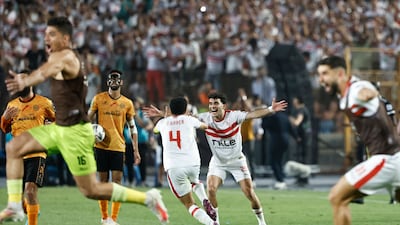
Zamalek's players celebrate winning the second leg of the CAF Confederation Cup final at the Cairo International Stadium. AFP -
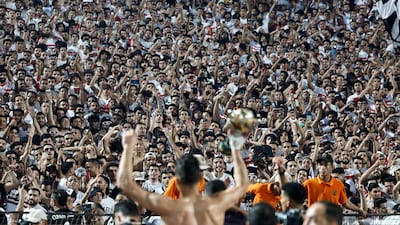
Zamalek's players celebrate with fans after their win at the Cairo International Stadium. AFP -
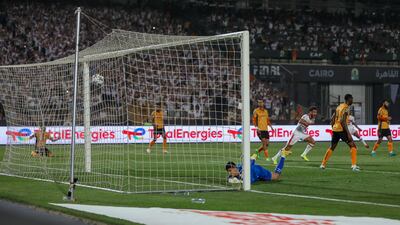
Zamalek midfielder Ahmed Hafez scores against RS Berkane. Getty Images


It does get louder when Zamalek score the crucial goal that tips the tie in their favour on 22 minutes through Ahmed Hamdi. The goalscorer, who came through the rival academy to play at Al Ahly, the team he supported, runs the considerable distance towards the fans to celebrate. There are Palestine flags among the home and away fans.
Zamelek hold their lead in the heat, while Berkane’s players are regularly targeted with the green lights of a laser pen from the crowd, especially when they get into dangerous positions. There’s no water on offer at half time in the away section, though some Zamalek supporters pass water down from the sections above.
Others throw the bottles when decisions are disputed on the pitch, but the mood is generally positive between rival fans. Public announcements are made in English and Arabic, while a pitch side advertising hoarding reads: "Protect African Football. Recognise, Resist, Report". An email address starting with the word "integrity" is then included.
The game becomes edgy in its final minutes, Berkane’s players frustrated because they can’t find a breakthrough and they’re going to lose the final of a competition they won in both 2020 and 2022, an achievement for a club from such a small city. They have 15 shots to Zamalek’s 16, but none are on target.
Berkane’s Hamza El Moussaoui is sent off in the 92nd minute. Another player appears aggressive towards a linesman who is far bigger than him. The linesman looks like he has complete control of the situation as he stares him down. It’s amusing.
The final whistle brings a roar as loud as any I’ve heard in a football ground. There’s no talk here about the stadium roof not helping the acoustics as it’s fully uncovered, but the celebrations are and trophy presentations don’t go to plan.
Berkane players continue to protest in anger, while there’s the unedifying sight of a woman holding the trophy before the presentation before being pushed over because of a scuffle between three men, two in orange security shirts.
The following day, amid a Cairo heatwave, I stay in the hotel. On the next table at lunch are the match officials from the previous evening who are drawn from several African countries including Senegal and Somalia. They’re talking in English about sportsmanship, fair play and feel that they officiated a game well in trying circumstances and intense heat.
“What you have to understand,” explains a lady who is sitting with the officials. “Is that when two Arab teams from North Africa meet, especially in a big game such as last night, there is always electricity.”

