Ivory Coast coach Jean-Louis Gasset will be relying on players like Willy Boly who have developed overseas. AFP

Afcon 2023: Ivory Coast's legacy for producing homegrown stars a fading memory


Ian Hawkey
  • English
  • Arabic

To find tranquility in Abidjan, it’s best to head for the banks of the lagoon. To find the heart of Ivory Coast’s most popular sport, or at least the motor that has driven the country’s football, go to the eastern edge of the Ebrie.

Here are the headquarters of ASEC Mimosas, the nation’s most celebrated club with an academy that not so long ago would have been deemed among the world’s most productive. Scan the roll of honour as you enter the site’s patchwork of pitches, classrooms and dormitories , and you’ll see listed the Toure bothers, Kolo and Yaya, the latter the great galvaniser of Manchester City’s modern rise and a European club champion with Barcelona.

There are the Kalous, too, Salomon, a Champions League winner with Chelsea, and his brother Bonaventure, later of Paris Saint-Germain. There’s Gervinho, later of Arsenal. There’s Didier Zokora, the most capped player for Ivory Coast’s national team and an asset to the midfields of various European clubs after he made the familiar journey abroad from ASEC.

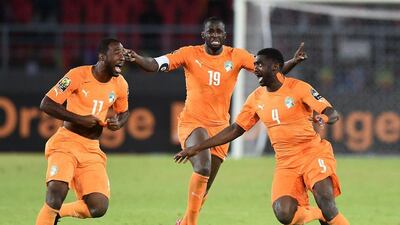
There will be more recent ASEC graduates, though less feted, among those representing the national team on Saturday at the new Olympic Stadium in Epimbe for the opening match of the Africa Cup of Nations, the first hosted in Ivory Coast for 40 years. It's a major chance for The Elephants, as they are nicknamed, to repeat their lone Afcon triumph, the 2015 victory that endorsed the so-called golden generation of Ivorian players, a high concentration of them brought through the ASEC hothouse.

If the champion side of the Toures and the younger Kalou, of Didier Drogba – a superstar whose football upbringing was largely in France – casts an imposing shadow, they also represent a different time, when the pathway between homegrown excellence and the top of the sport ran smoother. Ivory Coast has in the last decade lost its pre-eminent place among the nurseries of African talent. It now looks enviously at near neighbours like Senegal for how youth football is being run.

The enduring truth that almost none of the best African prospects stay in Africa for long – the comparative financial rewards for moving to Europe, or the Gulf, are vast – remains, but more and more leading players for the Elephants have also done their apprenticeships outside Africa. Of the 27 selected in Ivory Coast’s squad by head coach Jean-Louis Gasset for this Afcon, less than half came through Ivorian academies.

Sebastien Haller is among the core group of Ivory Coast players who have not come through their system. AFP

Partly that’s because, like other heavyweights such as Morocco, Ivory Coast have determinedly sought potential internationals from the country’s diaspora, players of Ivorian heritage who were born or grew up in Europe. The spine of Gasset’s best XI, from centre-forward Sebastien Haller, of Borussia Dortmund, through midfielder Seko Fofana, of Al Nassr, to central defender Willy Boly, of Nottingham Forest, all represented France at youth level.

Fifa rules on switching national team have eased in the past 10 years, and several African countries have been beneficiaries of the lighter regulations. But there is a risk that expatriate hiring also loosens the bond with supporters, with the locale.

Viewed from the academies of Africa, it can look like evidence their students are at an ever greater disadvantage, that a schoolboy player learning how to be a professional is on a faster track to the professional elite at a high-spec European academy than at home.

ASEC can feel like an island in treacherous territory. While the methods and learnings within the academy may be rigorous, there is no coherent youth league for the players to compete in. Coaches there bemoan the haphazard fixture list their young players have to contend with.

“You never know if your age-group team are going to playing against a side filled with players older than they say they are,” one tells The National. At senior level, ASEC, who were African club champions at the end of the 1990s, have, like Ivorian clubs generally, made a steadily reducing impact in pan-African club competitions.

Ivory Coast win 2015 Afcon - in pictures

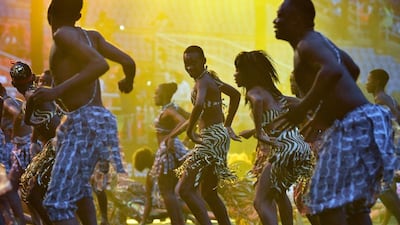
  • Dancers perform during the opening ceremonies of the 2015 Africa Cup of Nations final between Ivory Coast and Ghana on Sunday night in Equatorial Guinea. Issouf Sanogo / AFP
    Dancers perform during the opening ceremonies of the 2015 Africa Cup of Nations final between Ivory Coast and Ghana on Sunday night in Equatorial Guinea. Issouf Sanogo / AFP
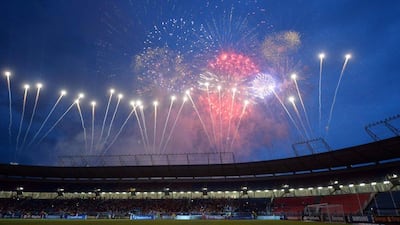
  • Fireworks explode over the stadium in Bata, Equatorial Guinea during the Africa Cup of Nations final opening ceremonies on Sunday night before Ivory Coast and Ghana battled for continental supremacy. Khaled Desouki / AFP
    Fireworks explode over the stadium in Bata, Equatorial Guinea during the Africa Cup of Nations final opening ceremonies on Sunday night before Ivory Coast and Ghana battled for continental supremacy. Khaled Desouki / AFP
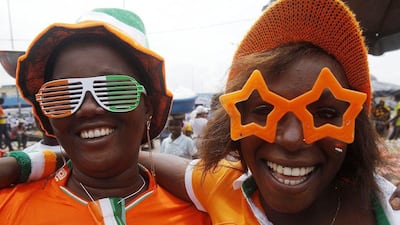
  • Ivory Coast fans prepare for their team's Africa Cup of Nations final against Ghana on Sunday in Abidjan, Ivory Coast. Luc Gnago / Reuters
    Ivory Coast fans prepare for their team's Africa Cup of Nations final against Ghana on Sunday in Abidjan, Ivory Coast. Luc Gnago / Reuters
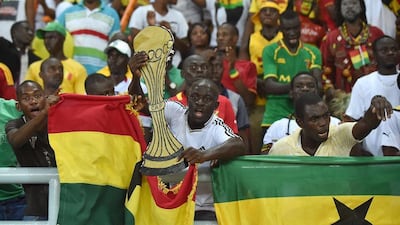
  • Ghanaian fans cheer for their team ahead of the 2015 Africa Cup of Nations final match against Ivory Coast in Bata, Equatorial Guinea on Sunday. Carl de Souza / AFP
    Ghanaian fans cheer for their team ahead of the 2015 Africa Cup of Nations final match against Ivory Coast in Bata, Equatorial Guinea on Sunday. Carl de Souza / AFP
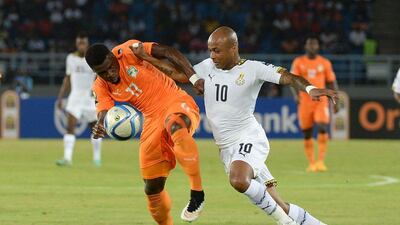
  • Ghana midfielder Andre Ayew, right, challenges Ivory Coast defender Serge Aurier during the Africa Cup of Nations final on Sunday night. Khaled Desouki / AFP
    Ghana midfielder Andre Ayew, right, challenges Ivory Coast defender Serge Aurier during the Africa Cup of Nations final on Sunday night. Khaled Desouki / AFP
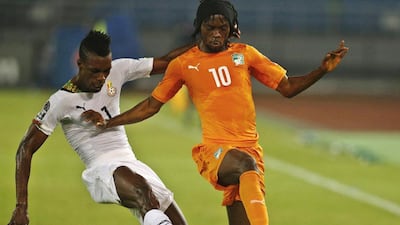
  • Ghana's Mubarak Wakaso, left, challenges Ivory Coast's Gervinho during the 2015 Africa Cup of Nations final on Sunday in Equatorial Guinea. Mike Hutchings / Reuters
    Ghana's Mubarak Wakaso, left, challenges Ivory Coast's Gervinho during the 2015 Africa Cup of Nations final on Sunday in Equatorial Guinea. Mike Hutchings / Reuters
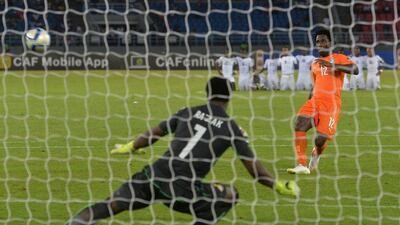
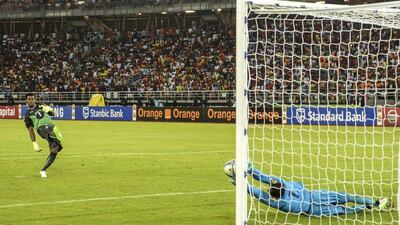
  • Ivory Coast forward Wilfried Bony, right, misses his penalty during the shootout against Ghana in the Africa Cup of Nations final on Sunday. Ivory Coast missed their first two shots, before Ghana missed their third and fourth shots, and the Ivorians eventually won the shootout 9-8. Khaled Desouki / AFP
    Ivory Coast forward Wilfried Bony, right, misses his penalty during the shootout against Ghana in the Africa Cup of Nations final on Sunday. Ivory Coast missed their first two shots, before Ghana missed their third and fourth shots, and the Ivorians eventually won the shootout 9-8. Khaled Desouki / AFP
  • Goalkeeper Boubacar Barry of Ivory Coast, right, makes a save to give his team the edge against Ghana on Sunday in the Africa Cup of Nations final. Barry Aldworth / EPA
    Goalkeeper Boubacar Barry of Ivory Coast, right, makes a save to give his team the edge against Ghana on Sunday in the Africa Cup of Nations final. Barry Aldworth / EPA
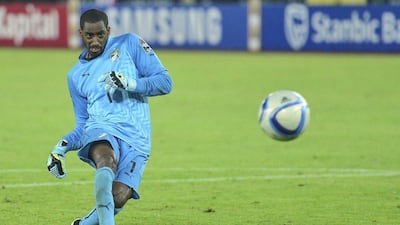
  • Ivory Coast keeper Boubacar Barry shoots and scores the winning penalty in the 9-8 shootout victory over Ghana on Sunday in the Africa Cup of Nations final in Bata, Equatorial Guinea. Barry Aldworth / EPA
    Ivory Coast keeper Boubacar Barry shoots and scores the winning penalty in the 9-8 shootout victory over Ghana on Sunday in the Africa Cup of Nations final in Bata, Equatorial Guinea. Barry Aldworth / EPA
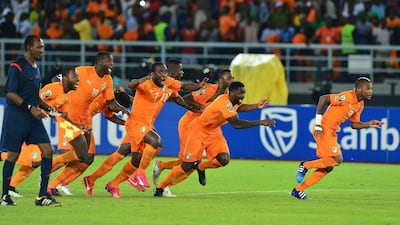
  • Ivory Coast players, from left to right, Siaka Tiene, Yaya Toure, Serey Doumbia, Kolo Toure and Serey Die react in celebration at the end of the penalty shootout win over Ghana in the Africa Cup of Nations final on Sunday. Gavin Barker / EPA
    Ivory Coast players, from left to right, Siaka Tiene, Yaya Toure, Serey Doumbia, Kolo Toure and Serey Die react in celebration at the end of the penalty shootout win over Ghana in the Africa Cup of Nations final on Sunday. Gavin Barker / EPA
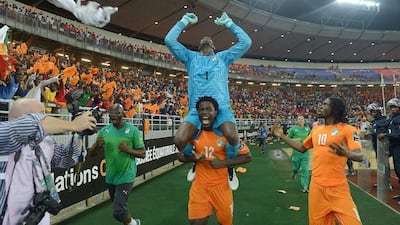
  • Ivory Coast's Wilfried Bony carries goalkeeper Boubacar Barry on his shoulders as they celebrate with forward Gervinho after winning the 2015 Africa Cup of Nations final against Ghana. Carl de Souza / AFP
    Ivory Coast's Wilfried Bony carries goalkeeper Boubacar Barry on his shoulders as they celebrate with forward Gervinho after winning the 2015 Africa Cup of Nations final against Ghana. Carl de Souza / AFP
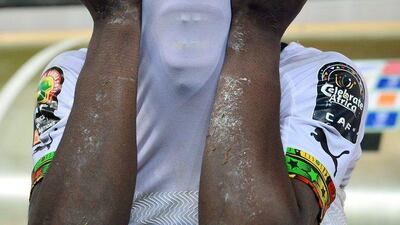
  • Afriyie Acquah of Ghana cries into his shirt after his team lose the 2015 Africa Cup of Nations final against Ivory Coast on Sunday. Gavin Barker / EPA
    Afriyie Acquah of Ghana cries into his shirt after his team lose the 2015 Africa Cup of Nations final against Ivory Coast on Sunday. Gavin Barker / EPA
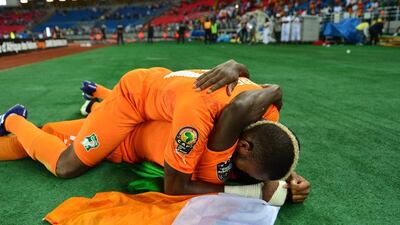
  • Serey Die of Ivory Coast, above, celebrates with teammate Serge Aurier, below, after they win the 2015 Africa Cup of Nations final in Bata, Equatorial Guinea on Sunday. Gavin Barker / EPA
    Serey Die of Ivory Coast, above, celebrates with teammate Serge Aurier, below, after they win the 2015 Africa Cup of Nations final in Bata, Equatorial Guinea on Sunday. Gavin Barker / EPA
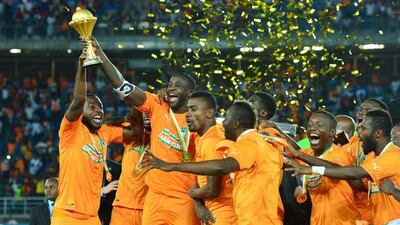
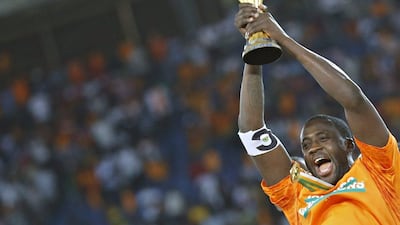
  • Yaya Toure holds aloft the Africa Cup of Nations trophy after Ivory Coast's win in the final against Ghana on Sunday. Gavin Barker / EPA
    Yaya Toure holds aloft the Africa Cup of Nations trophy after Ivory Coast's win in the final against Ghana on Sunday. Gavin Barker / EPA
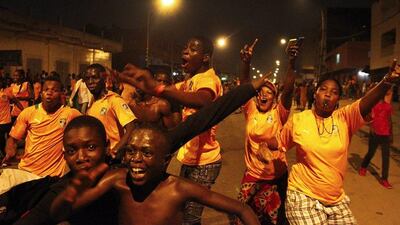
  • Supporters of Ivory Coast celebrate in the streets of Abidjan on Sunday after their team beat Ghana in the Africa Cup of Nations final. Legnan Koula / EPA
    Supporters of Ivory Coast celebrate in the streets of Abidjan on Sunday after their team beat Ghana in the Africa Cup of Nations final. Legnan Koula / EPA
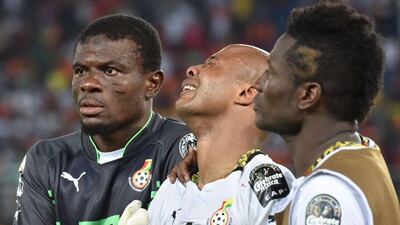
  • Ghana's Andre Ayew, centre, is comforted by keeper Razak Brimah, left, and Asamoah Gyan, right, after their loss in the Africa Cup of Nations final to Ivory Coast on Sunday. Issouf Sanogo / AFP
    Ghana's Andre Ayew, centre, is comforted by keeper Razak Brimah, left, and Asamoah Gyan, right, after their loss in the Africa Cup of Nations final to Ivory Coast on Sunday. Issouf Sanogo / AFP
  • Ivory Coast's captain Yaya Toure raises the trophy after winning the Africa Cup of Nations final against Ghana on Sunday. Amr Abdallah Dalsh / Reuters
    Ivory Coast's captain Yaya Toure raises the trophy after winning the Africa Cup of Nations final against Ghana on Sunday. Amr Abdallah Dalsh / Reuters

The impulse for talent to leave young, pursuing contracts abroad, partly explains that. The superclubs of the continent’s richer leagues – Egypt, the Maghreb and South Africa – tend to dominate the African Champions League, but there is still nostalgia at ASEC for the days their young sides, plucked from the academy, could hold their own across Africa.

There is a residual pride in how the leadership qualities of their most celebrated graduates are now being realised, post-retirement as players. Yaya Toure is at the Asian Cup, as assistant coach to Roberto Mancini with Saudi Arabia’s national team. Bonaventure Kalou has served for the last five years as mayor of Vavoua, in central Ivory Coast.

And there is eager anticipation at how the Elephants’ homegrown talents dovetail with expatriate expertise at Saturday's first assignment, against Guinea-Bissau, of what the country hopes is a journey all the way to the final. Midfielder Oumar Diakite, 20, and striker Karim Konate, 19, are carrying the baton for ASEC’s academy, both transferred to RB Salzburg in Austria last season, both hopeful of making this Afcon a platform for their next big career step.


Set-jetting on the Emerald Isle

Other shows filmed in Ireland include: Vikings (County Wicklow), The Fall (Belfast), Line of Duty (Belfast), Penny Dreadful (Dublin), Ripper Street (Dublin), Krypton (Belfast)

The%20specs%3A%202024%20Mercedes%20E200
%3Cp%3E%3Cstrong%3EEngine%3A%20%3C%2Fstrong%3E2.0-litre%20four-cyl%20turbo%20%2B%20mild%20hybrid%0D%3Cbr%3E%3Cstrong%3EPower%3A%20%3C%2Fstrong%3E204hp%20at%205%2C800rpm%20%2B23hp%20hybrid%20boost%0D%3Cbr%3E%3Cstrong%3ETorque%3A%20%3C%2Fstrong%3E320Nm%20at%201%2C800rpm%20%2B205Nm%20hybrid%20boost%0D%3Cbr%3E%3Cstrong%3ETransmission%3A%20%3C%2Fstrong%3E9-speed%20auto%0D%3Cbr%3E%3Cstrong%3EFuel%20consumption%3A%20%3C%2Fstrong%3E7.3L%2F100km%0D%3Cbr%3E%3Cstrong%3EOn%20sale%3A%20%3C%2Fstrong%3ENovember%2FDecember%0D%3Cbr%3E%3Cstrong%3EPrice%3A%20%3C%2Fstrong%3EFrom%20Dh205%2C000%20(estimate)%3C%2Fp%3E%0A
COMPANY PROFILE
Name: HyperSpace
 
Started: 2020
 
Founders: Alexander Heller, Rama Allen and Desi Gonzalez
 
Based: Dubai, UAE
 
Sector: Entertainment 
 
Number of staff: 210 
 
Investment raised: $75 million from investors including Galaxy Interactive, Riyadh Season, Sega Ventures and Apis Venture Partners
Infiniti QX80 specs

Engine: twin-turbocharged 3.5-liter V6

Power: 450hp

Torque: 700Nm

Price: From Dh450,000, Autograph model from Dh510,000

Available: Now

Some of Darwish's last words

"They see their tomorrows slipping out of their reach. And though it seems to them that everything outside this reality is heaven, yet they do not want to go to that heaven. They stay, because they are afflicted with hope." - Mahmoud Darwish, to attendees of the Palestine Festival of Literature, 2008

His life in brief: Born in a village near Galilee, he lived in exile for most of his life and started writing poetry after high school. He was arrested several times by Israel for what were deemed to be inciteful poems. Most of his work focused on the love and yearning for his homeland, and he was regarded the Palestinian poet of resistance. Over the course of his life, he published more than 30 poetry collections and books of prose, with his work translated into more than 20 languages. Many of his poems were set to music by Arab composers, most significantly Marcel Khalife. Darwish died on August 9, 2008 after undergoing heart surgery in the United States. He was later buried in Ramallah where a shrine was erected in his honour.

Sinopharm vaccine explained

The Sinopharm vaccine was created using techniques that have been around for decades. 

“This is an inactivated vaccine. Simply what it means is that the virus is taken, cultured and inactivated," said Dr Nawal Al Kaabi, chair of the UAE's National Covid-19 Clinical Management Committee.

"What is left is a skeleton of the virus so it looks like a virus, but it is not live."

This is then injected into the body.

"The body will recognise it and form antibodies but because it is inactive, we will need more than one dose. The body will not develop immunity with one dose," she said.

"You have to be exposed more than one time to what we call the antigen."

The vaccine should offer protection for at least months, but no one knows how long beyond that.

Dr Al Kaabi said early vaccine volunteers in China were given shots last spring and still have antibodies today.

“Since it is inactivated, it will not last forever," she said.

Key figures in the life of the fort

Sheikh Dhiyab bin Isa (ruled 1761-1793) Built Qasr Al Hosn as a watchtower to guard over the only freshwater well on Abu Dhabi island.

Sheikh Shakhbut bin Dhiyab (ruled 1793-1816) Expanded the tower into a small fort and transferred his ruling place of residence from Liwa Oasis to the fort on the island.

Sheikh Tahnoon bin Shakhbut (ruled 1818-1833) Expanded Qasr Al Hosn further as Abu Dhabi grew from a small village of palm huts to a town of more than 5,000 inhabitants.

Sheikh Khalifa bin Shakhbut (ruled 1833-1845) Repaired and fortified the fort.

Sheikh Saeed bin Tahnoon (ruled 1845-1855) Turned Qasr Al Hosn into a strong two-storied structure.

Sheikh Zayed bin Khalifa (ruled 1855-1909) Expanded Qasr Al Hosn further to reflect the emirate's increasing prominence.

Sheikh Shakhbut bin Sultan (ruled 1928-1966) Renovated and enlarged Qasr Al Hosn, adding a decorative arch and two new villas.

Sheikh Zayed bin Sultan (ruled 1966-2004) Moved the royal residence to Al Manhal palace and kept his diwan at Qasr Al Hosn.

Sources: Jayanti Maitra, www.adach.ae

The burning issue

The internal combustion engine is facing a watershed moment – major manufacturer Volvo is to stop producing petroleum-powered vehicles by 2021 and countries in Europe, including the UK, have vowed to ban their sale before 2040. The National takes a look at the story of one of the most successful technologies of the last 100 years and how it has impacted life in the UAE.

Part three: an affection for classic cars lives on

Read part two: how climate change drove the race for an alternative 

Read part one: how cars came to the UAE

Our legal consultant

Name: Dr Hassan Mohsen Elhais

Position: legal consultant with Al Rowaad Advocates and Legal Consultants.

Pharaoh's curse

British aristocrat Lord Carnarvon, who funded the expedition to find the Tutankhamun tomb, died in a Cairo hotel four months after the crypt was opened.
He had been in poor health for many years after a car crash, and a mosquito bite made worse by a shaving cut led to blood poisoning and pneumonia.
Reports at the time said Lord Carnarvon suffered from “pain as the inflammation affected the nasal passages and eyes”.
Decades later, scientists contended he had died of aspergillosis after inhaling spores of the fungus aspergillus in the tomb, which can lie dormant for months. The fact several others who entered were also found dead withiin a short time led to the myth of the curse.

How to turn your property into a holiday home
  1. Ensure decoration and styling – and portal photography – quality is high to achieve maximum rates.
  2. Research equivalent Airbnb homes in your location to ensure competitiveness.
  3. Post on all relevant platforms to reach the widest audience; whether you let personally or via an agency know your potential guest profile – aiming for the wrong demographic may leave your property empty.
  4. Factor in costs when working out if holiday letting is beneficial. The annual DCTM fee runs from Dh370 for a one-bedroom flat to Dh1,200. Tourism tax is Dh10-15 per bedroom, per night.
  5. Check your management company has a physical office, a valid DTCM licence and is licencing your property and paying tourism taxes. For transparency, regularly view your booking calendar.
Trump v Khan

2016: Feud begins after Khan criticised Trump’s proposed Muslim travel ban to US

2017: Trump criticises Khan’s ‘no reason to be alarmed’ response to London Bridge terror attacks

2019: Trump calls Khan a “stone cold loser” before first state visit

2019: Trump tweets about “Khan’s Londonistan”, calling him “a national disgrace”

2022:  Khan’s office attributes rise in Islamophobic abuse against the major to hostility stoked during Trump’s presidency

July 2025 During a golfing trip to Scotland, Trump calls Khan “a nasty person”

Sept 2025 Trump blames Khan for London’s “stabbings and the dirt and the filth”.

Dec 2025 Trump suggests migrants got Khan elected, calls him a “horrible, vicious, disgusting mayor”

The National Archives, Abu Dhabi

Founded over 50 years ago, the National Archives collects valuable historical material relating to the UAE, and is the oldest and richest archive relating to the Arabian Gulf.

Much of the material can be viewed on line at the Arabian Gulf Digital Archive - https://www.agda.ae/en

Updated: January 12, 2024, 4:40 AM