FILE - Brazil's soccer star Pele, left, embraces Mario Zagallo after the latter's appointment as coach of the Brazilian national soccer team, in Rio De Janeiro, Brazil, in March 1970. Zagallo, who reached the World Cup final a record five times, winning four, as a player and then a coach with Brazil, has died. He was 92. Brazilian soccer confederation president Ednaldo Rodrigues said in a statement in the early hours of Saturday, Jan. 5, 2024, confirming Zagallo's death that Zagallo "is one of the biggest legends" of the sport. (AP Photo, File)
FILE - Brazil's soccer star Pele, left, embraces Mario Zagallo after the latter's appointment as coach of the Brazilian national soccer team, in Rio De Janeiro, Brazil, in March 1970. Zagallo, who rea

Beckenbauer and Zagallo, footballing greats who attained excellence


Steve Luckings
  • English
  • Arabic

It's a sad day in football when the beautiful game loses one of its brightest stars. It's tragic when it loses two in the space of a week.

News of the deaths of Franz Beckenbauer, aged 78, and Mario Zagallo at 92 is a time for sadness and reflection on the careers of two men with legitimate claims to having transformed the game.

Zagallo's death last week was felt from the vibrant streets of Rio de Janeiro to the bustling metropolis of Dubai. The first of only three men to win the World Cup as both player and coach – Beckenbauer was the second – Zagallo earned his place in history and was never shy of reminding people of it.

In his seminal book Brazil 1970 – How the Greatest Team of all time won the World Cup, Sam Kunti described how Zagallo would ignore his questions to instead self-indulge.

"He was full-on vain. Here was a man who had spent a lifetime cultivating his own place in history, a man who would tell you of his glories, and would never pass on a chance to be thanked for his own largesse," wrote Kunti.

As a player, Zagallo was talented but limited. Perhaps that's unkind when judging anyone playing in the same era as Pele, Garrincha and Didi but while others may have accepted their fate and remained happy to watch from the sidelines, Zagallo instead reinvented himself and analysed where Brazil's weaknesses lay.

The Selecao's commitment to attacking football is part of its DNA. Zagallo, a winger by trade, began to drill into anyone who would listen that wide players needed to drop back into midfield to reduce being exposed. It seems trivial now but at the time the idea of an attacking player dropping back to help out his midfielders or defenders was anathema to many Brazilians.

If Zagallo the player was the disruptor then Beckenbauer was the likeable statesman who promised a better future in a Germany still reeling from the ravages of war.

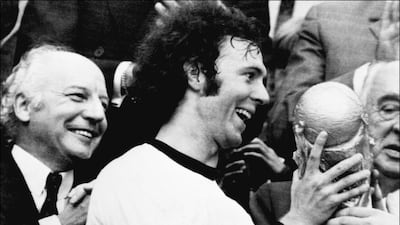
  • Germany captain Franz Beckenbauer receives the World Cup after a 2-1 victory over the Netherlands on July 7, 1974 in Munich. AFP
    Germany captain Franz Beckenbauer receives the World Cup after a 2-1 victory over the Netherlands on July 7, 1974 in Munich. AFP
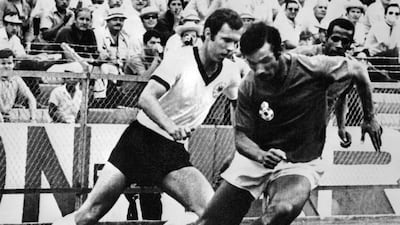
  • Franz Beckenbauer, left, fights for the ball with Moroccan Benkhrif Boujemaa during the World Cup first round match between West Germany and Morocco, June 1970 in Leon. AFP
    Franz Beckenbauer, left, fights for the ball with Moroccan Benkhrif Boujemaa during the World Cup first round match between West Germany and Morocco, June 1970 in Leon. AFP
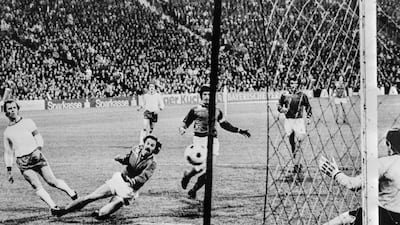
  • Franz Beckenbauer, left, opens the scoring for Bayern Munich against St Etienne in the European Cup semi-final of 1975. AFP
    Franz Beckenbauer, left, opens the scoring for Bayern Munich against St Etienne in the European Cup semi-final of 1975. AFP
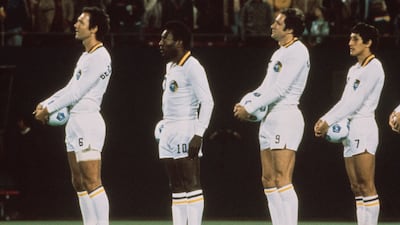
  • From left to right: Germany's Franz Beckenbauer, Brazil's Pele, Italy's Giorgio Chinaglia and Paraguay's Romerito line up for New York Cosmos in 1980. Getty Images
    From left to right: Germany's Franz Beckenbauer, Brazil's Pele, Italy's Giorgio Chinaglia and Paraguay's Romerito line up for New York Cosmos in 1980. Getty Images
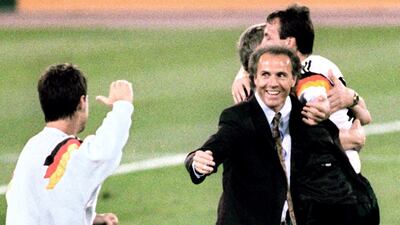
  • West Germany coach Franz Beckenbauer, centre, celebrates after his team beat the defending champions Argentina 1-0 in the World Cup final, July 8, 1990 in Rome. AFP
    West Germany coach Franz Beckenbauer, centre, celebrates after his team beat the defending champions Argentina 1-0 in the World Cup final, July 8, 1990 in Rome. AFP
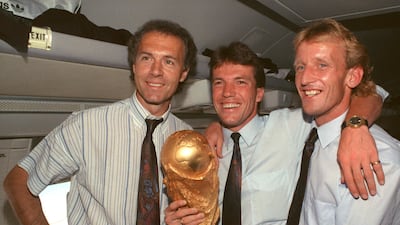
  • Germany manager Franz Beckenbauer, left, stands with midfielder and captain Lothar Matthaus, centre, and defender Andreas Brehme in the cabin of an airplane with the World Cup trophy in 1990. Getty Images
    Germany manager Franz Beckenbauer, left, stands with midfielder and captain Lothar Matthaus, centre, and defender Andreas Brehme in the cabin of an airplane with the World Cup trophy in 1990. Getty Images
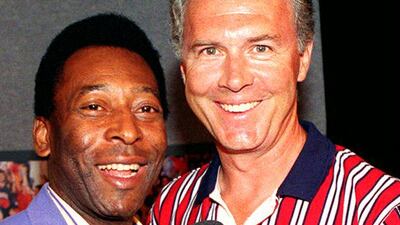
  • The two greats, Brazil's Pele, left, and Franz Beckenbauer of Germany meet again in Chicago on June 18, 1994. AFP
    The two greats, Brazil's Pele, left, and Franz Beckenbauer of Germany meet again in Chicago on June 18, 1994. AFP
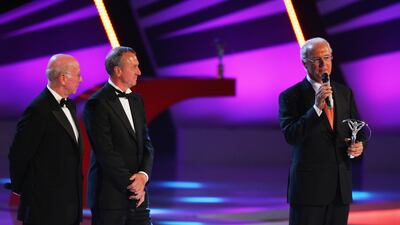
  • Franz Beckenbauer, right, accepts the Laureus Lifetime Achievement Award from fellow greats Sir Bobby Charlton, left, and Johan Cruyff. Getty Images
    Franz Beckenbauer, right, accepts the Laureus Lifetime Achievement Award from fellow greats Sir Bobby Charlton, left, and Johan Cruyff. Getty Images
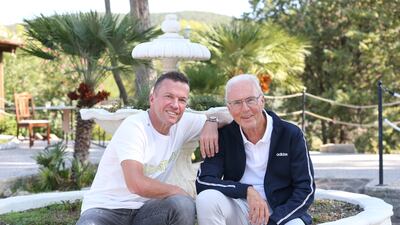
  • World Champions Lothar Matthaus, left, and Franz Beckenbauer pictured together in 2020. Getty Images
    World Champions Lothar Matthaus, left, and Franz Beckenbauer pictured together in 2020. Getty Images

Being blessed with an evocative nickname like Der Kaiser will always open pathways and so it was for Beckenbauer. Before the 1966 World Cup final, England boss Alf Ramsey had earmarked West Germany's 20-year-old sometime-defender-sometime-midfielder as a player who warranted special attention. And while the gnarly Nobby Stiles, England's pugnacious midfielder, was probably more suited to the role, it was Bobby Charlton, Ramsey's chief attacking threat, who was tasked with shadowing Beckenbauer.

The thinking was that, though Stiles would carry out the task better, England could not afford for their midfield anchor to be snapping at Beckenbauer's heels high up the pitch one minute only to find his defenders exposed when West Germany or Der Kaiser transitioned effortlessly between defence and attack the next.

Though not eponymous, few argue that Beckenbauer created the libero role, or at least mastered it. It was at club level with Bayern Munich that Beckenbauer redefined the role of sweeper to make the most of his offensive as well as defensive ability. Three successive league titles between 1972 and 1974 were followed by a hat-trick of European Cups from 1974 to 1976.

It was a golden era for German football in which Beckenbauer would earn the plaudits of teammates and opponents alike. Beckenbauer captained West Germany to World Cup success in 1974, two years after leading the team to victory at the European Championship. Football is usually defined by great attacking teams or players but there is a case to argue that the period between 1972 and 1976 belongs to Beckenbauer.

Zagallo and Beckenbauer were both establishment figures, tied by association and politics to either club or country – or both – but to view them as merely company men is folly.

Both were transformative and innovative, seeing the game far beyond the confines of the pitch. Just as they were as players, both were subtle masters at manoeuvring themselves into positions of power and influence.

  • Mario Zagallo, who won the World Cup four times as a player and then a coach with Brazil, has died. He was 92. AP
    Mario Zagallo, who won the World Cup four times as a player and then a coach with Brazil, has died. He was 92. AP
  • Mario Zagallo of Brazil, second left, shoots at England's goal during a World Cup quarter-final match in Vina Del Mar, Chile, June 10, 1962. AP
    Mario Zagallo of Brazil, second left, shoots at England's goal during a World Cup quarter-final match in Vina Del Mar, Chile, June 10, 1962. AP
  • Mario Zagallo, right, alongside former Brazil teammate Pele left, after the former's appointment as coach of the Brazilian national team in March 1970.
    Mario Zagallo, right, alongside former Brazil teammate Pele left, after the former's appointment as coach of the Brazilian national team in March 1970.
  • A portrait of Brazil's national team coach Mario Zagallo taken in June 1970 during the World Cup. AFP
    A portrait of Brazil's national team coach Mario Zagallo taken in June 1970 during the World Cup. AFP
  • Brazilian coach Mario Zagallo comforts striker Ronaldo at the Stade de France in Saint-Denis, near Paris, after France defeated Brazil in the 1998 World Cup final. AFP
    Brazilian coach Mario Zagallo comforts striker Ronaldo at the Stade de France in Saint-Denis, near Paris, after France defeated Brazil in the 1998 World Cup final. AFP
  • Brazilian players toss Mario Zagallo in the air at the end of a friendly match with South Korea in Seoul in 2002. AFP
    Brazilian players toss Mario Zagallo in the air at the end of a friendly match with South Korea in Seoul in 2002. AFP
  • Brazilian football team caretaker coach Mario Zagallo poses with his starting line-up in Seoul in 2002. AFP
    Brazilian football team caretaker coach Mario Zagallo poses with his starting line-up in Seoul in 2002. AFP
  • Brazil coach Carlos Alberto Parreira, third right, and supervisor Mario Zagallo, fourth right, chat with players at the 2004 Copa America. AFP
    Brazil coach Carlos Alberto Parreira, third right, and supervisor Mario Zagallo, fourth right, chat with players at the 2004 Copa America. AFP
  • Four-time World Cup winner Mario Zagallo holds the Jules Rimet and Fifa trophies as he poses for photographers in Rio de Janeiro in March 2003. AFP
    Four-time World Cup winner Mario Zagallo holds the Jules Rimet and Fifa trophies as he poses for photographers in Rio de Janeiro in March 2003. AFP
  • Brazilian former player and coach Mario Zagallo smiles next a statue representing him during a ceremony in his tribute in Rio de Janeiro, Brazil, October 20, 2022. Reuters
    Brazilian former player and coach Mario Zagallo smiles next a statue representing him during a ceremony in his tribute in Rio de Janeiro, Brazil, October 20, 2022. Reuters

Both would go on to coach their countries; both would lead them to World Cup success. If Zagallo the player can be judged conservative by Brazilian standards, Zagallo the coach was anything but. Zagallo won the first of his two World Cups with Brazil as a player in 1958 before repeating the feat four years later but it is his Brazil of 1970, that of Pele, Rivelino, Tostao, Carlos Alberto, Jairzinho et al, that is feted as the greatest team of all time.

If no team before or since could hold a candle to that side, Beckenbauer's West Germany that lifted the trophy in 1990 was a construct of ruthless efficiency and a dash of daring. Jurgen Kohler, Lothar Matthaus and Rudi Voller will never be remembered in the same vein as Brazil's Class of 1970 but their achievement in Rome was the embodiment of Beckenbauer's devotion to the fundamentals of football.

Indeed Beckenbauer and Zagallo were on a collision course to meet at that tournament. The UAE were drawn in the same Group D as the beaten 1986 finalists. But having led the Emirates through qualification, Zagallo resigned from his post before the tournament. West Germany won their encounter 5-1. It remains the UAE's only appearance at the World Cup finals.

Few attain the excellence Beckenbauer did as a player; none have come close to assembling and organising an attacking array of talent as Zagallo did with Brazil in 1970. Two men, bonded by brilliance.


The years Ramadan fell in May

1987

1954

1921

1888

The biog

Born: Kuwait in 1986
Family: She is the youngest of seven siblings
Time in the UAE: 10 years
Hobbies: audiobooks and fitness: she works out every day, enjoying kickboxing and basketball

Ain Dubai in numbers

126: The length in metres of the legs supporting the structure

1 football pitch: The length of each permanent spoke is longer than a professional soccer pitch

16 A380 Airbuses: The equivalent weight of the wheel rim.

9,000 tonnes: The amount of steel used to construct the project.

5 tonnes: The weight of each permanent spoke that is holding the wheel rim in place

192: The amount of cable wires used to create the wheel. They measure a distance of 2,4000km in total, the equivalent of the distance between Dubai and Cairo.

Timeline

2012-2015

The company offers payments/bribes to win key contracts in the Middle East

May 2017

The UK SFO officially opens investigation into Petrofac’s use of agents, corruption, and potential bribery to secure contracts

September 2021

Petrofac pleads guilty to seven counts of failing to prevent bribery under the UK Bribery Act

October 2021

Court fines Petrofac £77 million for bribery. Former executive receives a two-year suspended sentence 

December 2024

Petrofac enters into comprehensive restructuring to strengthen the financial position of the group

May 2025

The High Court of England and Wales approves the company’s restructuring plan

July 2025

The Court of Appeal issues a judgment challenging parts of the restructuring plan

August 2025

Petrofac issues a business update to execute the restructuring and confirms it will appeal the Court of Appeal decision

October 2025

Petrofac loses a major TenneT offshore wind contract worth €13 billion. Holding company files for administration in the UK. Petrofac delisted from the London Stock Exchange

November 2025

180 Petrofac employees laid off in the UAE

Ziina users can donate to relief efforts in Beirut

Ziina users will be able to use the app to help relief efforts in Beirut, which has been left reeling after an August blast caused an estimated $15 billion in damage and left thousands homeless. Ziina has partnered with the United Nations High Commissioner for Refugees to raise money for the Lebanese capital, co-founder Faisal Toukan says. “As of October 1, the UNHCR has the first certified badge on Ziina and is automatically part of user's top friends' list during this campaign. Users can now donate any amount to the Beirut relief with two clicks. The money raised will go towards rebuilding houses for the families that were impacted by the explosion.”

Indoor cricket in a nutshell

Indoor Cricket World Cup - Sep 16-20, Insportz, Dubai

16 Indoor cricket matches are 16 overs per side

8 There are eight players per team

There have been nine Indoor Cricket World Cups for men. Australia have won every one.

5 Five runs are deducted from the score when a wickets falls

Batsmen bat in pairs, facing four overs per partnership

Scoring In indoor cricket, runs are scored by way of both physical and bonus runs. Physical runs are scored by both batsmen completing a run from one crease to the other. Bonus runs are scored when the ball hits a net in different zones, but only when at least one physical run is score.

Zones

A Front net, behind the striker and wicketkeeper: 0 runs

B Side nets, between the striker and halfway down the pitch: 1 run

Side nets between halfway and the bowlers end: 2 runs

Back net: 4 runs on the bounce, 6 runs on the full

Mercer, the investment consulting arm of US services company Marsh & McLennan, expects its wealth division to at least double its assets under management (AUM) in the Middle East as wealth in the region continues to grow despite economic headwinds, a company official said.

Mercer Wealth, which globally has $160 billion in AUM, plans to boost its AUM in the region to $2-$3bn in the next 2-3 years from the present $1bn, said Yasir AbuShaban, a Dubai-based principal with Mercer Wealth.

Within the next two to three years, we are looking at reaching $2 to $3 billion as a conservative estimate and we do see an opportunity to do so,” said Mr AbuShaban.

Mercer does not directly make investments, but allocates clients’ money they have discretion to, to professional asset managers. They also provide advice to clients.

“We have buying power. We can negotiate on their (client’s) behalf with asset managers to provide them lower fees than they otherwise would have to get on their own,” he added.

Mercer Wealth’s clients include sovereign wealth funds, family offices, and insurance companies among others.

From its office in Dubai, Mercer also looks after Africa, India and Turkey, where they also see opportunity for growth.

Wealth creation in Middle East and Africa (MEA) grew 8.5 per cent to $8.1 trillion last year from $7.5tn in 2015, higher than last year’s global average of 6 per cent and the second-highest growth in a region after Asia-Pacific which grew 9.9 per cent, according to consultancy Boston Consulting Group (BCG). In the region, where wealth grew just 1.9 per cent in 2015 compared with 2014, a pickup in oil prices has helped in wealth generation.

BCG is forecasting MEA wealth will rise to $12tn by 2021, growing at an annual average of 8 per cent.

Drivers of wealth generation in the region will be split evenly between new wealth creation and growth of performance of existing assets, according to BCG.

Another general trend in the region is clients’ looking for a comprehensive approach to investing, according to Mr AbuShaban.

“Institutional investors or some of the families are seeing a slowdown in the available capital they have to invest and in that sense they are looking at optimizing the way they manage their portfolios and making sure they are not investing haphazardly and different parts of their investment are working together,” said Mr AbuShaban.

Some clients also have a higher appetite for risk, given the low interest-rate environment that does not provide enough yield for some institutional investors. These clients are keen to invest in illiquid assets, such as private equity and infrastructure.

“What we have seen is a desire for higher returns in what has been a low-return environment specifically in various fixed income or bonds,” he said.

“In this environment, we have seen a de facto increase in the risk that clients are taking in things like illiquid investments, private equity investments, infrastructure and private debt, those kind of investments were higher illiquidity results in incrementally higher returns.”

The Abu Dhabi Investment Authority, one of the largest sovereign wealth funds, said in its 2016 report that has gradually increased its exposure in direct private equity and private credit transactions, mainly in Asian markets and especially in China and India. The authority’s private equity department focused on structured equities owing to “their defensive characteristics.”

What can victims do?

Always use only regulated platforms

Stop all transactions and communication on suspicion

Save all evidence (screenshots, chat logs, transaction IDs)

Report to local authorities

Warn others to prevent further harm

Courtesy: Crystal Intelligence

CHELSEA SQUAD

Arrizabalaga, Bettinelli, Rudiger, Christensen, Silva, Chalobah, Sarr, Azpilicueta, James, Kenedy, Alonso, Jorginho, Kante, Kovacic, Saul, Barkley, Ziyech, Pulisic, Mount, Hudson-Odoi, Werner, Havertz, Lukaku. 

Updated: January 09, 2024, 3:01 PM