


Roberto Mancini may still be searching for his first win as Saudi Arabia manager but there are reasons for optimism ahead of Tuesday night's clash with Mali in Portugal.
The September camp, which saw Saudi Arabia lose back-to-back games against Costa Rica and South Korea in Mancini’s second week in the job, was merely an opportunity for the Italian to learn about the players at his disposal, with no clear idea of what can be expected apart from Mancini's adoption of a 4-3-3 formation.
But in the third and most recent game of his fledgling reign, Friday's 2-2 draw against Nigeria, patterns of play and a glimpse of the system the former Italy boss plans to employ started to take shape.
The selection of Hassan Tambakti, arguably the nation’s most highly-rated centre-back, on the right of a four-man defence raised eyebrows, but once the game got underway, it was clear how Mancini wanted to use the 24-year-old Al Hilal player.
The Italian set up his team to defend with a back-four but attack with a back-three, with Tambakti tucking in alongside Abdulelah Al Amri and the left-footed Ali Al Bulayhi, while Nasser Al Dawsari pushed higher up from his starting position at left-back.
Al Amri and Al Bulayhi struggled to contain Nigeria’s attack, with the pace of Victor Boniface and the physicality of Victor Osimhen causing trouble time and time again. If not for poor finishing from Ademola Lookman, Manicni’s side would have found themselves staring at a third consecutive defeat.
Set to face another side with similar attacking qualities to Nigeria in Mali, Mancini is likely to continue with the same defensive approach, but he could opt for a change of personnel to firm up his starting XI, with only one more international window to come before the AFC Asian Cup gets underway in Qatar in January 2024.

One challenge facing the Italian is the absence of established centre-back options in his squad beyond the three he fielded against Nigeria, meaning his only moves are to start either the tenacious Saud Abdulhamid or the adventurous Sultan Al Ghannam on the right and revert to playing his quickest defender, Tambakti, centrally.
It was clear that Mancini went for form over experience in midfield against Nigeria, starting three of the best-performing players this season, Ali Hazazi of Al Ettifaq, Abdullah Al Khaibari from Al Nassr and the latest Al Ittihad signing, Faisal Al Ghamdi. With Hazazi and Al Ghamdi having played side-by-side for years in Dammam, the understanding between them was evident, while Al Khaibari continued to excel in the holding midfield role that he has perfected under Al Nassr’s Luis Castro since the start of the season.
Despite the strong showing from the starting three midfielders, it was the two experienced central midfielders, Salman Al Faraj and Mohammed Kanno, who delivered the goals, both coming from direct free-kicks.
No goals from open play in 270 minutes of play is an early concern for Mancini, the Falcons’ only goal prior to Friday’s double came from defender Ali Al Bulayhi against Costa Rica, off the back of corner-kick.
Salem Al Dawsari remains the main attacking threat, and fresh off his nomination for the AFC Asian Player of the Year award, he is expected to be an undisputed starter on the left of the front three, despite coming off the bench against Nigeria. But the main question marks for Mancini will be around who spearheads the attack and who is to be employed on the right side of attack.
Abdullah Al Hamdan was handed the starting spot against Nigeria, but once more could not deliver, extending his international drought to 10 matches without a goal.
Against Mali, Mancini could opt to hand the number nine spot to Saleh Al Shehri, who scored Saudi Arabia’s second goal against Argentina in the famous win in Qatar nearly a year ago. Alternatively, Feras Al Buraikan, who started on the left and remains a victim of his own versatility, could be utilised up front. The new Al Ahli striker is the highest-scoring Saudi player in the league for the second season running, and if anyone is to find goals in this Saudi set-up, it could well be him.
While it is never wise to judge a team based on the results of a few friendly matches, Tuesday’s encounter against Mali is a must-win for Saudi Arabia if they are to avoid the scrutiny and pressure that may come with two winless international breaks.
For Mancini, the focus will be more on further instilling his ethos and ways of playing ahead of the AFC Asian Cup where he hopes to add continental glory in Asia to his previous European success with his native Italy.
-
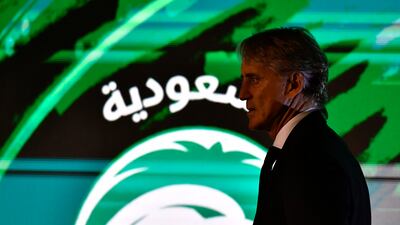
Italian manager Roberto Mancini takes his seat as he was unveiled as Saudi Arabia coach in Riyadh. EPA -
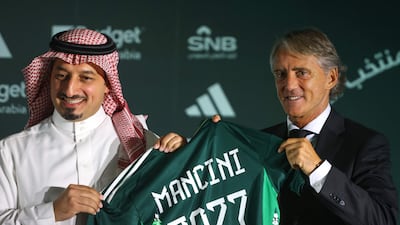
The president of the Saudi Arabian Football Federation, Yasser al-Misehal, left, and newly-appointed Italian coach of the Saudi Arabia national football team, Roberto Mancini. AFP -

Roberto Mancini and Yasser Al Misehal, the Saudi Arabian Football Federation president, arrive for the press conference in Riyadh. AP -

Roberto Mancini and Yasser Al Misehal, the Saudi Arabian Football Federation president, take questions from the press. AP -
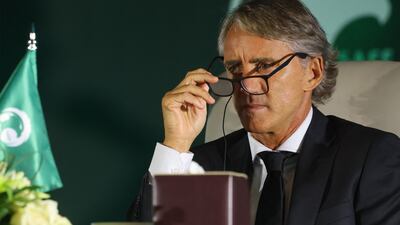
Roberto Mancini with a quizzical expression at Monday's press conference in Riyadh. AFP -
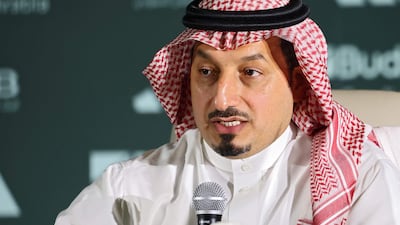
The president of the Saudi Arabian Football Federation, Yasser al-Misehal speaks during the press conference. AFP



