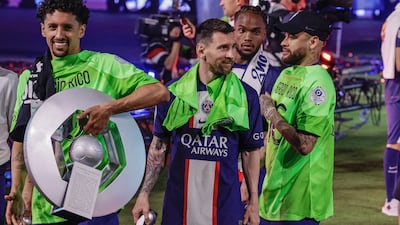
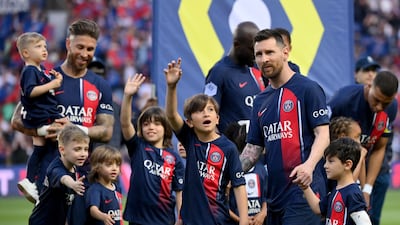
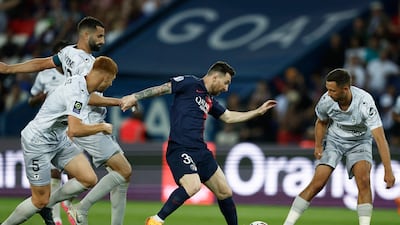
Lionel Messi shocked many when he announced he would be signing with Major League Soccer's Inter Miami when he leaves Paris Saint-Germain at the end of this month.
MLS, the top-tier in professional men’s football in the United States, began in 1996 but has long struggled to find the same success as other leading leagues around the world, such as England’s Premier League or Spain’s La Liga.
While MLS has had its share of big-name signings over the years – David Beckham, Thierry Henry, Zlatan Ibrahimovic, Gareth Bale, Wayne Rooney and Steven Gerrard have all had stints Stateside – Messi is undoubtedly the biggest.
So while all eyes will be tuned into MLS next season when the Argentine superstar makes his debut for Inter Miami, will this be enough to finally grow the league into what it has always hoped to be?
Growing up in the US, I could always see how MLS struggled to draw in fans. I still remember watching Taylor Twellman and the New England Revolution play in a half-full Gillette Stadium with plenty of visible empty seats. It looked a bit depressing compared to when the New England Patriots would play to their sell-out crowds in the NFL.
I should preface all this by saying that I grew up in small town in western Massachusetts where “soccer” is our sport. Unlike other American high schools that focus on American football or baseball, thanks to our large Portuguese community, both the boys’ and girls’ football teams were not only the most successful but also the most popular.
Most children are even taught to play the sport at a young age, regardless of whether they want to continue when they get older.
But even my own football-loving classmates had more of a preference for teams and players abroad rather than the home team just a couple of hours away. I’d see more Luis Figo and Iker Casillas jerseys than I would of anything related to MLS.
While I’m sure there will be initial interest in Messi’s arrival to Inter Miami, I’m not sure if it will be enough to get football fans to suddenly start watching more of the league long-term.
And to suddenly pit hopes that Messi can be the one to single-handedly turn it all around seems unfair. Yes, Messi is an elite player, but he also needs to have some elite competition to really make things interesting and, at the moment, it's questionable whether that exists.
Another issue for MLS is that it competes against other major American sports leagues such as the NFL (American football), MLB (baseball), NBA (basketball) and NHL (hockey). However, unlike those leagues – which can boast of being the best in the world for those sports – MLS still has some catching up to do.
Whereas top athletes in their respective field want to compete in the NFL, MLB, NBA or NHL, aspiring football players in America have plenty of choices when it comes to growing their careers, with most usually looking to Europe or Asia. Even some of the best current players on the US men's national team, such as Christian Pulisic who plays for Chelsea, are abroad.
It also doesn’t help that MLS has developed a reputation for being a place ageing stars go to finish off their careers before retiring. However, at 35, while Messi may not be at the peak of his powers any more, his recent World Cup performances in Qatar should prove there’s still plenty left he can give on the field.
Despite all of this, there is also still some hope for MLS but it won't only be the short-term gain.
Perhaps Messi’s biggest legacy won’t be what he does for Inter Miami, but what his time spent in the league will mean for children in the US who get to grow up watching him play through an even closer lens.
Europe has been lucky for decades to have players the calibre of Cristiano Ronaldo and Messi for young children to aspire to. But even when the US has home-grown talent, they tend to leave for other clubs overseas.
Even if Messi's biggest contribution won't be winning the MLS Cup or setting records, but instead helping grow the game so that future superstars will want to play in the US instead of going abroad, maybe this could be considered the greatest long-term payoff for MLS.

Who's who in Yemen conflict
Houthis: Iran-backed rebels who occupy Sanaa and run unrecognised government
Yemeni government: Exiled government in Aden led by eight-member Presidential Leadership Council
Southern Transitional Council: Faction in Yemeni government that seeks autonomy for the south
Habrish 'rebels': Tribal-backed forces feuding with STC over control of oil in government territory
Fight card
Preliminaries:
Nouredine Samir (UAE) v Sheroz Kholmirzav (UZB); Lucas Porst (SWE) v Ellis Barboza (GBR); Mouhmad Amine Alharar (MAR) v Mohammed Mardi (UAE); Ibrahim Bilal (UAE) v Spyro Besiri (GRE); Aslamjan Ortikov (UZB) v Joshua Ridgwell (GBR)
Main card:
Carlos Prates (BRA) v Dmitry Valent (BLR); Bobirjon Tagiev (UZB) v Valentin Thibaut (FRA); Arthur Meyer (FRA) v Hicham Moujtahid (BEL); Ines Es Salehy (BEL) v Myriame Djedidi (FRA); Craig Coakley (IRE) v Deniz Demirkapu (TUR); Artem Avanesov (ARM) v Badreddine Attif (MAR); Abdulvosid Buranov (RUS) v Akram Hamidi (FRA)
Title card:
Intercontinental Lightweight: Ilyass Habibali (UAE) v Angel Marquez (ESP)
Intercontinental Middleweight: Amine El Moatassime (UAE) v Francesco Iadanza (ITA)
Asian Featherweight: Zakaria El Jamari (UAE) v Phillip Delarmino (PHI)
Terror attacks in Paris, November 13, 2015
- At 9.16pm, three suicide attackers killed one person outside the Atade de France during a foootball match between France and Germany
- At 9.25pm, three attackers opened fire on restaurants and cafes over 20 minutes, killing 39 people
- Shortly after 9.40pm, three other attackers launched a three-hour raid on the Bataclan, in which 1,500 people had gathered to watch a rock concert. In total, 90 people were killed
- Salah Abdeslam, the only survivor of the terrorists, did not directly participate in the attacks, thought to be due to a technical glitch in his suicide vest
- He fled to Belgium and was involved in attacks on Brussels in March 2016. He is serving a life sentence in France
Mercer, the investment consulting arm of US services company Marsh & McLennan, expects its wealth division to at least double its assets under management (AUM) in the Middle East as wealth in the region continues to grow despite economic headwinds, a company official said.
Mercer Wealth, which globally has $160 billion in AUM, plans to boost its AUM in the region to $2-$3bn in the next 2-3 years from the present $1bn, said Yasir AbuShaban, a Dubai-based principal with Mercer Wealth.
“Within the next two to three years, we are looking at reaching $2 to $3 billion as a conservative estimate and we do see an opportunity to do so,” said Mr AbuShaban.
Mercer does not directly make investments, but allocates clients’ money they have discretion to, to professional asset managers. They also provide advice to clients.
“We have buying power. We can negotiate on their (client’s) behalf with asset managers to provide them lower fees than they otherwise would have to get on their own,” he added.
Mercer Wealth’s clients include sovereign wealth funds, family offices, and insurance companies among others.
From its office in Dubai, Mercer also looks after Africa, India and Turkey, where they also see opportunity for growth.
Wealth creation in Middle East and Africa (MEA) grew 8.5 per cent to $8.1 trillion last year from $7.5tn in 2015, higher than last year’s global average of 6 per cent and the second-highest growth in a region after Asia-Pacific which grew 9.9 per cent, according to consultancy Boston Consulting Group (BCG). In the region, where wealth grew just 1.9 per cent in 2015 compared with 2014, a pickup in oil prices has helped in wealth generation.
BCG is forecasting MEA wealth will rise to $12tn by 2021, growing at an annual average of 8 per cent.
Drivers of wealth generation in the region will be split evenly between new wealth creation and growth of performance of existing assets, according to BCG.
Another general trend in the region is clients’ looking for a comprehensive approach to investing, according to Mr AbuShaban.
“Institutional investors or some of the families are seeing a slowdown in the available capital they have to invest and in that sense they are looking at optimizing the way they manage their portfolios and making sure they are not investing haphazardly and different parts of their investment are working together,” said Mr AbuShaban.
Some clients also have a higher appetite for risk, given the low interest-rate environment that does not provide enough yield for some institutional investors. These clients are keen to invest in illiquid assets, such as private equity and infrastructure.
“What we have seen is a desire for higher returns in what has been a low-return environment specifically in various fixed income or bonds,” he said.
“In this environment, we have seen a de facto increase in the risk that clients are taking in things like illiquid investments, private equity investments, infrastructure and private debt, those kind of investments were higher illiquidity results in incrementally higher returns.”
The Abu Dhabi Investment Authority, one of the largest sovereign wealth funds, said in its 2016 report that has gradually increased its exposure in direct private equity and private credit transactions, mainly in Asian markets and especially in China and India. The authority’s private equity department focused on structured equities owing to “their defensive characteristics.”
The Florida Project
Director: Sean Baker
Starring: Bria Vinaite, Brooklynn Prince, Willem Dafoe
Four stars
Dust and sand storms compared
Sand storm
- Particle size: Larger, heavier sand grains
- Visibility: Often dramatic with thick "walls" of sand
- Duration: Short-lived, typically localised
- Travel distance: Limited
- Source: Open desert areas with strong winds
Dust storm
- Particle size: Much finer, lightweight particles
- Visibility: Hazy skies but less intense
- Duration: Can linger for days
- Travel distance: Long-range, up to thousands of kilometres
- Source: Can be carried from distant regions
The more serious side of specialty coffee
While the taste of beans and freshness of roast is paramount to the specialty coffee scene, so is sustainability and workers’ rights.
The bulk of genuine specialty coffee companies aim to improve on these elements in every stage of production via direct relationships with farmers. For instance, Mokha 1450 on Al Wasl Road strives to work predominantly with women-owned and -operated coffee organisations, including female farmers in the Sabree mountains of Yemen.
Because, as the boutique’s owner, Garfield Kerr, points out: “women represent over 90 per cent of the coffee value chain, but are woefully underrepresented in less than 10 per cent of ownership and management throughout the global coffee industry.”
One of the UAE’s largest suppliers of green (meaning not-yet-roasted) beans, Raw Coffee, is a founding member of the Partnership of Gender Equity, which aims to empower female coffee farmers and harvesters.
Also, globally, many companies have found the perfect way to recycle old coffee grounds: they create the perfect fertile soil in which to grow mushrooms.