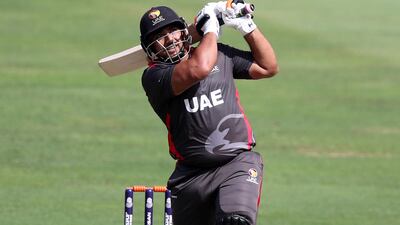
Ashfaq Ahmed during UAE's T20 World Cup Qualifier warm-up against Scotland. Chris Whiteoak / The National

'I have done absolutely nothing wrong' - Ashfaq Ahmed pleads innocence after ICC corruption charges


  • English
  • Arabic

Ashfaq Ahmed has denied any wrongdoing after being charged with five counts of breaching cricket’s anti-corruption rules.

The opening batsman was formally banned from the sport on Sunday, as the corruption crisis in UAE cricket deepened.

Ashfaq and Amir Hayat, the fast bowler, face a variety of charges. They include “seeking, accepting, offering or agreeing to accept any bribe or other reward” to “influence improperly” aspects of international matches.

They also relate to failing to disclose gifts, hospitality “or other non-contractual benefits” with “a value of $750 or more”, as well as failing to report approaches to engage in corrupt conduct.

The duo were suspended indefinitely by the ICC. It takes the number of UAE players currently banned pending the corruption investigation to five.

Ashfaq, though, refutes the charges, claiming he has never accepted bribes or improperly influenced matches.

"I have done absolutely nothing wrong," Ashfaq, 35, told The National.

“The UAE was my second home. I'm forever grateful to the country that gave me so much – an opportunity to play at the highest level, the means to earn a living and, most importantly, respect.

“And that is why I cannot imagine compromising everything I have earned to do something like this.

“I cannot do this to the UAE, which has given me so much, including transforming an ordinary cricketer to an international one.

“Maybe I made a mistake. Maybe I should have reported those people who spoke to me in Ajman to the ICC.

“But for such a small mistake I don't deserve this kind of punishment.”

Ashfaq was thrown out of the UAE team hotel in Abu Dhabi after two matches of the T20 World Cup Qualifier last year.

He was suspended by the Emirates Cricket Board, the domestic ruling body for the sport, and has not played since.

Amir Hayat has also been suspended by the ICC. Chris Whiteoak / The National

His departure from the squad came at a torrid time for the national team, who were attempting to qualify for a competition that had been due to be played in Australia this month.

On the eve of the qualifier, three players were suspended by the ICC, and charged with a variety of corruption offences.

Mohammed Naveed, who had been the side’s captain, Shaiman Anwar, and Qadeer Ahmed are all awaiting judgement. They have not played formal cricket again since.

Ashfaq’s defence is similar to that of Naveed. The former captain acknowledged that he had failed to report an approach by someone claiming to be a representative from a T10 franchise.

Ashfaq also says he met someone at a domestic match in Ajman who told him “they were planning to acquire a franchise in the T10 League and were looking to hire players”.

“I didn’t know what to say, because I didn’t make anything of it and walked away,” Ashfaq said.

“One day I received a message from someone, just saying hi.

“I saved the number on my phone to check the profile of the person.

“The profile photo was of the woman who had come up and spoken to me in Ajman. But that was the end of that.”

One of the charges facing him is of failing to disclose “full details of any approaches or invitations received by [him] to engage in corrupt conduct under the anti-corruption code”.

“I have no inkling of who these people are,” Ashfaq said.

“As an international cricketer, you meet lots of people all the time. Even at a small cricket match, there will be hangers-on. People come up and say hi. But it’s not like you know for sure that that person is corrupt.

“There is no way of knowing. People don’t walk around with ‘I’m corrupt’ written on their foreheads.

“So I really don’t see why I’m being punished. I have done nothing wrong. And I have said all that I know to the ICC.”

Ashfaq and Hayat have 14 days from September 13 to respond to the charges. Hayat could not be contacted for comment.


Mercer, the investment consulting arm of US services company Marsh & McLennan, expects its wealth division to at least double its assets under management (AUM) in the Middle East as wealth in the region continues to grow despite economic headwinds, a company official said.

Mercer Wealth, which globally has $160 billion in AUM, plans to boost its AUM in the region to $2-$3bn in the next 2-3 years from the present $1bn, said Yasir AbuShaban, a Dubai-based principal with Mercer Wealth.

Within the next two to three years, we are looking at reaching $2 to $3 billion as a conservative estimate and we do see an opportunity to do so,” said Mr AbuShaban.

Mercer does not directly make investments, but allocates clients’ money they have discretion to, to professional asset managers. They also provide advice to clients.

“We have buying power. We can negotiate on their (client’s) behalf with asset managers to provide them lower fees than they otherwise would have to get on their own,” he added.

Mercer Wealth’s clients include sovereign wealth funds, family offices, and insurance companies among others.

From its office in Dubai, Mercer also looks after Africa, India and Turkey, where they also see opportunity for growth.

Wealth creation in Middle East and Africa (MEA) grew 8.5 per cent to $8.1 trillion last year from $7.5tn in 2015, higher than last year’s global average of 6 per cent and the second-highest growth in a region after Asia-Pacific which grew 9.9 per cent, according to consultancy Boston Consulting Group (BCG). In the region, where wealth grew just 1.9 per cent in 2015 compared with 2014, a pickup in oil prices has helped in wealth generation.

BCG is forecasting MEA wealth will rise to $12tn by 2021, growing at an annual average of 8 per cent.

Drivers of wealth generation in the region will be split evenly between new wealth creation and growth of performance of existing assets, according to BCG.

Another general trend in the region is clients’ looking for a comprehensive approach to investing, according to Mr AbuShaban.

“Institutional investors or some of the families are seeing a slowdown in the available capital they have to invest and in that sense they are looking at optimizing the way they manage their portfolios and making sure they are not investing haphazardly and different parts of their investment are working together,” said Mr AbuShaban.

Some clients also have a higher appetite for risk, given the low interest-rate environment that does not provide enough yield for some institutional investors. These clients are keen to invest in illiquid assets, such as private equity and infrastructure.

“What we have seen is a desire for higher returns in what has been a low-return environment specifically in various fixed income or bonds,” he said.

“In this environment, we have seen a de facto increase in the risk that clients are taking in things like illiquid investments, private equity investments, infrastructure and private debt, those kind of investments were higher illiquidity results in incrementally higher returns.”

The Abu Dhabi Investment Authority, one of the largest sovereign wealth funds, said in its 2016 report that has gradually increased its exposure in direct private equity and private credit transactions, mainly in Asian markets and especially in China and India. The authority’s private equity department focused on structured equities owing to “their defensive characteristics.”

Our family matters legal consultant

Name: Hassan Mohsen Elhais

Position: legal consultant with Al Rowaad Advocates and Legal Consultants.

Biography

Favourite Meal: Chicken Caesar salad

Hobbies: Travelling, going to the gym

Inspiration: Father, who was a captain in the UAE army

Favourite read: Rich Dad Poor Dad by Robert Kiyosaki and Sharon Lechter

Favourite film: The Founder, about the establishment of McDonald's

Who's who in Yemen conflict

Houthis: Iran-backed rebels who occupy Sanaa and run unrecognised government

Yemeni government: Exiled government in Aden led by eight-member Presidential Leadership Council

Southern Transitional Council: Faction in Yemeni government that seeks autonomy for the south

Habrish 'rebels': Tribal-backed forces feuding with STC over control of oil in government territory

Desert Warrior

Starring: Anthony Mackie, Aiysha Hart, Ben Kingsley

Director: Rupert Wyatt

Rating: 3/5