


As awakenings go, the one UAE women’s cricket had on its first day as an international entity was not so much rude as downright spiteful.
“That was a day which really broke our hearts,” Manvi Dhodhi, who opened the batting for the UAE on that landmark occasion in July 2007, says now.
If every journey starts with a single step, then it is fair to say this was a jittery, baby one. Even physically rather than figuratively, there were not many steps at all, in the final count up. They managed a grand total of just nine runs, none of which were boundaries, and three of which were donated by the other team via a bye and two wides.
The match against Bangladesh in Malaysia comprised just 46 minutes of game time in total, with the chase taking only eight balls. All of which meant the shaken side of rookie players needed some words to the wise by an experienced captain. Cue 12-year-old Natasha Cherriath.
“At that particular moment it was very important for me, not only as a captain but also as a friend, to remind everyone it was fine,” Cherriath says, just over 17 years later.
“It was very difficult. It was embarrassing. It was all the negative words in the dictionary put together. But we also had really good coaches [Smitha Harikrishna and Pramila Bhatt, each of whom had played for India previously].
“For them, it was a bitter pill to swallow because they had come from a high-level background. The way they coached us and spoke to us, they kept telling us this was just a learning curve.
“It was about focusing on what we can do better, because this was literally the first time we were doing anything at this level. Putting things into perspective was really important for us at that moment.”

Given Cherriath’s youth, even terming that pioneering side a “women’s” team is somewhat of a misnomer, given how few adults there were in the team. She was only a young girl herself, as were many of her teammates. They were learning on the job, and learning the hard way. What they did not realise was they were setting the foundations for something significant.
Less than two decades later, hundreds of women and girls are involved in regular cricket in the Emirates, and the country is about to stage the Women’s T20 World Cup. No matter the result of their first game, they were trailblazers. Not that they realised it at the time.
“We just felt like good friends,” Cherriath says. “It was such a new thing for everyone. 2007 was the time when India had won the first [men’s T20] World Cup. I remember calling everyone in my team about it. We felt so motivated.
“Our dreams were far-fetched, to win a T20 World Cup when it didn’t even exist for us yet, but we just felt motivated to be in that same cricketing circle.
“These idols that we had been following had just won the World Cup, and it made us want to keep going, wherever it goes. I don’t think any of us paid a thought to the fact we were the first team representing the UAE.”
Cricket had been an established sport in the Emirates for the best part of 30 years by that point, thanks to the roaring success of the Sharjah Cup from the start of the 1980s.
It was widely played on a recreational basis across the country by males. The Emirates Cricket Board had been attempting to spread the game among females. But women’s sport – let alone cricket – in this country was in its infancy at the time, and getting the word out proved a challenge.
UAE women's first captain
“In 2003 we were struggling to make an XI when we were trying to make a team to play against some visiting girls,” says Mazhar Khan, the long serving administrator for Sharjah Cricket. “I had to apologise and say, ‘Listen, we’ll have to have seven girls and four boys.’ The parents were reluctant to send their girls to play cricket.
“We had a few girls, like Charvi [Bhatt] and Manvi, who had played back home in India [and were both part of the first UAE national team]. They were the senior players we had, and the rest were all born and brought up here in this part of the world.
“It was a challenge in the initial days to encourage them to come to the ground. They were shy about playing with the boys, but gradually we were able to build a team.”
Cherriath was one of those who had been born and raised in Dubai. Her dad and grandad had played cricket for their company sides in India, and when her parents relocated to the UAE, they brought their passion for cricket with them. And her father Michael’s love for the game rubbed off on his daughter.
“I never wanted dolls, and was pretty much a tomboy growing up,” Cherriath says. “I was gifted a yellow plastic cricket bat and my dad and uncle would bowl to me in my bedroom. The floor was four and the ceiling was a six, and that was my first introduction to cricket.”
Despite the prevailing landscape for sport, Michael Cherriath encouraged his daughter to pursue cricket. He enrolled her at Insportz Academy, now known as Young Talents, which has been a productive breeding ground for cricketers down the years.
“I was 10 and Sharjah Cricket Stadium seemed like the biggest stadium in the world at the time because I was so small,” Cherriath says. “I trained with the boys and even went on a tour with them to Delhi. They had to get a lot of special permits for me to play.”
She was the first girl to play for her academy. There have been a number who have followed in her footsteps since, but Shahzad Altaf, the former UAE bowler who runs Young Talents, fondly remembers the pioneer.
“She was totally different to the other girls we have had,” Altaf says. “At that time there were no girls who played, but her father was very interested in sending his daughter to the academy.
“She was performing just like the boys. I told her mother that if she played with the boys she would improve her cricket. She would come regularly for nets and matches. She never felt any different to the boys, and they all helped her.”
Altaf then staged a double-wicket schools tournament for girls to try to find some teammates for Cherriath, and enlisted the help of one of his teenaged academicians to help out. Manish Dhakan was only a few years above Cherriath, and he was happy to help run the new girls’ competition.
“It was very courageous of her,” says Dhakan, who now runs an indoor cricket academy for females at his sports centre, U-Pro Sports, in Al Quoz in Dubai. “She was the lone girl playing among all the guys. It was a groundbreaking thing from her parents’ perspective, as she was the first professionally trained girl in UAE cricket.”
Cherriath says that respect was hard-earned when she played against boys. “Initially there was a lot of scepticism,” she says. “If a boy got out to my bowling it was like the biggest dishonour they could ever face.
“After a point, for me it was just about letting my skills do the talking. I wasn’t too bothered about what people said because I just really loved the game. I didn’t care who I was playing it with, so long as I was playing.
“When I was playing with the boys, I would come in way down the order. When I would show up, everyone would come in to within 15 yards. When you hit the ball past them and they finally move back, it is not the case that I want to bring the boys down. It is more that I am trusting my skills and it is paying off, and they put me on the same level as them.
“Strength-wise and power-wise, it is always going to be different, but there are certain skills that can always be at par. That feeling [getting the respect of the boys for her skills] is 100 percent the best feeling in the world. And once I saw other girls were interested, I was motivated to get better, to play more and to get more girls to come and play.”
Her school team, St Mary’s, won that inaugural tournament. It put in train the beginnings of that first UAE national team, as the ECB scoured for more players to join their movement.
“One fine day, I was working in a bank, and I saw an ad in the paper saying UAE wanted to start a women’s cricket team,” says Dhodhi, who had played previously at school in India, before giving up after relocating to the UAE.
batter in first UAE team
“They were going to hold trials in Sharjah Stadium. I was sitting at my desk thinking, ‘Oh my God, this is an opportunity I shouldn’t miss.’ I wanted to reconnect to the game again. I never imagined I would step up into cricket in the way I have now. It was all coincidental. I never planned a life in cricket.”
Dhodhi says cricket was “in the bloodline” as her dad had played at home in India, and she has since made a career from it, too. After that advert in the newspaper brought her back to playing, she soon landed a day job in cricket administration, which she continues to this day.
Despite her excitement at being back playing, she acknowledges that first team had felt a degree of trepidation ahead of that first tournament, which was an Asian Cricket Council event in Malaysia in 2007.
“There was nervousness because we were representing UAE as a country for the first time,” Dhodhi says. “Most of us – not me – were school-going kids. Because there was a level of prestige to the tournament, we put pressure on ourselves, but there was no expectation from the parents. We knew we were on our first tour, and it was about learning more than anything else.”
Then there was that opening day, which she says broke her heart.
“It wasn’t a record we were proud of,” Dhodhi says of being bowled out for nine by Bangladesh. “But it was our first match. The opposition was a Bangladesh team that had played many matches against good-level sides. There was a massive difference in the standard, but we were lucky to have a good support system of experienced people.”
The pair of former India internationals who were coaching them, in particular, were crucial to developing a side to endure. Clearly, they had a clear view of the future, given they handed the captaincy to a 12-year-old schoolgirl who was still learning the fielding positions, let alone tactics.
“I just sat on my bed,” Cherriath says of the moment she was told by Harikrishna she had been picked to captain the side. “I think she thought I had disconnected the call. I didn’t speak for a bit.
“I was 12. We did a Good Morning Dubai live TV show and I was a wreck. I couldn’t speak as well as I do now. I was super nervous and didn’t know what I was doing. But I had my parents there, and Smitha, who said, ‘I’m going to be here the whole time, I’m going to be showing you the ropes.’

“At that time, I was still learning the names of different fielding positions. I used to watch a lot of cricket, but to be on the field and make quick decisions to change fielders, it was still a learning curve. When they gave me the cap, I thought, ‘OK, this is happening, I’ve got to do this.’”
Now aged 30, Cherriath has not played for the national team since the Asia Cup in Bangladesh two years ago. Based in Abu Dhabi, she is focused instead on her day job, and that too is often centred on cricket.
For example, in her role as a sports operations and events manager, she recently helped organise a cricket tournament for over 700 construction workers at Neom in Saudi Arabia.
Even in absentia, she keeps a keen check on how her former colleagues have been doing. And she is not the only one who is thrilled with how the women’s game has blossomed in the country.
“The girls have done us proud,” Mazhar Khan says. “We were always the punchbags of Thailand. We used to always lose to them, but it is good to see them beating sides like them, Namibia and Zimbabwe now. Hats off to them for their sheer hard work and commitment. Now they are playing regularly and being supported by the ECB, it is bearing fruit.”
That refers to the recent series win in Windhoek by the national team, where they lost just one game in a tri-nations event that also included Namibia and Zimbabwe.
They have beaten Thailand each of the past two times they have played them, too, meaning they could rightfully now be considered the best side in Asia, beyond the four Test nations – India, Sri Lanka, Bangladesh and Pakistan.
-

UAE captain Esha Oza made 38 off 36 deliveries in her side's 78-run defeat to India in the Women's Asia Cup match at the Rangiri Dambulla International Cricket Stadium, Sri Lanka, on July 21, 2024. All photos: ACC / CREIMAS -
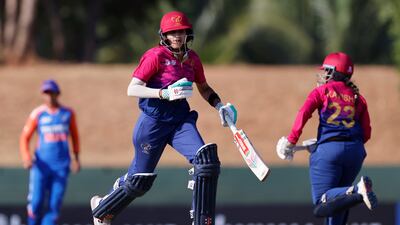
UAE skipper Esha Oza in action against India. -

Kavisha Kumari made 40 not out off 32 balls. -
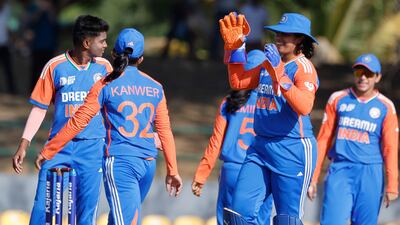
Pooja Vastrakar of India celebrates the wicket of Rinitha Rajith of the UAE. -
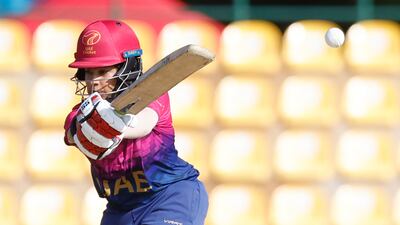
Samaira Dharnidharka of the UAE plays a shot. -
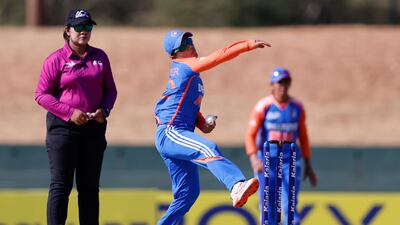
Tanuja Kanwar of India bowls. -

UAE's Theertha Satish on the UAE drive. -
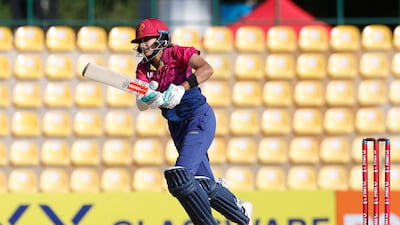
Esha Oza of the UAE. -

Rinitha Rajith of the UAE was out for 7. -
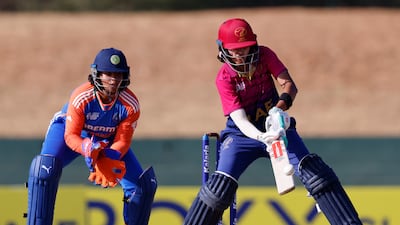
The UAE's Esha Oza plays a ramp shot. -
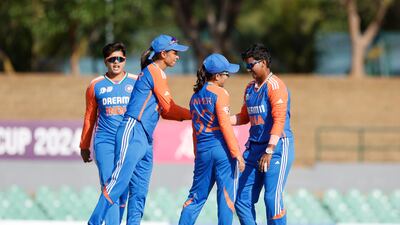
Deepti Sharma of India celebrates the wicket of Samaira Dharnidharka of the UAE. -

Renuka Singh Thakur of India. -

Deepti Sharma of India celebrates the wicket of Samaira Dharnidharka of the UAE. -

Theertha Satish of the UAE.


It is true they will be the ghosts at the feast when the T20 World Cup starts on Thursday in Sharjah. The hosts are not one of the 10 teams involved in the tournament, but the fact they got as close as they did to qualifying is a mark of the substantial strides they have made.
At the qualifying tournament in Abu Dhabi earlier this year, they reached the semi-finals and gave Sri Lanka a scare in the decisive match. They fell 15 runs short of beating a side that would go on to become the Asia Cup champions shortly after.
Esha Oza, their captain, acknowledges that seeing the World Cup played on home soil is going to be bittersweet, but hopes it can have a lasting effect on the game here.
“It is definitely important for the development of women’s cricket in the UAE,” Oza said. “Fifteen runs and we might have been playing in a home World Cup. That is going to haunt us. It is not going to go away any time soon, but we are still excited that the World Cup is coming here.
“It means there will be so many more girls watching the game live. It is going to be inspiring for many, and I hope women’s cricket continues to rise in UAE.”
It might feel as though UAE women’s cricket has been bookended by heartbreak, with that chastening beginning against Bangladesh, then by having their hopes dashed by Sri Lanka 17 years later. But, as one of the originals says, just consider how far they have come in the meantime.
“The coaches took us back to the hotel after that game against Bangladesh, calmed us down, and said, ‘This is just the start. You will get better from here on,’” Dhodhi says.
“Those are the words I wish I could share with the girls right now. They are on the brink of qualifying for World Cups. They are doing tremendously well.
“To have players like Esha, Kavisha [Kumari], Theertha [Satish], our coaches would be so proud. They would be so proud of the improvement UAE women’s cricket has made.”

