


The DP World International League T20 is a mere 40 overs old, but it has already delivered its first feel-good story for UAE cricket.
Akif Rafa might have been forgiven for feeling a little starry-eyed while sharing a viewing area with teammates like Joe Root, Rovman Powell and Robin Uthappa during Friday’s lavish opening ceremony.
After all, this was by far the most high-profile cricket he has tasted in the six years since he left his native Lahore to take up a job as a storekeeper in Abu Dhabi.
As recently as last month, the 30-year-old Pakistani had been a net bowler for England when they were training in Dubai.
He has had a modest international career of his own so far, including five ODIs, three T20Is, plus around 18 months’ worth of carrying the drinks for his UAE national teammates.
So, when he was tossed the ball as his Dubai Capitals side went about defending 188 against Abu Dhabi Knights Riders, with thousands in the stands and potentially millions watching on TV, the nerves were tangible.
“This is a big league for us,” Raja said after his side had completed a comfortable debut win at Dubai International Stadium.

“We are Associate players, and not famous in the world. But I felt famous when I delivered the first ball.
“I was very excited. My first match, and I got my debut wicket. I just tried to bowl at the stumps and focus on the right length.”
With just his second delivery, he induced an edge from Brandon King, the Jamaican batter, which was easily taken at the wicket by Uthappa, the Indian Premier League veteran.
Raja was clearly ready for this, seeing as he already had a choreographed celebration routine. He stood with one arm in the air, and the other covering his mouth.
“I was playing in the D10 [a UAE domestic 10-over competition], and I had a little fight with a guy,” Raja explained.
“He is my good friend now, but after it, the umpires called me and said I should not do that – even though it was not my fault.
“After that, I called my mum. She said, ‘Please, Akif, don’t do that. Just keep your mouth quiet and focus on your cricket. Give your answers with your bat and ball'.
“That is why I did that celebration. It means: silence is not empty, it is full of answers.”
-

Abu Dhabi Knight Riders' Ali Khan takes the wicket of Dubai Capitals' Joe Root during the first game of the International League T20 at the Dubai International Stadium on Friday, January 13, 2023. All photos by Chris Whiteoak / The National -

Capitals' Joe Root bats during the ILT20 match against Abu Dhabi Knight Riders. -

Dubai Capitals' Robin Uthappa hits a boundary. -

Capitals' Joe Root bats with Robin Uthappa in Dubai. -

Abu Dhabi Knight Riders captain Sunil Narine sets his field. -

Capitals' Robin Uthappa scored a brisk 43. -

Abu Dhabi Knight Riders' Zawar Farid almost runs out Dubai Capitals' Rovman Powell. -

Ravi Rampaul celebrates taking the wicket of Dubai Capitals' Rovman Powell. -

Capitals' Sikandar Raza hits a boundary. -

Knight Riders' Andre Russell after taking the wicket of Capitals' Bhanuka Rajapaksa at the Dubai International Stadium. -

Knight Riders' Sunil Narine took the wicket Capitals' Robin Uthappa.


Raja has always followed the counsel of his mother, Nasreen Akhtar. After all, it is the main reason he is a cricketer.
His father, Raja Arif Ullah Khan, had been against the idea of his son pursuing such a precarious career.
“Before, he did not like cricket,” Raja said. “He said, ‘We don’t have a lot of money, cricket is not for you’. I just said, ‘Dad, please, give me a chance, I want to play cricket’.
“He told me not to play, but my mum always supported me. She just said, ‘No worries, you keep going. Keep playing cricket and don’t focus on what your dad says. Let him say what he says’.”
After playing one match of first-class cricket in Pakistan’s Qaid-e-Azam Trophy, Raja decided on a new, more financially secure life in the UAE six years ago.
He took a job with New Medical Centre in the UAE capital. He moved to Sharjah after being handed a new job with MGM on the strength of his cricket.
Soon after, he was attracting the attention of the national team. He made a match-defining impact on his UAE debut against Ireland in a T20I in 2022, but his chances have been limited since.
“I was injured, and I missed the T20 World Cup [in Australia in October],” he said.
“It was my dream to play in the World Cup, but it is a part of life. Alhamdulillah I am very happy to be part of ILT20 with Dubai Capitals. They arranged trials in Dubai, I bowled very well, and they picked me.”
Maybe a few tips from the famous friends he made while training with James Anderson, Jofra Archer, and the England Lions during their training camp at The Sevens, Dubai at the end of last year helped.
“Jofra Archer guided me a lot,” Raja said. “He told me I was good enough. He just suggested I focus on my line, try to bowl wicket to wicket, and hit the stumps.”
Sadly, Raja’s emergence in ILT20 has come too late to impress his father. Raja Arif died from Covid while his son was in Dubai playing cricket.
“I was playing in D10 when I found out the news my father had died,” he said. “I could not go to Pakistan after his death. I am very sad about it.”
After his uplifting performance on Friday night, Raja’s thoughts immediately returned to home.
“Before the start of the match I spoke with my mum,” he said.
“She gave me a lot of confidence. She is very happy that I am part of the ILT20. To be honest, when I am not playing in the starting XI, she is always very upset.
“Sometimes she is crying a lot. She doesn’t know a lot about cricket, she just wants to see me in front of the cameras.
“After tonight, I know she will be crying. When I call her on the video call, there will be tears. It was her dream for me to play for Pakistan.
“I didn’t get the chance there, but Alhamdulillah, I have got my chance in the UAE. She was very excited I was in the Abu Dhabi T10, and now she is excited I am in the ILT20.”
-

Actor Shah Rukh Khan during the opening ceremony of the DP World International League T20 at the Dubai International Stadium on Friday, January 13, 2023. Chris Whiteoak / The National -

Actor Shah Rukh Khan at the opening ceremony of the International League T20. Chris Whiteoak / The National -
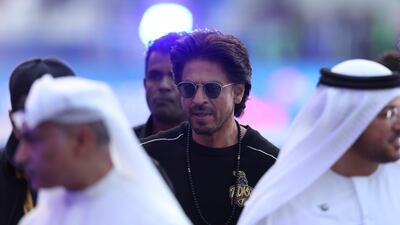
Shah Rukh Khan attends the opening ceremony of the ILT20 2023 in Dubai. Getty -
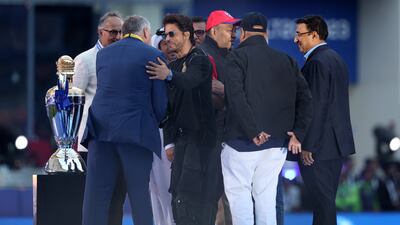
Shah Rukh Khan at the Dubai International Stadium on Friday. Getty -
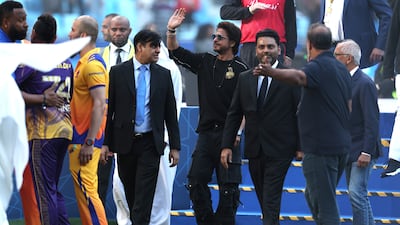
Shah Rukh Khan waves to the crowd in Dubai. Getty -

Team captains at the opening ceremony of the International League T20. Chris Whiteoak / The National -

Jason Derulo performs at the opening ceremony of the ILT20 in Dubai. Chris Whiteoak / The National -

West Indies cricketer Dwayne Bravo performs at the opening ceremony. Chris Whiteoak / The National -

Jason Derulo performs at the opening ceremony of the International League T20. -

Jason Derulo performs at the opening ceremony. Chris Whiteoak / The National -

Emirati dancers perform in Dubai on Friday. Chris Whiteoak / The National -

Badshah performs at the Dubai International Stadium. Chris Whiteoak / The National -

Dwayne Bravo performs at the opening ceremony. Chris Whiteoak / The National -

Fireworks go off at the opening ceremony of the ILT20. Chris Whiteoak / The National



