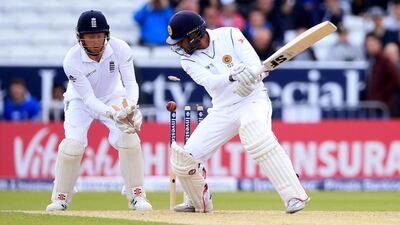
• England’s James Anderson celebrates dismissing Sri Lanka’s Dimuth Karunaratne. Action Images via Reuters / Lee Smith
    England’s James Anderson celebrates dismissing Sri Lanka’s Dimuth Karunaratne. Action Images via Reuters / Lee Smith
  • England’s Moeen Ali bowls Sri Lanka’s Dinesh Chandimal, right, during Day 3 of the first Test cricket match at Headingley, Leeds, England, Saturday, May 21, 2016. (Nigel French/PA via AP)
    England’s Moeen Ali bowls Sri Lanka’s Dinesh Chandimal, right, during Day 3 of the first Test cricket match at Headingley, Leeds, England, Saturday, May 21, 2016. (Nigel French/PA via AP)
  • Lahiru Thirimanne of Sri Lanka is caught out by Joe Root of England from the bowling of Steven Finn during Day 3 of the first Test match at Headingley on May 20, 2016 in Leeds, England. (Gareth Copley/Getty Images)
    Lahiru Thirimanne of Sri Lanka is caught out by Joe Root of England from the bowling of Steven Finn during Day 3 of the first Test match at Headingley on May 20, 2016 in Leeds, England. (Gareth Copley/Getty Images)
  • England’s James Anderson takes wicket of Nuwan Pradeep to take 10 for match. Action Images via Reuters / Lee Smith
    England’s James Anderson takes wicket of Nuwan Pradeep to take 10 for match. Action Images via Reuters / Lee Smith
  • England bowler James Anderson celebrates after taking his 10th wicket and the final wicket of the match by bowling Sri Lanka batsman Nuwan Pradeep during Day 3 of the first Test match between England and Sri Lanka at Headingley on May 21, 2016 in Leeds, United Kingdom. (Stu Forster/Getty Images)
    England bowler James Anderson celebrates after taking his 10th wicket and the final wicket of the match by bowling Sri Lanka batsman Nuwan Pradeep during Day 3 of the first Test match between England and Sri Lanka at Headingley on May 21, 2016 in Leeds, United Kingdom. (Stu Forster/Getty Images)
  • England’s James Anderson (R) celebrates after bowling Sri Lanka’s Nuwan Pradeep (not pictured) to wrap up the Sri Lankan second Innings on the third day of the first cricket Test match between England and Sri Lanka at Headingley in Leeds, northern England on May 21, 2016. England beat Sri Lanka by an innings and 88 runs with Anderson taking 10 wickets in the match. Lindsey Parnaby / AFP
    England’s James Anderson (R) celebrates after bowling Sri Lanka’s Nuwan Pradeep (not pictured) to wrap up the Sri Lankan second Innings on the third day of the first cricket Test match between England and Sri Lanka at Headingley in Leeds, northern England on May 21, 2016. England beat Sri Lanka by an innings and 88 runs with Anderson taking 10 wickets in the match. Lindsey Parnaby / AFP
  • Sri Lanka captain Angelo Mathews after losing the first Test match at Headingley on May 20, 2016 in Leeds, England. (Gareth Copley/Getty Images)
    Sri Lanka captain Angelo Mathews after losing the first Test match at Headingley on May 20, 2016 in Leeds, England. (Gareth Copley/Getty Images)
  • James Anderson of England salutes the crowd as he leaves the field after taking a 10 wicket haul to win the first Test match at Headingley on May 20, 2016 in Leeds, England. (Gareth Copley/Getty Images)
    James Anderson of England salutes the crowd as he leaves the field after taking a 10 wicket haul to win the first Test match at Headingley on May 20, 2016 in Leeds, England. (Gareth Copley/Getty Images)

Behind top-shelf bowling, England cricket decimate Sri Lanka in first Test – in pictures


  • English
  • Arabic

Images from England’s innings and 88-runs first Test victory over Sri Lanka on Saturday, with James Anderson paving the way with a second-innings five for 29 haul.

Cryopreservation: A timeline
  1. Keyhole surgery under general anaesthetic
  2. Ovarian tissue surgically removed
  3. Tissue processed in a high-tech facility
  4. Tissue re-implanted at a time of the patient’s choosing
  5. Full hormone production regained within 4-6 months
RESULTS

Lightweight (female)
Sara El Bakkali bt Anisha Kadka
Bantamweight
Mohammed Adil Al Debi bt Moaz Abdelgawad
Welterweight
Amir Boureslan bt Mahmoud Zanouny
Featherweight
Mohammed Al Katheeri bt Abrorbek Madaminbekov
Super featherweight
Ibrahem Bilal bt Emad Arafa
Middleweight
Ahmed Abdolaziz bt Imad Essassi
Bantamweight (female)
Ilham Bourakkadi bt Milena Martinou
Welterweight
Mohamed Mardi bt Noureddine El Agouti
Middleweight
Nabil Ouach bt Ymad Atrous
Welterweight
Nouredine Samir bt Marlon Ribeiro
Super welterweight
Brad Stanton bt Mohamed El Boukhari

MATCH INFO

Uefa Champions League semi-final, second leg result:

Ajax 2-3 Tottenham

Tottenham advance on away goals rule after tie ends 3-3 on aggregate

Final: June 1, Madrid

Tips to avoid getting scammed

1) Beware of cheques presented late on Thursday

2) Visit an RTA centre to change registration only after receiving payment

3) Be aware of people asking to test drive the car alone

4) Try not to close the sale at night

5) Don't be rushed into a sale 

6) Call 901 if you see any suspicious behaviour

Teaching your child to save

Pre-school (three - five years)

You can’t yet talk about investing or borrowing, but introduce a “classic” money bank and start putting gifts and allowances away. When the child wants a specific toy, have them save for it and help them track their progress.

Early childhood (six - eight years)

Replace the money bank with three jars labelled ‘saving’, ‘spending’ and ‘sharing’. Have the child divide their allowance into the three jars each week and explain their choices in splitting their pocket money. A guide could be 25 per cent saving, 50 per cent spending, 25 per cent for charity and gift-giving.

Middle childhood (nine - 11 years)

Open a bank savings account and help your child establish a budget and set a savings goal. Introduce the notion of ‘paying yourself first’ by putting away savings as soon as your allowance is paid.

Young teens (12 - 14 years)

Change your child’s allowance from weekly to monthly and help them pinpoint long-range goals such as a trip, so they can start longer-term saving and find new ways to increase their saving.

Teenage (15 - 18 years)

Discuss mutual expectations about university costs and identify what they can help fund and set goals. Don’t pay for everything, so they can experience the pride of contributing.

Young adulthood (19 - 22 years)

Discuss post-graduation plans and future life goals, quantify expenses such as first apartment, work wardrobe, holidays and help them continue to save towards these goals.

* JP Morgan Private Bank 

Ten tax points to be aware of in 2026

1. Domestic VAT refund amendments: request your refund within five years

If a business does not apply for the refund on time, they lose their credit.

2. E-invoicing in the UAE

Businesses should continue preparing for the implementation of e-invoicing in the UAE, with 2026 a preparation and transition period ahead of phased mandatory adoption. 

3. More tax audits

Tax authorities are increasingly using data already available across multiple filings to identify audit risks. 

4. More beneficial VAT and excise tax penalty regime

Tax disputes are expected to become more frequent and more structured, with clearer administrative objection and appeal processes. The UAE has adopted a new penalty regime for VAT and excise disputes, which now mirrors the penalty regime for corporate tax.

5. Greater emphasis on statutory audit

There is a greater need for the accuracy of financial statements. The International Financial Reporting Standards standards need to be strictly adhered to and, as a result, the quality of the audits will need to increase.

6. Further transfer pricing enforcement

Transfer pricing enforcement, which refers to the practice of establishing prices for internal transactions between related entities, is expected to broaden in scope. The UAE will shortly open the possibility to negotiate advance pricing agreements, or essentially rulings for transfer pricing purposes. 

7. Limited time periods for audits

Recent amendments also introduce a default five-year limitation period for tax audits and assessments, subject to specific statutory exceptions. While the standard audit and assessment period is five years, this may be extended to up to 15 years in cases involving fraud or tax evasion. 

8. Pillar 2 implementation 

Many multinational groups will begin to feel the practical effect of the Domestic Minimum Top-Up Tax (DMTT), the UAE's implementation of the OECD’s global minimum tax under Pillar 2. While the rules apply for financial years starting on or after January 1, 2025, it is 2026 that marks the transition to an operational phase.

9. Reduced compliance obligations for imported goods and services

Businesses that apply the reverse-charge mechanism for VAT purposes in the UAE may benefit from reduced compliance obligations. 

10. Substance and CbC reporting focus

Tax authorities are expected to continue strengthening the enforcement of economic substance and Country-by-Country (CbC) reporting frameworks. In the UAE, these regimes are increasingly being used as risk-assessment tools, providing tax authorities with a comprehensive view of multinational groups’ global footprints and enabling them to assess whether profits are aligned with real economic activity. 

Contributed by Thomas Vanhee and Hend Rashwan, Aurifer