Andrew Thompson remembers clearly how it all began.
Soon after the 2017 America’s Cup, Sir Russell Coutts, the New Zealand-born sailing legend, and the Oracle technology billionaire Larry Ellison were contemplating how to make the sport more appealing to fans and commercially viable.
They had a broad outline in mind, one that married Coutts’ sailing expertise with Ellison’s brilliant mind, but they couldn’t quite nail down the format.

Coutts turned to Thompson, a former Deloitte accountant with a lifelong passion for sport, who worked on the 2012 London Olympics, widely regarded as one of the most successful ever. At the time, Thompson was chief financial officer of the America’s Cup.
“Andy,” said Coutts. “Me and Larry have got a new idea. Can you put together a two-pager that we can send to Larry next week?”
Thompson, now managing director of SailGP, went to work producing a blueprint which still exists today, based on two core principles: identikit boats because, as Thompson explains, “even the tiniest technological advantage would mean a race is pretty much over before it's begun”, and tight cost controls, beginning with a budget cap of $10 million per season per team.
“We really wanted to put a framework together that meant that all participants had equal terms,” explains Thompson. “That was fundamental to the framework and remains so going forward.
“We designed our central services around us providing the logistics, the maintenance, the engineering to really control costs in that area. Each team has a vote around major changes to that framework. It also allows us to make decisions and drive the potential business forward.”
Thus SailGP was born – a centrally owned, franchise-based sports league that generates revenue through team sales, host-city fees, global sponsorships and media rights.
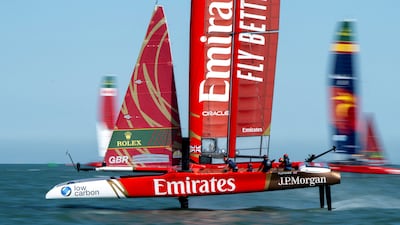
In five seasons of state-of-the-art, technology-driven, fan-friendly, "wild" onshore racing, SailGP has established itself as one of the fastest-growing spectacles in the world, one that has rewritten the emerging sports playbook, and, with it, gained the epithet of Formula One on water.
Races are held in 13 suitably glamorous locations across five continents, with up to 25 million viewers tuning into the live highlights of any given SailGP event.
In little more than seven years, SailGP has gone from “begging venues”, in Thompson’s words, to holding races, to having destinations clamouring to come on board, and willing to pay substantial host fees for the privilege.
“We've seen a huge spike in demand for host venues, and we currently don't have enough spots to fit them in. As a result, obviously the values of those have increased over time,” he says.
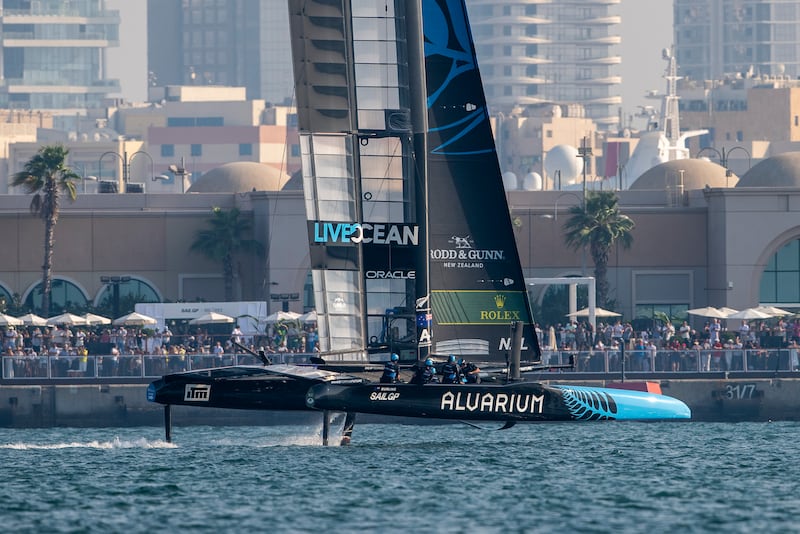
Hosting a race weekend where your city "amphitheatre" provides a stunning backdrop, one that is extremely valuable from a tourism perspective, generates an estimated $20m boost to the local economy. Venues are being locked in for up to five years and ideally longer.
Hong Kong and Rome have recently been announced as venues for 2027. The global footprint has helped to attract premium sponsorship partners like Rolex and Emirates.
“The plan has always been to go to different geographies around the world. The Middle East opened up to us, and we've got some great partners in Dubai and Abu Dhabi.
“We've touched a lot of European countries now. We've now gone to South America, where Brazil was a hugely growing market in terms of viewership. The awareness in the US is growing all the time, as is Australasia.
“I'd say in the next five years, we're looking at more expansion in Asia. I could foresee an event in China. Chinese sailing is booming right now. Japan is very interesting to us, as is Korea. We are very much looking at how we can again broaden the audience. Mexico and India are also very interesting for us.” The eventual target is between 18-20 venues.
The number of boats has risen from four to 13, all but one privately owned, with teams now trading at more than $75 million. A 14th will enter next season.
The most expensive purchase to date was made by Doug Devos, the chairman of Amway, the US-based global direct selling giant, who bought the Danish boat earlier this year for $60m.
For that, the owners get the franchise in perpetuity, which also allows them to negotiate their own sponsorship deals to commercialise the boat; some teams are already breaking even. With the cost base capped, there is potential for considerable upside.
“We're looking for stakeholders that share the same view of the sport as us in that they want it to really be viewed by a new audience,” Thompson says.
“They want to make sailing into a real business, to bring foiling sailing to a new audience and really show that it is a cool sport.”
Team valuations themselves are only going to rise exponentially as SailGP is capping the number of teams at 20, with only one per country.
Boats 15 and 16 will join the tour in 2028. Thereafter, the league will look at how best to expand and over what timescale.
“The demand has been there for us to do that, and we have definitely surpassed our expectations relating to the number of teams.
“There's a wider trend in the sports industry around team ownership being a good investment. We've certainly seen valuations of sports teams in the NFL, Premier League, Formula One going bonkers.
“We've certainly experienced that, and it is a position, hand on heart, I didn't expect us to get to so quickly. If I were to look back now at what we've achieved in these years, it has certainly surpassed all of those metrics that we put together back then,” Thompson explains.
SailGP’s annual revenue now tops $200m. The league is not yet profitable, as the focus has been on growth and reinvestment in the product.
That said, break-even is scheduled for 2028 at the latest, and the most recent estimates suggest SailGP, as a property, is worth more than $1 billion. That will no doubt please Ellison, who has underwritten the league’s nascent years.
The drive in the first five seasons has been to create an on-water product that resonates with people based close to shore with “wild” racing visible from land.
It has all been about bringing the sport to the fans. The approach is paying off. Regattas can attract up to 25,000 spectators over the two days of a race, and a new legion of fans, not necessarily from a sailing background, is being won over.
The league is proving a hit with broadcasters too. The total audience in 2025 was 215 million and growing. Engagement on social media has doubled, as has the fan base, 36 per cent of whom are in the sweet-spot age range of 18–34.
There will also be a drive to bring in younger athletes with whom fans can more readily identify, creating greater connections with the sport.
“Look at football, look at NFL”, Thompson says. “You know their heroes are people in their twenties and early thirties and think that's where we need to go in the sport.”
So, what is the long-term ambition and vision?
“Our ambition is to be one of the world's top global sports championships,” Thompson says.
“We’re talking it slowly year by year. On the business side in five years, we could be among the top 20 global sports championships.
“I don't say in five years we're going to be sat beside Formula One and NFL. But we do think that we can start becoming a challenger to some of those properties and sit alongside MotoGP and other sports properties of that size. I don't see why we wouldn't be able to do that. They said SailGP was a pipe dream when we started, and look where we are now.”

