

When the lights went on at Qatar 2022, it was supposed to represent more than the start of another World Cup.
For Fifa, it was the culmination of a strategy to make football's biggest tournament more representative of the world it serves, moving beyond its traditional heartlands in Europe and the Americas and bringing the game's showpiece event to new regions and audiences.
Qatar became the first Middle Eastern nation to host a World Cup, a landmark moment in Fifa's drive towards greater global inclusion. Yet while the tournament succeeded in broadening football's horizons off the pitch, the hosts struggled to make a similar impact on it.

The pressure of expectation proved overwhelming. Qatar lost all three group matches, scoring once and conceding seven times. While South Africa became the first host nation to exit in the group stage in 2010, Qatar's return of three defeats from three games remains the worst performance by a host country in World Cup history.
Though that tournament ultimately proved a success, culminating in Lionel Messi guiding Argentina to a third World Cup triumph, it was a humbling experience for Qatar, one they are eager to put right.
As hosts, Qatar had qualified automatically for the 2022 finals. This time around they did it via qualification, although it was far from easy.
Qatar entered the Asian qualifiers in the second round, topping Group A with 16 points but could only finish fourth in the third round that included home-and-away defeats to the UAE.
That meant a fourth round would have to be successfully navigated. In a move that still baffles, Qatar was chosen as a host venue for a three-team mini-league with Oman and UAE. Qatar beat both – the latter in controversial circumstances – to punch their ticket to North America.
Qatar beat UAE to book World Cup spot - in pictures
-
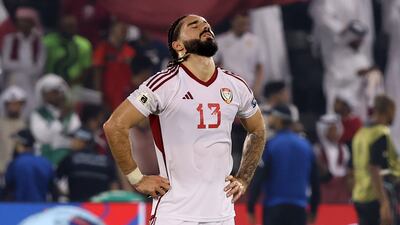
UAE's World Cup hopes suffered a big blow as they were beaten 2-0 by Qatar at the Jassim Bin Hamad Stadium in Doha on October 14, 2025. Chris Whiteoak / The National -

Dejected UAE defender Kouame Autonne after the match. Chris Whiteoak / The National -
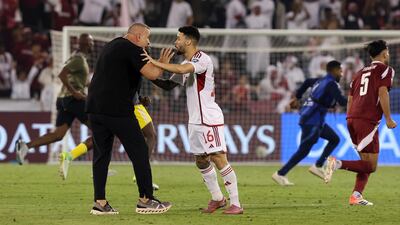
UAE coach Cosmin Olaroiu and Marcus Meloni after the match. Chris Whiteoak / The National -

Tarek Salman of Qatar is sent off late in the game. Chris Whiteoak / The National -
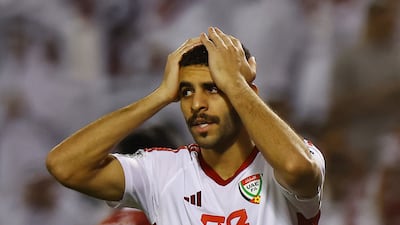
UAE's Sultan Adil after a missed opportunity. AFP -
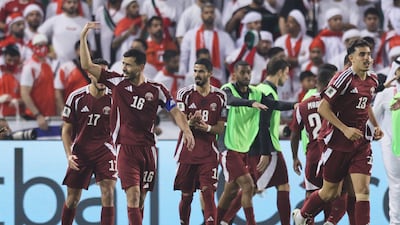
Qatar's Boualem Khoukhi, left, celebrates after scoring their first goal. AP -
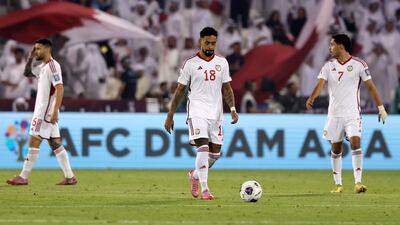
Dejected UAE players after the first Qatar goal. Chris Whiteoak / The National -
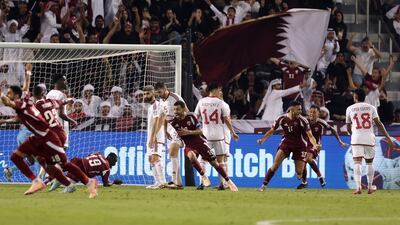
Boualem Khoukhi celebrates after scoring for Qatar. Chris Whiteoak / The National -
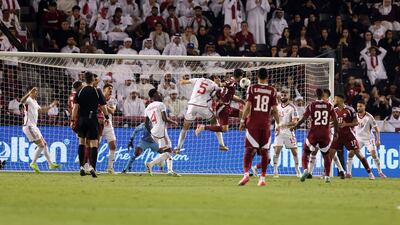
Boualem Khoukhi heads home to put Qatar 1-0 up. Chris Whiteoak / The National -
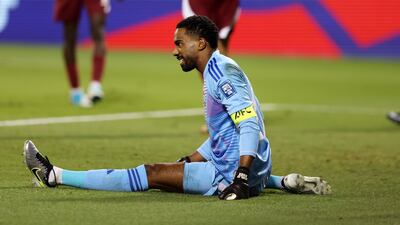
UAE goalkeeper Khalid Essa during the first half. Chris Whiteoak / The National -
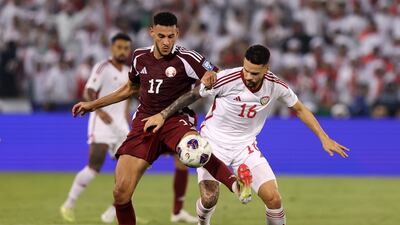
UAE's Marcus Meloni and Mohammad Naceur Al Mannai of Qatar battle for the ball. Chris Whiteoak / The National -
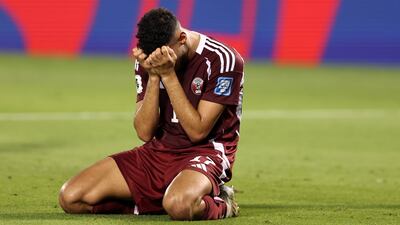
Qatar4's Mohammad Naceur Al Mannai after a chance goes begging. Chris Whiteoak / The National -
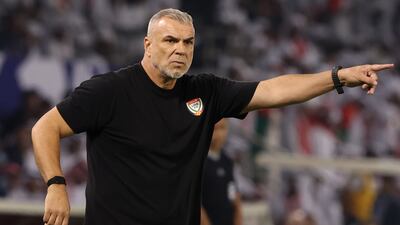
UAE manager Cosmin Olaroiu during the game against Qatar. Chris Whiteoak / The National -

Qatar's Mohammad Al Mannai is shown a yellow card by referee Ilgiz Tantashev. Reuters -
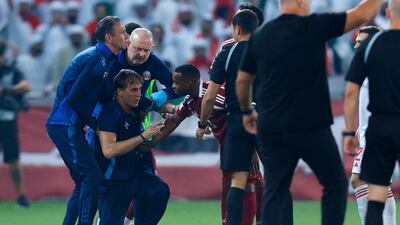
Qatar manager Julian Lopetegui is helped to his feet after being hit in the head by the ball. AFP -

The UAE team starting XI before the against Qatar. Chris Whiteoak / The National -
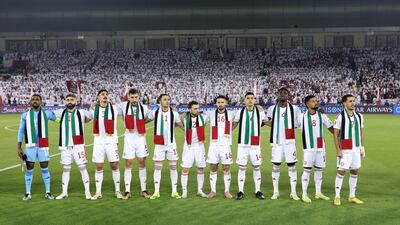
UAE players line up during the national anthems before the match. Chris Whiteoak / The National -
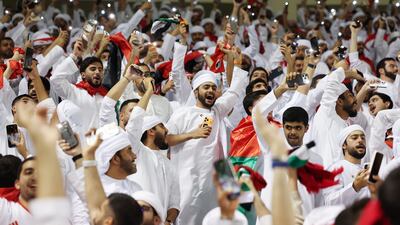
UAE fans before the game against Qatar. Chris Whiteoak / The National -
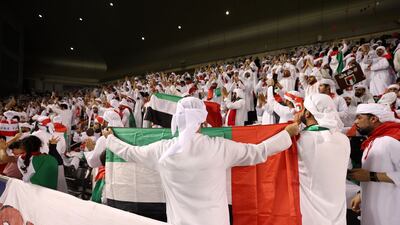
UAE fans before the game against Qatar. Chris Whiteoak / The National -

UAE fans outside the National Jassim Bin Hamed Stadium in Doha. Chris Whiteoak / The National -
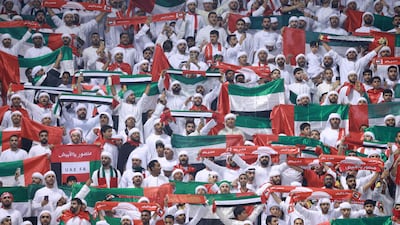
UAE supporters at Jassim Bin Hamad Stadium in Doha. AFP -
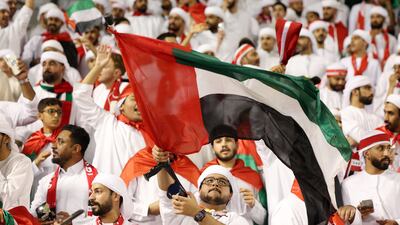
UAE fans in the National Jassim Bin Hamed Stadium in Doha. Chris Whiteoak / The National -
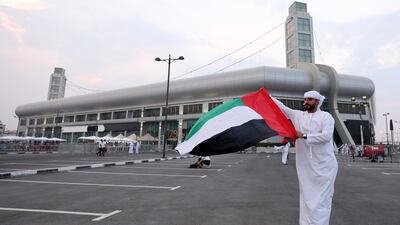
UAE fan outside the National Jassim Bin Hamed Stadium in Doha. Chris Whiteoak / The National


Qatar take on Switzerland in their World Cup opener on Saturday eager to shake off the pressure of expectation, coming in as back-to-back Asian champions but with an urgent need to erase the pain of 2022 and earn credibility on the global stage.
They might have hoped for a more gentle introduction, with the resurgent Swiss unbeaten in competitive matches since late 2024 following an impressive run at the most recent European Championship, and keen to make a mark in their sixth successive World Cup.
"We have to accept the fact that we will play against Switzerland first, and we have to be ready to do our best against a very strong team," Qatar's Spanish coach Julen Lopetegui said.
"We know our real reality, and that the competitors are better than us, but this does not mean surrendering ... it requires us to be ready in order to achieve our ambition and dream of being a strong contender."
With a squad of players mainly from their domestic league, Qatar have a cohesive unit that has been formidable in Asia but could struggle to fend off higher-level opposition in a Group B that also includes Bosnia and co-hosts Canada.
Against Switzerland, their fate could rest on defensive organisation and conditions that will ensure Almoez Ali, who scored 12 goals in qualifying, and two-time Asian Player of the Year Akram Afif can get into the game.
Swiss keen to avoid 'surprise'
But Switzerland are in confident mood, as they should be, having been unbeaten in qualifying while conceding just two goals.
They have stuck largely with the same group from the last World Cup and will include emerging talent like Dan Ndoye and versatile newcomer Johan Manzambi in attack, supported by the dependable Granit Xhaka, Manuel Akanji and Ricardo Rodriguez, who have 365 caps combined.
Switzerland's record in reaching World Cups is matched only in Europe by Germany, France, Spain, England and Portugal, yet a quarter-final has eluded them for seven decades with a string of round-of-16 exits.
Switzerland are favourites to advance from the group, though coach Murat Yakin is taking Qatar seriously, considering them "the big unknown" while keen to avoid an opening-match upset like the one eventual champions Argentina endured in 2022.
"Qatar is a very serious opponent. We can't let what Argentina experienced against Saudi Arabia four years ago happen to us," he said. "In the end, tournaments like this also thrive on their surprises."

