

It was five years ago this week when Amad Diallo left the steps of the British embassy in Rome and sent Manchester United official John Murtough a photo of him smiling. The Ivorian footballer had got his papers, which meant he could move to England and join the Premier League club.
Quarantine rules due to the coronavirus pandemic severely restricted movement in Europe, but Amad was finally allowed to join United. The fee was €20 million, with plenty of performance-related add-ons built into the deal should he be successful at Old Trafford. The figure was widely reported as £38 million. It wasn’t.
“Straightaway you could see the high level of technical ability,” one of United's coaches, Darren Fletcher, told me. “Amad’s first touch is immaculate, there’s balance.

"There was a lack of game understanding, as is normal in young players, so we knew it was a pathway for him, a journey. We always have this with young players and there’s no right or wrong way of doing it. Do you bring them into the club and adapt them to the club so people can get used to them? Or keep them at their club, in Amad’s case, Atalanta. But he wasn’t really playing there. You’re always weighing up what the best plan of action is for the player”.
Last Wednesday evening in Morocco, Amad lit up the Africa Cup of Nations with a man-of-the-match display as defending champions Ivory Coast defeated Burkina Faso in Marrakesh’s oddly shaped stadium, scoring one and assisting another. They were still watching it 24 hours later in the busy cafes of Casablanca, with commentators purring about his skills.
During his time at Old Trafford, Amad has been loaned twice – to Scottish club Rangers (unsuccessful) and fellow English club Sunderland (far more successful) – before establishing himself as one of the most exciting players at Manchester United.
Amad 23, made 43 appearances for the club last season, scoring 11 goals. He has played 16 times this term before heading for Afcon in late December. United have missed him. On Saturday evening, he will play against Egypt in a quarter-final in the southern Atlantic city of Agadir.
Further up the coast is Casablanca and Friday began with a train from there to Tangier, a city of a million in Morocco’s far north and only 14 miles from Europe across the Strait of Gibraltar.
Leaving Casablanca, Morocco’s biggest city where the bars hummed with activity in the city centre and where football fans mark their territory with colourful murals of their team in the historic medina, the Al Boraq train quickly sped north at 300kph on the flat Atlantic seaboard between major cities. Morocco has a new, efficient high-speed rail network that would be the envy of many wealthier countries.
Travel within cities is more chaotic, where traffic is heavy and cheap red taxis can pick up other passengers. There is a popular (although illegal) app the locals use called InDrive. Similar to Uber, you state which journey you want to make, place your price and drivers can choose to accept or not. The prices increase with high demand, such as around big football matches.
On the train north to Tangier, ticket inspectors wore red Afcon scarves and signage is all over the cities celebrating the competition. It’s far greener than Spain’s Andalusia to the north. Prices are low in comparison with southern Europe, but hotel prices are similar.
The train from Casablanca was well populated with Senegal fans. Some have travelled from France, which has a large Senegalese heritage population, and others from their homeland where flights cost around $500.
One was Astou, a Senegalese engineer in her 20s who lives near Paris and is travelling around alone watching games. She’d stayed with a Moroccan family who told her that what she’s doing would be more challenging for a solo Moroccan female, but that she should be OK. And she was.
Many of the fans at Afcon games now live in France but their heritage is Moroccan or Algerian, Tunisian or Senegalese. French is widely spoken in Morocco, but I started to hear plenty of Spanish being spoken on the streets of Tangier, where Senegal fans gathered outside the large modern station of Tangier Ville close to the attractive seafront.
Senegal v Mali - in pictures
-
Iliman Ndiaye celebrates scoring Senegal's winner in their Africa Cup of Nations quarter-final clash with Mali on January 9, 2025 -
Iliman Ndiaye scores Senegal's first-half winner. Reuters -

Fans at the Grand Stade de Tanger for Senegal's 1-0 Africa Cup of Nations quarter-final win over Mali. Andy Mitten for The National -
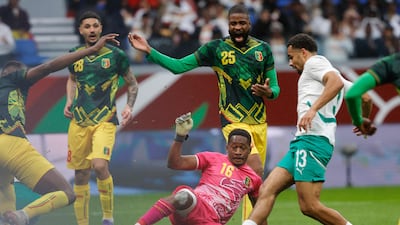
Iliman Ndiaye scores the only goal of the game in Senegal's Afcon win over Mali. AFP -
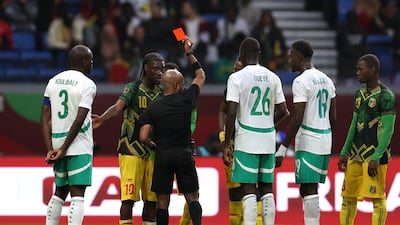
Mali's Yves Bissouma is shown a red card by referee Abongile Tom. Reuters -
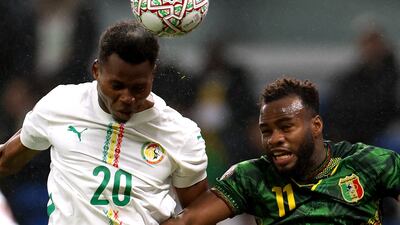
Senegal's Habib Diallo wins a header under pressure from Lassana Coulibaly of Mali. Reuters -
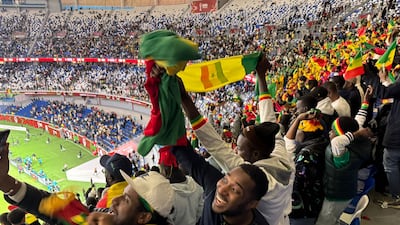
Fans at the Grand Stade de Tanger. Andy Mitten for The National -

Senegal fans with flags at the game in Tangier. Reuters -
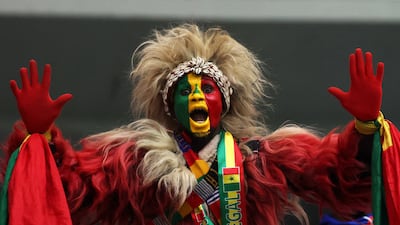
A Senegal fan inside the stadium before the match. Reuters -
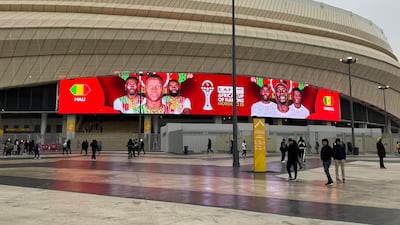
The Grand Stade de Tanger, venue for the Afcon quarter-final between Senegal and Mali. Andy Mitten for The National


The mood was good; the weather was not, cold and drizzly as fans moved to the stadium 10 kilometres from the city centre. Another stunning stadium too: the Grande Stade was rebuilt to seat 78,000 for the 2030 World Cup finals.
The attendance of 32,385 was well below capacity, with Senegal fans easily outnumbering Malians, though it was hard to spot since their national flags are almost identical. The words to the national anthems were also written in Arabic and English on the screens.
“Pluck all your koras, strike the balafons,” sang the Senegalese. “The red lion has roared. The tamer of the bush, leapt forward in one bound, dispelling the darkness.”
The Mali supporters were not to be outdone: “One people, one goal, one faith, For a united Africa. If the enemy should show himself. Inside or outside, standing on the ramparts, we are ready to die.”
Mali are draw merchants having drawn all three group games, including against hosts and favourites Morocco, to reach this stage. Senegal, with seven English Premier League players in their squad, start as pre-match favourites. Mali’s captain is Yves Bissouma of Tottenham Hotspur – their best player. Mali would have to largely have to do without him after he was sent off just before half time.
A mistake by Mali goalkeeper Djigui Diarra allowed the ball to slip under him and for Senegal (and Everton’s) Iliman Ndiaye to score what would be the game’s only goal. Senegal and their happy fans danced in the rain, while those leaving the stadium ran for cover. They will stay in Tangier for the semi-final and play the winners of Egypt and Ivory Coast.
With Morocco about to play Cameroon, the country was waiting, the bars and restaurants full. Sheltering from the rain, we waited in a cafe by the stadium, which erupted in noise as Morocco took the lead after the tournament’s top scorer, Brahim Diaz, scored his fifth goal in as many games.
The Real Madrid forward, who is usually a sub for his club, is a main man for his country. And how he will have felt it as the hosts reached the semi-finals, courtesy of a 2-0 win, and Morocco erupted in celebration.

