

It’s been four years since a landmark strategic partnership was signed between the NBA and the Department of Culture and Tourism Abu Dhabi (DCT Abu Dhabi).
The multi-year agreement brought NBA games to the Arabian Gulf for the first time in history, and it sparked an unprecedented level of interest in basketball from fans in the UAE and the region as a whole.
The NBA Abu Dhabi Games, which featured teams like the Boston Celtics, Denver Nuggets, Dallas Mavericks, and, most recently, the New York Knicks and Philadelphia 76ers, were just one part of the equation.
Youth initiatives such as the Jr NBA/WNBA programmes, as well as clinics and workshops held alongside the games, engaged with thousands of kids and coaches from across the nation each year.
According to market research firm YouGov, since the inaugural NBA Abu Dhabi Games in 2022, NBA fandom in the Middle East has grown by more than 25 per cent, which equates to two million new fans, while basketball participation has grown in that period by over 400 per cent in Abu Dhabi, more than 60 per cent in the UAE and 50 per cent in the Middle East.
Four years into the partnership, it’s fair to say the games have been a huge success. But it’s unclear whether they will return next year, with no official announcement regarding the future of the event.
NBA commissioner Adam Silver met with Sheikh Khaled bin Mohamed, Crown Prince of Abu Dhabi and Chairman of the Abu Dhabi Executive Council, along with DCT Abu Dhabi chairman Mohamed Khalifa Al Mubarak, in the capital last week to discuss the preseason games as well as the youth initiatives aimed at nurturing young sports talent in basketball.
Silver told The National at Etihad Arena that the NBA views the relationship with Abu Dhabi as a “long-term partnership”, one which has so far exceeded expectations.
“My biggest takeaways are that the opportunity here has exceeded our expectations now that I'm looking back over four years,” said Silver, who has been the commissioner of the league since 2014.
“I mean, the growth in youth basketball here, boys and girls, has gone up many multiples, beyond what we were predicting when we first got here.
“The quality of the games here, we're in a state-of-the-art arena here in Abu Dhabi. The teams have embraced the experience, and the cultural experience as well, that the teams coming here, taking advantage of getting a sense of what life is like here, seeing religious places, celebratory opportunities, great dinners, great sites, and just tremendous friendliness from the people here as well.”
Ahead of the Knicks-Sixers pre-season games this year, an NBA Academy Showcase took place in NYU Abu Dhabi, where top international young prospects from four elite youth academies from around the world – NBA Academy Africa (Senegal), Centre of Excellence (Australia), Pole France INSEP (France) and IMG Academy Ascender (USA) – competed in a three-day event in front of NCAA coaches, NBA scouts and representatives from the NBA.
Through its academies around the world, the NBA has produced several draft picks, most recently South Sudan’s Khaman Maluach, who joined the NBA Academy in Senegal at age 14 and was selected 10th by the Houston Rockets before being traded to the Phoenix Suns in the 2025 NBA Draft.
Egypt’s Jana El Alfy attended the NBA Global Academy in Australia. Last season, she was the starting centre for UConn during their run to the NCAA title.
ESPN reported late last year that the NBA is restructuring its academy programme and cited Abu Dhabi as a potential new “global hub” for the organisation’s youth development efforts. The NBA’s academies in Australia and Mexico have since closed.
Silver revealed that talks of setting up an academy in the UAE capital have indeed begun, but DCT Abu Dhabi has yet to confirm its interest.
“I view this as a very long-term partnership. Of course, we have arrangements here for an academy. I think we see Abu Dhabi as a major hub for the region in terms of development of youth talent,” said Silver.
“Also, there is so much focus on technology here. This is a global AI centre. Technology is part and parcel of our league. Everything from the consumer experience, the fan experience, to how we will try to prevent injuries going forward, how we will look to use technology to find better presentations of the game to our fans.
“So it's a great convergence of so many things that are happening in the world, all here in Abu Dhabi.”
No timeline has been set for the launch of the academy but Silver added: “We're very focused on it right now. It's part of what I'm discussing with the DCT Abu Dhabi while we're here in town. And I know it's something we're working on, we're all very excited about.
“We hope to take advantage of the fact there is a great university in NYU that is also based here. So those are all ongoing discussions, but we're very excited about the opportunity.”
Another exciting opportunity for the NBA is the planned expansion into Europe. The NBA announced in March it is looking to launch a professional basketball league in Europe within the next two years, in collaboration with FIBA.
-

Malcolm Brogdon of New York Knicks during a preseason game against Philadelphia 76ers at the NBA Abu Dhabi Games. Getty Images -

Jalen Brunson was the star performer for New York Knicks against Philadelphia 76ers in Abu Dhabi. Getty Images -

Miles McBride of New York Knick dribbles past Tyrese Maxey of Philadelphia 76ers. Getty Images -

Jabari Walker of Philadelphia dribbles the ball past Jordan Clarkson of New York. Getty Images -

Johni Broome at the Etihad Arena in Abu Dhabi. Getty Images -

Kennedy Chandler of Philadelphia 76ers during the preseason match against New York Knicks. Getty Images -
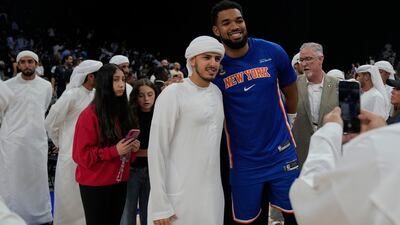
Fans take pictures with New York Knicks centre Karl-Anthony Towns. AP


According to The Athletic, the league is meant to include 16 teams, 12 of which will be permanent members.
Silver and other key NBA executives met with representatives from Real Madrid and Galatasaray over the summer to discuss their potential participation in the new league.
Real Madrid compete in Europe’s current premier basketball competition, the EuroLeague, and have a shareholders’ status, which expires in 2026.
There has been pushback from EuroLeague executives, who don’t see the NBA’s new venture as a threat, but classify it as a “confusion”.
Silver explained why the NBA has chosen to create a new competition rather than partner with the existing EuroLeague.
“I've been with the NBA for over three decades now and I've watched the development of basketball on the [European] continent,” said Silver.
“And while from a skill standpoint it's amazing what we're seeing in terms of players – as you know many of our top players are European right now. From a commercial standpoint, for whatever reason, they haven't experienced the kind of growth we've seen from a commercial standpoint, certainly in the NBA or even other leagues in the world.
“So we think there's an opportunity to help advance the growth of the game in Europe to make it a more appealing fan experience, to do so using our expertise in media and marketing to take basketball to another level.”
DCT Abu Dhabi recently signed a new global partnership, naming ‘Experience Abu Dhabi’ the official tourism and travel destination of the EuroLeague.
Silver said that EuroLeague executives were present in the UAE capital last weekend and that he planned to “continue to have discussions with them”.
“To us, it's not about us or them, it's how can we collectively do a better job continuing to advance the game in Europe?” he added. “And so I'm hopeful that we will have productive discussions with the EuroLeague as we go forward.
“We come in as friends, but we do think that it's necessary to bring our expertise to Europe to continue to develop the sport. We see so much advancement in football [soccer] in Europe.
“We see nothing but opportunity. There's just a whole new approach to how to present sport right now. And part of it requires enormous investment, and I think we have access to capital markets, we have access to investors who are interested in additional sports opportunities, but I think it will all accrue to the benefit of European fans. And then ultimately, our hope is it's a league in Europe for the world, though, not just for European fans.”
Silver believes the new European league could help boost the sport in the Middle East as well, with games taking place in a more favourable time zone that would allow basketball fans in the region to watch more live games.
The league is planned to be semi-open, with a certain number of slots available for teams to earn their way into the competition.
“In Europe, there's clearly a tradition of promotion and relegation. And as we look to the model in Europe, I think we want the best of both systems. I think from a financial standpoint, in terms of creating incentives to build arena infrastructures and invest in team organisations, having some permanence obviously helps from an investor standpoint,” he explained.
“On the other hand, we do want to take advantage of great European traditions in sport and of course, promotion and relegation is part of that. So I think what we're looking at in Europe is a hybrid, both to have permanent clubs and then have opportunities for other teams to play in.”
Meanwhile, the NBA’s approach to their league in Africa is taking a different direction. The Basketball Africa League (BAL) – a collaboration between the NBA and FIBA – is about to undergo significant changes, with the NBA looking to transform it into a franchise-based competition.
Currently based on a qualification format, the BAL will be shifting to a model with 12 permanent franchises in key African markets.
“Africa is at a very different stage in its development in terms of basketball. There's a fairly minimal arena infrastructure in place right now,” said Silver. “We think in order to take the investment in the game and arena infrastructure to the next level, there needs to be some sense that clubs are going to be in a position to be in a league and compete for the foreseeable future.
“I think a model for the long term has yet to be determined. But entering into Europe, it's a dramatically different price point than the opportunity in Africa. It's at an earlier stage.
“But having said that, I should point out that Africa is producing an enormous amount of talent right now. I just think there's a huge divide between the talent and the amount of basketball being played and the commercial sports generally in Africa. It's not just unique to basketball.
“I think in Africa, there's an opportunity to, in essence, create a whole new economic engine for economies throughout Africa, and that is through sport. And hopefully, if the NBA and basketball comes in, other sports will follow and see similar opportunities.”

