



In May 2003, just after Australia had won the Cricket World Cup for the third time, a trial was held in Kabul with a view to setting up an Afghanistan cricket team for the first time.
The aspiring players were newly returned from exile across the border in Pakistan, where they had learnt the favourite sport of their hosts while housed in refugee camps.
That team of pioneers started its competitive life on international cricket’s furthest extremities, playing against the likes of Japan, Jersey and Botswana.
None of the players had been on an airplane before their debut cricket tour. In transit in Dubai for the first time, they could not work out how to use the escalators.
Among them was Mohammed Nabi, the champion allrounder who has – 21 years later – just helped his side beat Australia to a place in a T20 World Cup semi-final.
Afghanistan’s team of cricketing supermen will play South Africa in Trinidad in the early hours of Thursday morning UAE time. Such has been their fairytale rise in the sport, there is no reason why they will feel further progress in the competition is beyond them.
On Tuesday, they sealed their place in the last four in the most gripping fashion imaginable – and at the expense of Australia.
They navigated rain delays in St Vincent, score revisions, an iffy pitch, and a Bangladesh side who themselves had a shot at advancing to clinch their place.
“It is like a dream for us as a team being in a semi-final,” Rashid Khan, the Afghanistan captain, said after the eight-run win over Bangladesh that sent them through in second place in the group behind India.
“It is all about how we started the tournament. The belief came from when we beat New Zealand. It is unbelievable. I don’t have the words to describe my feelings. Everyone back at home is so, so happy for this big achievement.”
The stage for their semi-final meeting against the Proteas might be a fitting one. Trinidad is the home island of Brian Lara, the West Indies great.
According to Rashid, Lara was one of the only people who backed the Afghans to make the last four of the competition.
“We proved him right,” he said. “It is what we discussed before the competition and the welcome party. I told him, ‘We won’t let you down, we will prove you right.’ I think that is something everyone is proud of. I’m super proud of the team.”
This T20 World Cup has been characterised by variable batting conditions, and it has made for captivating cricket.
Poor wickets in New York and elsewhere have meant the team defending have never been out of the game, no matter what they post.
Like the big one in the Big Apple when Win Predictor had Pakistan at over 90 percent to beat India during their chase of 120 to win. They ended up losing by six.
The opposite is true on flat wickets. The shirtfront in St Lucia, for example, meant India could never sit comfortably in their defence of 205 in their final Super Eight match against Australia.
Win, and Australia would guarantee themselves a place in the semis. Lose, and there was still an opportunity for Afghanistan or Bangladesh to pinch the spot.
Rohit Sharma assessed the importance of a fast start perfectly. The India captain’s blitz against Mitchell Starc and Pat Cummins at the Daren Sammy International Stadium was a masterpiece.
At the other end, Virat Kohli and Rishabh Pant looked like they were still struggling in the park in Long Island, scratching around trying to make sense of things.
Rohit, by contrast, knew there was no time to waste, and got straight on the front foot. His 92 from 41 balls was thrilling stuff, but Australia started their chase with purpose.
While Travis Head was at the wicket, they were always a chance, but when he went for 76, the game swung inexorably India’s way. Their 24-run win had sizeable ramifications across the Caribbean Sea in Jamaica.
-
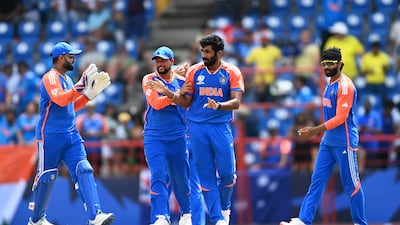
Jasprit Bumrah of India celebrates with teammates after dismissing Travis Head of Australia during their 24-run T20 Cricket World Cup Super Eight win at the Daren Sammy National Cricket Stadium in St Lucia on June 24, 2024. Getty Images -

India's captain Rohit Sharma hits a six. AFP -

Australia's Travis Head hits a six on his way to an innings of 76 off 43 deliveries. AFP -

Axar Patel of India celebrates after dismissing Marcus Stoinis of Australia for two runs. Getty Images -

Australia's Glenn Maxwell hit 20 off 12 deliveries before being bowled by Kuldeep Yadav. AFP -

India's Axar Patel holds up the ball after taking a brilliant catch to dismiss Australia's captain Mitchell Marsh for 37. AFP -
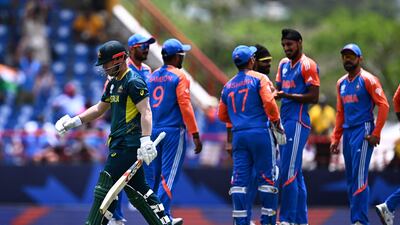
Australia's David Warner walks after being dismissed for six runs. AFP -

Arshdeep Singh of India celebrates after dismissing David Warner of Australia, caught by Suryakumar Yadav. Getty Images -
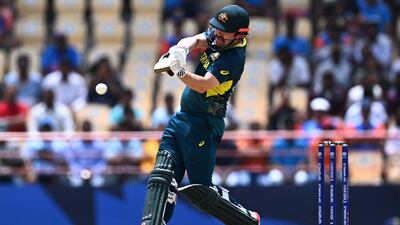
Australia's Travis Head hits a boundary. AFP -

India's Rohit Sharma cracks one of eight sixes in his 41-ball 92 which also included seven fours. India reached 205-5 in their 20 overs. Getty Images -
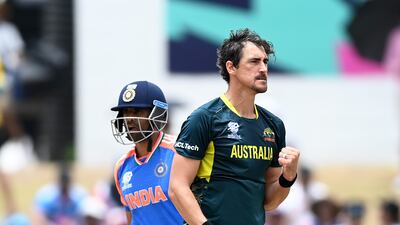
Relief for Mitchell Starc after bringing Rohit Sharma's brutal innings for India to a close. The Australian bowler finished with figures of 2-45 off his four overs. Getty Images -
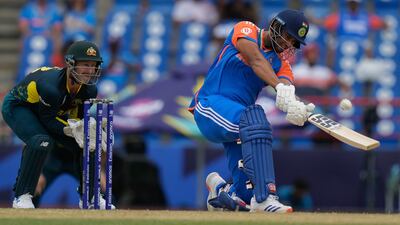
India's Shivam Dube hits a six on his way to 28 off 22 balls. AP -

India captain Rohit Sharma is bowled by Australia's Mitchell Starc for 92. AP -

Australia bowler Josh Hazlewood, right, celebrates with captain Mitchell Marsh after the dismissal of India's Virat Kohli. AP -

India's Suryakumar Yadav cracked 31 off 16 balls including three fours and two sixes. AP -
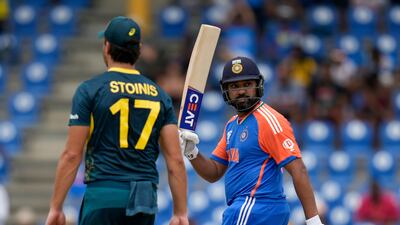
India's Rohit Sharma celebrates after reaching 50 off just 19 balls, including 29 off the third over bowled by Mitchell Starc. AP -
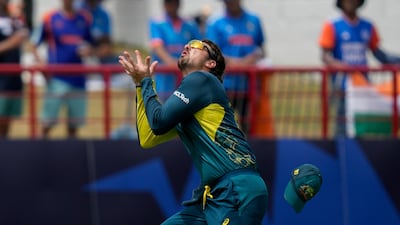
Australia's Tim David takes a catch to dismiss India's Virat Kohli. AP -

India's Virat Kohli was out for a five-ball duck. AFP


A win of any kind for Afghanistan would guarantee their progress. Bangladesh, meanwhile, needed an ever altering target, which eventually settled on needing to win within 12.1 overs, to make it through themselves.
The wicket proved to be of the challenging variety. It meant Afghanistan, with an enviable bowling attack, felt they had a chance even though they only posted 115 for five from their overs.
The fact they took wickets at regular intervals meant they always had belief, but the two sides flip-flopped in terms of who held the advantage.
Each time there was a rain interruption, though, it was always Afghanistan who held the edge according to the Duckworth Lewis Stern calculations.
In fact, so preoccupied were they by that scenario, at one point Gulbadin Naib – another of the originals in the side – went down holding his left hamstring, stalling for time.
The veracity of the injury was questioned by the commentators. When the sides did reemerge after the subsequent shower had passed, it was not long before Gulbadin had the ball in his hand. He delivered a vital wicket, too, with Bangladesh inching ever closer towards the target.
The equation reached the point where Bangladesh needed nine to win from the same number of deliveries. At which point, Naveen-ul-Haq started the party with two wickets in consecutive balls.
“We were dreaming and waiting for this day,” said Naveen, who took four for 26 in all. “When this day happens, it is a surreal experience. I am lost for words.
“These are the games where you never know what can happen. After conceding one boundary you feel like the game is gone, then suddenly you pick up a wicket and you are back again.
“We have worked for this day. We have worked for the semis and we are looking forward to that that now.”

