


When an administrative oversight by Gujarat Giants deprived Mahika Gaur a place in the first Women’s Premier League, it was a mixed blessing for the UAE teenager.
It meant the 16-year-old left-arm pacer would miss out on playing in the WPL, whose inaugural edition was completed last week when Mumbai Indians beat Delhi Capitals in the final.
The female version of the Indian Premier League has already altered the landscape of the women’s game, and is likely to become the franchise event in which players most want to feature, much like the IPL in the men’s sphere.
Gaur was the subject of a bid by the Giants on auction day back in February, only for the team to be told they had exhausted their overseas player quota.
So no party for the towering seam bowler, but at least it meant she did not have to ask for any more time off school.
“When I found out I had been picked up for the auction I was really excited,” Gaur said. “I didn’t actually watch the auction as we had training that day, but I checked my phone after.
“My sister had sent a message saying, ‘You won’t understand, just watch the video.’ I watched the video and saw that a team had bid for me but they had already done their quota of international players.
“That was a bittersweet moment for me. It gave me great confidence to see a team had bid for me, so I didn’t take it in a negative way. Hopefully I can play in that at some point in the future.
“Everyone thought [the WPL] would be big, but not on the scale that it was. For sure, it is a goal of mine to play in that at some point in the future.”
-
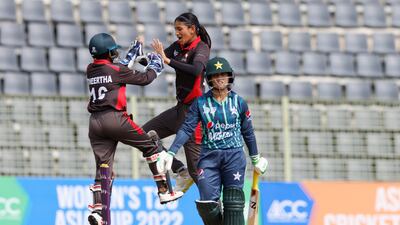
Mahika Gaur of UAE celebrates the wicket of Sidra Amin of Pakistan during the Women’s T20 Asia Cup 2022 matcg at the Sylhet International Cricket Stadium, Sylhet, Bangladesh on October 9, 2022. All photos: Asian Cricket Council -

Mahika Gaur of UAE during the Women’s T20 Asia Cup 2022 cricket match against Pakistan on October 9, 2022. -
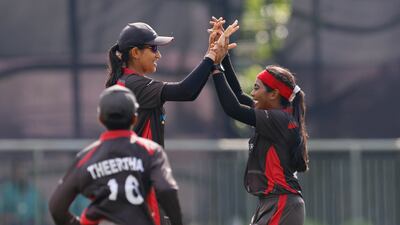
Mahika Gaur, left, and Indhuja Nandakumar of UAE celebrate the wicket of Mas Elysa Yasmin of Malaysia during the Women’s T20 Asia Cup 2022 cricket match at the Sylhet Outer Cricket Stadium, Sylhet, Bangladesh onOctober 5, 2022. -
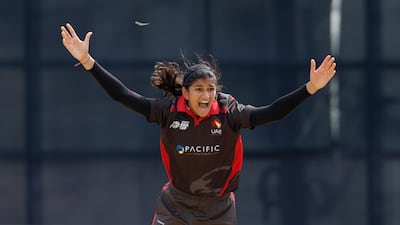
Mahika Gaur of UAE celebrates the wicket of Sabbineni Meghana of India during the Women’s T20 Asia Cup 2022 cricket match at the Sylhet Outer Cricket Stadium, Sylhet, Bangladesh on October 4, 2022. -

UAE's Mahika Gaur bowls in the game against Malaysia in the ICC Women's T20 World Cup Asia Region Qualifier at the ICC Academy, Sports City, Dubai. Chris Whiteoak / The National -
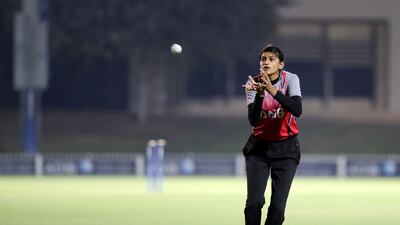
Mahika Gaur goes through fielding drills. Chris Whiteoak / The National


For both male and female players in the UAE, the path to leading franchise competitions is becoming increasingly navigable.
The men’s players benefited from the advent of the DP World International League T20 this year, by which they can advertise their abilities to other franchise leagues around the world.
Similar can be said for the FairBreak Invitational for women. When Covid restrictions in Hong Kong meant the first season of that event was brought to the UAE last year, many locally-based players benefited.
Esha Oza, Kavisha Kumari, Chaya Mughal and Theertha Satish all played alongside some of the stars of the world game. Other UAE internationals, such as Gaur, Vaishnave Mahesh and Samaira Dharnidharka were recruited as reserves during the season, but did not play.
The second season of the tournament starts in Hong Kong next week, and Gaur has been drafted this time, with Oza, Kumari and Theertha again involved.
“I was happy for them but at the same time, I really wanted to be part of it,” Gaur said of missing out on playing last year.
“Seeing the exposure that they got, seeing them playing with such big names, that was really motivating for me to continue training as hard as I can.
“This year when I got the call up, obviously I was really happy. All of them said it was a great experience and they didn’t stop talking about it. I have heard lots of stories about what they learnt.”
Gaur was invited to tour Australia with a FairBreak squad during the winter, but had to turn down the opportunity. She had already missed a large chunk of the school term while playing for UAE at the Under 19 World Cup in South Africa.
The English-born bowler returned to the UK last year to attend boarding school on a sports scholarship, but her home remains Dubai.
Picking which cricket commitments to pursue among her academics is not an easy task, but she is glad of the chance to be heading to Hong Kong for FairBreak.
“The fact Associate players get so much exposure playing alongside players from Test-playing nations, it’s letting women who might not otherwise be recognised to be seen,” Gaur said.
“If you are from an Associate nation, bowling to players from Test-playing nations and getting them out, then with Women’s Premier League, the Hundred, and so many other franchise leagues, it will be great for people to spot potential talent.
“Last year, there were a lot of new people who hadn’t been heard about, and because of FairBreak, people got to see them.
“There are more franchise leagues, which is amazing, and more women’s matches are being telecast. Even the U19 World Cup.
"It was so well broadcast, and the ICC Instagram account was putting out so much stuff. It was great. It is really exciting for the future.”

