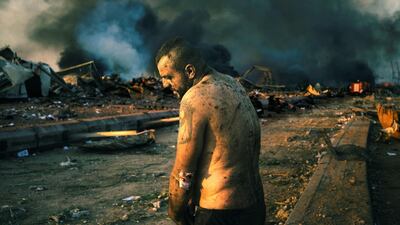
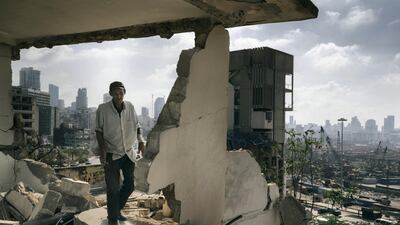
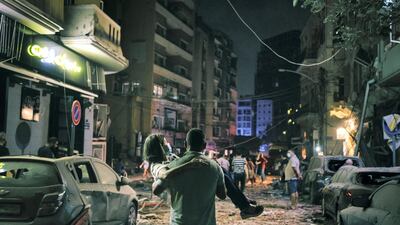
Just after 6pm on August 4, 2020. Zero Hour.
The fire in Beirut Port's Warehouse 12 had grown in intensity. It was out of control.
A fire crew arrived to try to tackle the blaze, but it was like nothing they had ever seen before. They called for backup.
Ghassan Hasrouty and his colleagues were still working in the silos next door, offloading grain from the ship that docked earlier in the day. They’re just metres from Warehouse 12 and the deadly stockpile of ammonium nitrate.
Bystanders living in the neighbourhood around the port came to their windows and on to their balconies to watch the clouds of smoke rise into the pale blue sky.
Many, however, are unaware anything is wrong. Those like Sarah Copland, an Australian UN employee who’s feeding her son Isaac, 2, next to the big glass windows of the family’s dining room in a quiet Beirut neighbourhood less than a kilometre away from the fire.
This is Episode 3 of The Blast. It’s the story of what happened when Beirut blew up, told by the people who were there.
This episode contains witness accounts of the events of August 4, 2020, that some listeners may find distressing. If you are based in Lebanon and want to talk about any of the issues raised in this series you can contact the Embrace Lifeline.
Finbar, like many others in Beirut that day, was badly injured in the explosion.
Now, a year on, he is looking to get answers to questions that so many in Lebanon have — who was responsible for the Beirut blast, how did the ammonium nitrate end up there, who knew about it and what caused the explosion.
The Blast from Beyond the Headlines traces the events of that tragic day.
In Episode 1, Finbar enlists Erin Clare Brown, The National’s Tunis correspondent and resident Russian speaker. They track down Boris Prokoshev, the captain of the Rhosus — the ship that first brought the cargo of ammonium nitrate to Beirut Port. Boris tells us about the ill-fated voyage from the start, how a detour brought them to Beirut and how it — and he — got stuck there.
In Episode 2, Finbar enlisted his Beirut colleague Sunniva Rose and they headed down to Beirut Port to find out who knew the ammonium nitrate was sitting in hanger 12, who was responsible for it and how it sat there for six years.
Next time on The Blast, we conclude by looking at what’s happened in the year since the explosion, who has been accused, how life has changed and what justice the victims of that explosion are seeking.
Mercer, the investment consulting arm of US services company Marsh & McLennan, expects its wealth division to at least double its assets under management (AUM) in the Middle East as wealth in the region continues to grow despite economic headwinds, a company official said.
Mercer Wealth, which globally has $160 billion in AUM, plans to boost its AUM in the region to $2-$3bn in the next 2-3 years from the present $1bn, said Yasir AbuShaban, a Dubai-based principal with Mercer Wealth.
“Within the next two to three years, we are looking at reaching $2 to $3 billion as a conservative estimate and we do see an opportunity to do so,” said Mr AbuShaban.
Mercer does not directly make investments, but allocates clients’ money they have discretion to, to professional asset managers. They also provide advice to clients.
“We have buying power. We can negotiate on their (client’s) behalf with asset managers to provide them lower fees than they otherwise would have to get on their own,” he added.
Mercer Wealth’s clients include sovereign wealth funds, family offices, and insurance companies among others.
From its office in Dubai, Mercer also looks after Africa, India and Turkey, where they also see opportunity for growth.
Wealth creation in Middle East and Africa (MEA) grew 8.5 per cent to $8.1 trillion last year from $7.5tn in 2015, higher than last year’s global average of 6 per cent and the second-highest growth in a region after Asia-Pacific which grew 9.9 per cent, according to consultancy Boston Consulting Group (BCG). In the region, where wealth grew just 1.9 per cent in 2015 compared with 2014, a pickup in oil prices has helped in wealth generation.
BCG is forecasting MEA wealth will rise to $12tn by 2021, growing at an annual average of 8 per cent.
Drivers of wealth generation in the region will be split evenly between new wealth creation and growth of performance of existing assets, according to BCG.
Another general trend in the region is clients’ looking for a comprehensive approach to investing, according to Mr AbuShaban.
“Institutional investors or some of the families are seeing a slowdown in the available capital they have to invest and in that sense they are looking at optimizing the way they manage their portfolios and making sure they are not investing haphazardly and different parts of their investment are working together,” said Mr AbuShaban.
Some clients also have a higher appetite for risk, given the low interest-rate environment that does not provide enough yield for some institutional investors. These clients are keen to invest in illiquid assets, such as private equity and infrastructure.
“What we have seen is a desire for higher returns in what has been a low-return environment specifically in various fixed income or bonds,” he said.
“In this environment, we have seen a de facto increase in the risk that clients are taking in things like illiquid investments, private equity investments, infrastructure and private debt, those kind of investments were higher illiquidity results in incrementally higher returns.”
The Abu Dhabi Investment Authority, one of the largest sovereign wealth funds, said in its 2016 report that has gradually increased its exposure in direct private equity and private credit transactions, mainly in Asian markets and especially in China and India. The authority’s private equity department focused on structured equities owing to “their defensive characteristics.”
'O'
%3Cp%3E%3Cstrong%3EAuthor%3A%3C%2Fstrong%3E%20Zeina%20Hashem%20Beck%3Cbr%3E%3Cstrong%3EPages%3A%3C%2Fstrong%3E%20112%3Cbr%3E%3Cstrong%3EPublisher%3A%3C%2Fstrong%3E%20Penguin%20Books%3Cbr%3E%3Cstrong%3EAvailable%3A%3C%2Fstrong%3E%20Now%3C%2Fp%3E%0A
Cricket World Cup League 2
UAE squad
Rahul Chopra (captain), Aayan Afzal Khan, Ali Naseer, Aryansh Sharma, Basil Hameed, Dhruv Parashar, Junaid Siddique, Muhammad Farooq, Muhammad Jawadullah, Muhammad Waseem, Omid Rahman, Rahul Bhatia, Tanish Suri, Vishnu Sukumaran, Vriitya Aravind
Fixtures
Friday, November 1 – Oman v UAE
Sunday, November 3 – UAE v Netherlands
Thursday, November 7 – UAE v Oman
Saturday, November 9 – Netherlands v UAE
The specs
Engine: 3.0-litre six-cylinder MHEV
Power: 360bhp
Torque: 500Nm
Transmission: eight-speed automatic
Price: from Dh282,870
On sale: now
War
Director: Siddharth Anand
Cast: Hrithik Roshan, Tiger Shroff, Ashutosh Rana, Vaani Kapoor
Rating: Two out of five stars
Pakistan World Cup squad
Sarfraz Ahmed (c), Fakhar Zaman, Imam-ul-Haq, Abid Ali, Babar Azam, Haris Sohail, Shoaib Malik, Mohammad Hafeez(subject to fitness), Imad Wasim, Shadab Khan, Hasan Ali, Faheem Ashraf, Junaid Khan, Shaheen Shah Afridi, Mohammad Hasnain
Two additions for England ODIs: Mohammad Amir and Asif Ali
Global state-owned investor ranking by size
|
1.
|
United States
|
|
2.
|
China
|
|
3.
|
UAE
|
|
4.
|
Japan
|
|
5
|
Norway
|
|
6.
|
Canada
|
|
7.
|
Singapore
|
|
8.
|
Australia
|
|
9.
|
Saudi Arabia
|
|
10.
|
South Korea
|
How%20to%20avoid%20getting%20scammed
%3Cul%3E%0A%3Cli%3ENever%20click%20on%20links%20provided%20via%20app%20or%20SMS%2C%20even%20if%20they%20seem%20to%20come%20from%20authorised%20senders%20at%20first%20glance%3C%2Fli%3E%0A%3Cli%3EAlways%20double-check%20the%20authenticity%20of%20websites%3C%2Fli%3E%0A%3Cli%3EEnable%20Two-Factor%20Authentication%20(2FA)%20for%20all%20your%20working%20and%20personal%20services%3C%2Fli%3E%0A%3Cli%3EOnly%20use%20official%20links%20published%20by%20the%20respective%20entity%3C%2Fli%3E%0A%3Cli%3EDouble-check%20the%20web%20addresses%20to%20reduce%20exposure%20to%20fake%20sites%20created%20with%20domain%20names%20containing%20spelling%20errors%3C%2Fli%3E%0A%3C%2Ful%3E%0A