

Under the shadow of Beirut port’s 48 towering grain silos on an August afternoon in 2020, a ship pulls up to the quay.
Ghassan Hasrouty is not meant to be working but he switched shifts to take the religious holiday off the following week and he knows it’s going to be a long night ahead. He’s worked at the docks for decades and today, he thinks, will be no different.
But it is. There’s a fire in a nearby warehouse, black smoke is billowing into the sky.
On August 4, 2020, 2,750 tons of ammonium nitrate stored in that warehouse exploded.
Episode 2 of The Blast rewinds nearly six years from that day.
We pick up as Boris Prokoshev, captain of the Rhosus that brought the dangerous cargo to Beirut, leaves Lebanon with a warning about the ammonium nitrate. We trace what happened to the cargo in the long years it sat in Beirut port until the fateful day it exploded.
Host, Finbar Anderson, is joined by Beirut colleague Sunniva Rose to visit Beirut port, meet officials and workers. They try to get to the bottom of who knew about the ammonium nitrate, when did they know about it and who was responsible for making sure it was safe.
Finbar, like many others, spent the day of the blast being seen by doctors at blown-apart hospitals. The next days too were focused on recovery.
Now, a year on, he sought to get answers to questions that so many in Lebanon have — who was responsible for the Beirut blast, how did the ammonium nitrate end up there, who knew about it and what caused the explosion.
The Blast from Beyond the Headlines traces the events of that tragic day.
In Episode 1, Finbar enlists Erin Clare Brown, The National’s Tunis correspondent and resident Russian speaker. They track down Boris Prokoshev, the captain of the Rhosus — the ship that first brought the cargo of ammonium nitrate to Beirut Port. Boris tells us about the ill-fated voyage from the start, how a detour brought them to Beirut and how it — and he — got stuck there.
If you have not listened to that episode, go back now.
Over the next two episodes, we’ll trace the events of August 4 and hear how the blast ripped apart lives and livelihoods. We’ll conclude by looking at what’s happened in the year since the explosion, who has been accused, how life has changed and what justice the victims of that explosion are seeking.
-
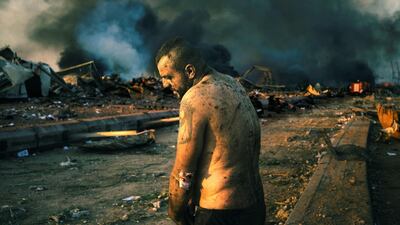
The winner of the World Press Photo contest 'Spot News - Stories' category is 'Port Explosion in Beirut' by Lorenzo Tugnoli. An injured man stands inside the wrecked site of the port of Beirut while firefighters work to put out the fires that engulfed the warehouses after the explosion. Lorenzo Tugnoli/Contrasto for The Washington Post -
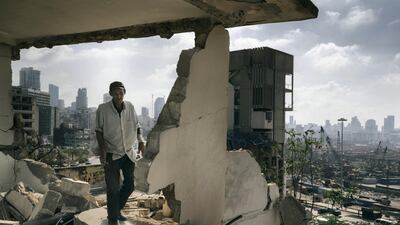
Abdullah walks in the ruins of his former house. Since the day of the explosion he is squatting in the damaged building were he once lived with his family, with no water or electricity. An estimated 300,000 people lost their homes in after the blast. Lorenzo Tugnoli/Contrasto for The Washington Post -

Firefighters work to put out the fires that engulfed the warehouses in the port of Beirut after the explosion. Lorenzo Tugnoli/Contrasto for The Washington Post -
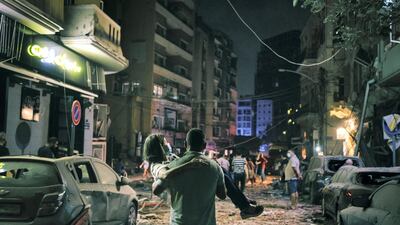
An old woman is carried to safety in the destroyed neighbourhood of Jemmayzeh. The blast wrecked several densely populated neighbourhoods. Lorenzo Tugnoli/Contrasto for The Washington Post



