


Recently, the Israeli historian Tom Segev published a biography of Israel's first prime minister, David Ben Gurion. An underlying theme Mr Segev develops is Ben Gurion’s persistent contradictions on the subject of Arabs.
Ben Gurion fought Arabs as a settler in Palestine, yet was close to certain Arab individuals. He promised “full and equal citizenship” to Arab citizens of Israel in the country’s declaration of statehood, but also presided over their expulsion during the war in 1948, later placing them under military rule – a decision lifted only in 1966.

The results of Israel’s recent elections showed that the ground is shifting when it comes to the country’s relationship with its Arab population. The Joint List of Arab parties emerged with fifteen seats, making it the third-largest party in the Knesset. Immediately, Prime Minister Benjamin Netanyahu, worried that his rival, Benny Gantz, would try to form an alliance with the Arabs, denounced him as seeking a deal with “terror supporters,” who were “not part of the equation” in the Knesset.
Mr Netanyahu has alienated the Arabs with many other measures that have underlined his evidently profound contempt for them. During the 2015 elections, he had galvanised his electoral base on election day by recording a video in which he declared, “Arab voters are heading to the polling stations in droves.” Using this scare tactic to mobilise Jewish voters against their Arab compatriots was disgraceful, but par for the course for the prime minister.
The prime minister’s strong support for a Basic Law declaring Israel to be “the nation state for the Jewish people,” pushed Arabs away even further. Effectively, the law created a two-tier citizenship, underlining that while Arabs might enjoy civil and political rights, this was only in the context of a state in which Jews alone had a right to self-determination. Many critics denounced the law as racist.
Mr Netanyahu’s third blow against Israel’s Arabs came indirectly, in the form of US President Donald Trump's so-called peace plan, released in January. Though a US proposal, it was also very much Mr Netanyahu’s preferences relayed via the Americans drafting the plan. One of its most controversial elements was the transfer of some 350,000 Arab Israelis living in villages abutting the West Bank to a future Palestinian state.
Israeli Arabs, rightly, saw this as a demographic power play by the Americans, at Mr Netanyahu’s urging, to reduce their country's Arab population. Aymen Odeh, the leader of the Joint List denounced the move, stating, “No one will deprive us of citizenship in the homeland where we were born.”
-

Arab Israelis wave Palestinian flags as they take part in a rally to express their opposition to the US-brokered proposal for a settlement of the Israeli-Palestinian Middle East conflict, in the Arab-Israeli town of Baqa al-Gharbiya in northern Israel. AFP -

Israelis and Israeli Arabs protest against US President Trump's peace plan as they march in Tel Aviv , Israel. EPA -

Israelis and Israeli Arabs protest against US President Trump's peace plan as they march in Tel Aviv , Israel. EPA -
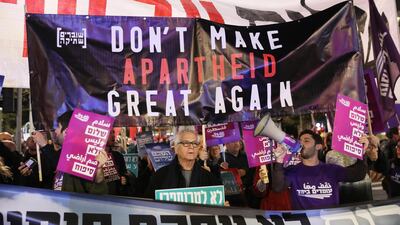
Israelis and Israeli Arabs protest against US President Trump's peace plan as they march in Tel Aviv , Israel. EPA -
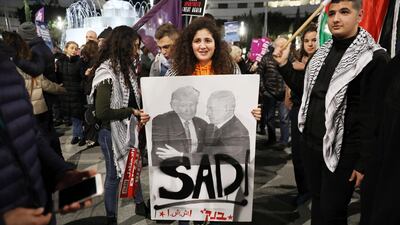
Israelis and Israeli Arabs protest against US President Trump's peace plan as they march in Tel Aviv , Israel. EPA -

Israelis and Israeli Arabs protest against US President Trump's peace plan as they march in Tel Aviv , Israel. EPA


It would be too easy to put this solely at the door of Mr Netanyahu and his Likud Party, who are the political heirs of Revisionist Zionism, a school of thought that has long advocated the security of Israel through an “iron wall” of overwhelming power that is “not amenable to any Arab pressure,” in the words of its founder, Ze’ev Jabotinsky.
Yet the Labour Party – Likud's historical rival – has hardly been better. Labour governments kept Israel’s Arabs under arbitrary military rule for almost two decades. It was Golda Meir, a Labour prime minister, who denied that there ever was a Palestinian people. And Labour has long pursued a similar policy in the occupied West Bank to right-wing parties, backing settlements and advocating for Israel’s annexation of the Jordan Valley.
Today, several factors are imposing upon Israel a re-evaluation of its relations with its Arab citizens and those under its occupation. The first is that the two-state solution no longer appears to be viable, meaning that Israel is already facing an Arab demographic majority between the Jordan River and the Mediterranean.
While Israel’s Arabs may have a different agenda than their brethren in the occupied territories, the undermining of a two-state solution means that Palestinians under occupation will increasingly begin to demand their rights in the framework of an Israeli state, perhaps seeking common cause with their Arab counterparts inside Israel.
This will be unacceptable to Israelis, who will regard such a situation as a threat to their state's Jewish identity. More than that, however, it will create a dilemma for the country's Jewish majority, which will find itself opposed to both a two-state and a one-state solution, while pursuing its repression and marginalisation of West Bank and Gaza Palestinians. The result will only be a further erosion of Israel’s international credibility.
The essential question is how Israeli Arabs and those under occupation can combine their efforts and act jointly to impose change upon Israel's Jewish majority. The success of the Joint List creates space to take such collaboration a step further, but the flip side of this is that it will exacerbate Jewish insecurities. That is not necessarily a bad thing if it forces Israeli leaders to realise that they can no longer have their cake and eat it, too, and that pursuing maximalist objectives also means having to deal with the consequences.
While Ben Gurion accepted the United Nations' original partition plan in 1947, he remained sensitive to demographic factors in the prospective Jewish state. But he was inconsistent on the matter, writes Mr Segev, ultimately welcoming Israel’s expansion after the 1967 war, regardless of its demographic implications. Israel today, even as it has affirmed its Jewish identity more forcefully, is facing more forceful Arabs in its midst. This has the potential to rewrite entirely the narrative of the two communities' relations in the future, surely for the better.
Michael Young is editor of Diwan, the blog of the Carnegie Middle East programme, in Beirut

