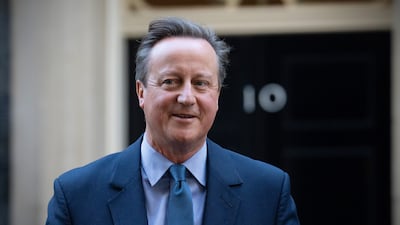
David Cameron was appointed to his new role as Foreign Secretary this week. On the political side of the fence, there seems to exist a permanent situation of chaos. Getty Images


Revolving door reshuffle is baffling for British business


  • English
  • Arabic

November 14, 2023

In the City this week, there is much scratching of heads and yes, some laughter, but also a fair degree of anger and frustration.

As soon as the cabinet reshuffle got under way, the messages and emails started flowing – most centred on the appointment of David Cameron as Foreign Secretary.

“Is it true?” asked one correspondent, who, presumably, was not near a screen and could not see footage of the former prime minister ambling along Downing Street and through the door which used to be his home. I had to inform him that indeed it was. He still said he could not believe it.

I thought of him as working as a senior fund manager in a global financial powerhouse. He oversees a division that invests several billions of pounds for its clients. Every day they make decisions that have serious consequences.

They work as a unit, each knowing what the other is doing, all of them trusting and relying on their colleagues. That dependence, their solidity, is transferred to their clients. That’s why they are entrusted with other people’s money.

They have a chemistry, a bond, that builds up over time. When they change personnel, which is rarely, they do so carefully, ensuring that whoever they choose forms a perfect fit.

They don’t always get it right, of course they don’t. But on most occasions, they do.

Then they look at the government, which is charged with running Britain, setting the strategy for a vast public machine that delivers education health, welfare, defence, social care, transport, law and order and the rest, and they’re baffled – utterly perplexed, to the extent that it’s humorous.

Except it’s not funny and definitely not imaginary. It’s extremely real.

An ex-chief executive is brought back after being in the wilderness for seven years. In that period, he’s been criticised for displaying poor judgment when pushing his old boardroom pals to act favourably towards a finance firm that was failing and in which he had a personal interest.

He also gave an interview in which he proclaimed categorically that he had no desire to return. Still, forget all that. Cameron is awarded one of the top four posts in government.

How does that work? Does Cameron bite his lip in meetings with his new boss and resist saying, “Well in my day…”? Or does he come out with it, telling Rishi Sunak what he did in similar circumstances?

How irritating is that, having the ex-chief sitting across the table? Do ministers and officials automatically defer to him, not helping themselves, regarding Cameron as remaining in charge?

  • Former prime minister David Cameron leaves No 10 Downing Street after being appointed Foreign Secretary in a Cabinet reshuffle. Getty Images
    Former prime minister David Cameron leaves No 10 Downing Street after being appointed Foreign Secretary in a Cabinet reshuffle. Getty Images
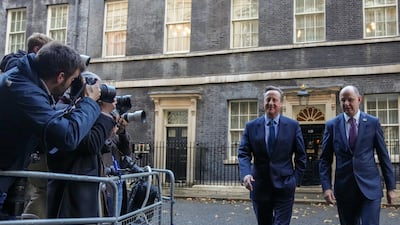
  • Mr Cameron's surprise return to government comes after he stepped down as UK prime minister in 2016 following the Brexit referendum. PA
    Mr Cameron's surprise return to government comes after he stepped down as UK prime minister in 2016 following the Brexit referendum. PA
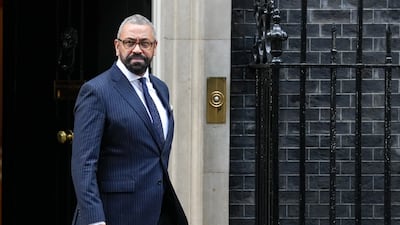
  • Newly appointed Home Secretary James Cleverly leaves Downing Street on Monday morning. PA
    Newly appointed Home Secretary James Cleverly leaves Downing Street on Monday morning. PA
  • Mr Cleverly replaces Suella Braverman, pictured here leaving her home on Monday morning, as Home Secretary. Reuters
    Mr Cleverly replaces Suella Braverman, pictured here leaving her home on Monday morning, as Home Secretary. Reuters
  • Mr Braverman and Mr Cleverly attend the National Service of Remembrance at the Cenotaph on Sunday. Ms Braverman was sacked after she wrote an article that was heavily critical of the police ahead of Saturday's pro-Palestine march in central London. Reuters
    Mr Braverman and Mr Cleverly attend the National Service of Remembrance at the Cenotaph on Sunday. Ms Braverman was sacked after she wrote an article that was heavily critical of the police ahead of Saturday's pro-Palestine march in central London. Reuters
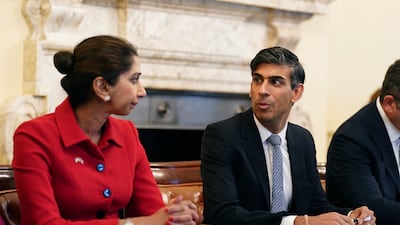
  • Ms Braverman listens to Britain's Prime Minister Rishi Sunak as he hosts a policing roundtable at 10 Downing Street in October. She courted controversy throughout her time in Cabinet and is believed to have designs on the leadership of the Conservative Party. AP
    Ms Braverman listens to Britain's Prime Minister Rishi Sunak as he hosts a policing roundtable at 10 Downing Street in October. She courted controversy throughout her time in Cabinet and is believed to have designs on the leadership of the Conservative Party. AP

In the corporate world, there are heavyweight figures who move, seemingly effortlessly, between substantial, demanding posts – folks like Stuart Rose, Howard Davies, Roger Carr, Archie Norman. No one criticises these omni-chairmen for taking up a new position. They’ve got track records of success behind them; they also have a tried and tested formula for working.

They know how to get the best out of management, they probe and challenge, they spot talent and the not-so talented, and they encourage and motivate. They’re judged by results and they do not run when things g awry – fudging and blaming others will not wash.

Nothing approaching that is visible on the political side of the fence. Instead, there seems to exist a permanent situation of chaos, of doors revolving at such speed that the occupants do not know whether they are coming or going.

Neither, let us remember, do those who work with them.

One moment, as foreign secretary, James Cleverly is touring Middle East capitals, seeing fellow leaders, urgently assessing the ramifications of the Israel-Gaza war; another, he’s in Beijing, greeting the main power-players at an acutely sensitive period in Anglo-Chinese relations.

The next, he is gone. Kaput. Now, his brief includes UK domestic policing and the stopping of small boats of migrants from crossing the Channel.

James Cleverly, second left, mixes with G7 foreign secretaries. AP

Barring a return to the Foreign Office – and stranger things have happened, just look at this latest round of rearranging, that as well as Cameron saw Damien Hinds, once education secretary, made a junior education minister – or Cleverly’s ascent to prime minister, those overseas dignitaries he was cultivating and wooing are unlikely to ever see him again.

Cleverly was shunted to the Home Office, to succeed Suella Braverman. Again, you’re the chief executive and you hand a key division to a person you know will not toe the corporate line, who will defy the rules on speaking out publicly, who wants your job and will do all she can to undermine you.

Crazy, isn’t it? But that’s exactly what Sunak did. Cleverly solved a headache, but it was a problem entirely of Sunak’s own making. The friction caused by Braverman and her subsequent ousting were totally predictable.

Nothing matters more to this regime, we’re assured, than housing. In speech after speech, Sunak has cited the requirement to construct more houses. It was a central 2019 Conservative manifesto pledge, to build one million homes over the course of the parliament. They are nowhere near to reaching that target.

But is that a surprise, given we’re now on our 16th housing minister since 2010? Rachel Maclean has been sacked after nine months. No matter that Maclean was widely thought to be performing well.

One member of Sunak’s senior team, Business and Trade Secretary Kemi Badenoch, even and somewhat rebelliously openly described Maclean as an “excellent minister” who had been “always attentive to MPs and their constituents and got some very tricky legislation over the line”. Badenoch, though, is another with her eye on the main prize, tipped as a possible future leader.

Maclean duly declared her disappointment and wished her successor well. On it goes, the great British ship of state, lurching from side to side, barely staying afloat. Its captain, if he was ever given to bouts of self-reflection, may just question why other vessels travel so much more quickly, and why their engines function so much more efficiently and smoothly.


The burning issue

The internal combustion engine is facing a watershed moment – major manufacturer Volvo is to stop producing petroleum-powered vehicles by 2021 and countries in Europe, including the UK, have vowed to ban their sale before 2040. The National takes a look at the story of one of the most successful technologies of the last 100 years and how it has impacted life in the UAE. 

Read part four: an affection for classic cars lives on

Read part three: the age of the electric vehicle begins

Read part one: how cars came to the UAE


Trump v Khan

2016: Feud begins after Khan criticised Trump’s proposed Muslim travel ban to US

2017: Trump criticises Khan’s ‘no reason to be alarmed’ response to London Bridge terror attacks

2019: Trump calls Khan a “stone cold loser” before first state visit

2019: Trump tweets about “Khan’s Londonistan”, calling him “a national disgrace”

2022:  Khan’s office attributes rise in Islamophobic abuse against the major to hostility stoked during Trump’s presidency

July 2025 During a golfing trip to Scotland, Trump calls Khan “a nasty person”

Sept 2025 Trump blames Khan for London’s “stabbings and the dirt and the filth”.

Dec 2025 Trump suggests migrants got Khan elected, calls him a “horrible, vicious, disgusting mayor”

Timeline

2012-2015

The company offers payments/bribes to win key contracts in the Middle East

May 2017

The UK SFO officially opens investigation into Petrofac’s use of agents, corruption, and potential bribery to secure contracts

September 2021

Petrofac pleads guilty to seven counts of failing to prevent bribery under the UK Bribery Act

October 2021

Court fines Petrofac £77 million for bribery. Former executive receives a two-year suspended sentence 

December 2024

Petrofac enters into comprehensive restructuring to strengthen the financial position of the group

May 2025

The High Court of England and Wales approves the company’s restructuring plan

July 2025

The Court of Appeal issues a judgment challenging parts of the restructuring plan

August 2025

Petrofac issues a business update to execute the restructuring and confirms it will appeal the Court of Appeal decision

October 2025

Petrofac loses a major TenneT offshore wind contract worth €13 billion. Holding company files for administration in the UK. Petrofac delisted from the London Stock Exchange

November 2025

180 Petrofac employees laid off in the UAE

The%20specs
%3Cp%3E%3Cstrong%3EEngine%3A%3C%2Fstrong%3E%201.8-litre%204-cyl%20turbo%0D%3Cbr%3E%3Cstrong%3EPower%3A%20%3C%2Fstrong%3E190hp%20at%205%2C200rpm%0D%3Cbr%3E%3Cstrong%3ETorque%3A%3C%2Fstrong%3E%20320Nm%20from%201%2C800-5%2C000rpm%0D%3Cbr%3E%3Cstrong%3ETransmission%3A%20%3C%2Fstrong%3ESeven-speed%20dual-clutch%20auto%0D%3Cbr%3E%3Cstrong%3EFuel%20consumption%3A%3C%2Fstrong%3E%206.7L%2F100km%0D%3Cbr%3E%3Cstrong%3EPrice%3A%3C%2Fstrong%3E%20From%20Dh111%2C195%0D%3Cbr%3E%3Cstrong%3EOn%20sale%3A%20%3C%2Fstrong%3ENow%3C%2Fp%3E%0A
Jetour T1 specs

Engine: 2-litre turbocharged

Power: 254hp

Torque: 390Nm

Price: From Dh126,000

Available: Now

Profile of Whizkey

Date founded: 04 November 2017

Founders: Abdulaziz AlBlooshi and Harsh Hirani

Based: Dubai, UAE

Number of employees: 10

Sector: AI, software

Cashflow: Dh2.5 Million  

Funding stage: Series A

FA CUP FINAL

Chelsea 1
Hazard (22' pen)

Manchester United 0

Man of the match: Eden Hazard (Chelsea)

Red Sparrow

Dir: Francis Lawrence

Starring: Jennifer Lawrence, Joel Egerton, Charlotte Rampling, Jeremy Irons

Three stars

LOVE%20AGAIN
%3Cp%3EDirector%3A%20Jim%20Strouse%3C%2Fp%3E%0A%3Cp%3EStars%3A%20Priyanka%20Chopra%20Jonas%2C%20Sam%20Heughan%2C%20Celine%20Dion%3C%2Fp%3E%0A%3Cp%3ERating%3A%202%2F5%3C%2Fp%3E%0A
Libya's Gold

UN Panel of Experts found regime secretly sold a fifth of the country's gold reserves. 

The panel’s 2017 report followed a trail to West Africa where large sums of cash and gold were hidden by Abdullah Al Senussi, Qaddafi’s former intelligence chief, in 2011.

Cases filled with cash that was said to amount to $560m in 100 dollar notes, that was kept by a group of Libyans in Ouagadougou, Burkina Faso.

A second stash was said to have been held in Accra, Ghana, inside boxes at the local offices of an international human rights organisation based in France.

Our family matters legal consultant

Name: Dr Hassan Mohsen Elhais

Position: legal consultant with Al Rowaad Advocates and Legal Consultants.

Company%20profile
%3Cp%3E%3Cstrong%3ECompany%20name%3A%20%3C%2Fstrong%3EHakbah%0D%3Cbr%3E%3Cstrong%3EStarted%3A%20%3C%2Fstrong%3E2018%0D%3Cbr%3E%3Cstrong%3EFounder%3A%20%3C%2Fstrong%3ENaif%20AbuSaida%0D%3Cbr%3E%3Cstrong%3EBased%3A%20%3C%2Fstrong%3ESaudi%20Arabia%0D%3Cbr%3E%3Cstrong%3ESector%3A%20%3C%2Fstrong%3EFinTech%0D%3Cbr%3E%3Cstrong%3ECurrent%20number%20of%20staff%3A%20%3C%2Fstrong%3E22%20%0D%3Cbr%3E%3Cstrong%3EInitial%20investment%3A%20%3C%2Fstrong%3E%24200%2C000%0D%3Cbr%3E%3Cstrong%3EInvestment%20stage%3A%20%3C%2Fstrong%3Epre-Series%20A%0D%3Cbr%3E%3Cstrong%3EInvestors%3A%20%3C%2Fstrong%3EGlobal%20Ventures%20and%20Aditum%20Investment%20Management%0D%3Cbr%3E%3Cbr%3E%3C%2Fp%3E%0A

Mercer, the investment consulting arm of US services company Marsh & McLennan, expects its wealth division to at least double its assets under management (AUM) in the Middle East as wealth in the region continues to grow despite economic headwinds, a company official said.

Mercer Wealth, which globally has $160 billion in AUM, plans to boost its AUM in the region to $2-$3bn in the next 2-3 years from the present $1bn, said Yasir AbuShaban, a Dubai-based principal with Mercer Wealth.

Within the next two to three years, we are looking at reaching $2 to $3 billion as a conservative estimate and we do see an opportunity to do so,” said Mr AbuShaban.

Mercer does not directly make investments, but allocates clients’ money they have discretion to, to professional asset managers. They also provide advice to clients.

“We have buying power. We can negotiate on their (client’s) behalf with asset managers to provide them lower fees than they otherwise would have to get on their own,” he added.

Mercer Wealth’s clients include sovereign wealth funds, family offices, and insurance companies among others.

From its office in Dubai, Mercer also looks after Africa, India and Turkey, where they also see opportunity for growth.

Wealth creation in Middle East and Africa (MEA) grew 8.5 per cent to $8.1 trillion last year from $7.5tn in 2015, higher than last year’s global average of 6 per cent and the second-highest growth in a region after Asia-Pacific which grew 9.9 per cent, according to consultancy Boston Consulting Group (BCG). In the region, where wealth grew just 1.9 per cent in 2015 compared with 2014, a pickup in oil prices has helped in wealth generation.

BCG is forecasting MEA wealth will rise to $12tn by 2021, growing at an annual average of 8 per cent.

Drivers of wealth generation in the region will be split evenly between new wealth creation and growth of performance of existing assets, according to BCG.

Another general trend in the region is clients’ looking for a comprehensive approach to investing, according to Mr AbuShaban.

“Institutional investors or some of the families are seeing a slowdown in the available capital they have to invest and in that sense they are looking at optimizing the way they manage their portfolios and making sure they are not investing haphazardly and different parts of their investment are working together,” said Mr AbuShaban.

Some clients also have a higher appetite for risk, given the low interest-rate environment that does not provide enough yield for some institutional investors. These clients are keen to invest in illiquid assets, such as private equity and infrastructure.

“What we have seen is a desire for higher returns in what has been a low-return environment specifically in various fixed income or bonds,” he said.

“In this environment, we have seen a de facto increase in the risk that clients are taking in things like illiquid investments, private equity investments, infrastructure and private debt, those kind of investments were higher illiquidity results in incrementally higher returns.”

The Abu Dhabi Investment Authority, one of the largest sovereign wealth funds, said in its 2016 report that has gradually increased its exposure in direct private equity and private credit transactions, mainly in Asian markets and especially in China and India. The authority’s private equity department focused on structured equities owing to “their defensive characteristics.”

Updated: November 14, 2023, 4:57 PM