



Theresa May has a lot to answer for. Not least, it seems, the decision by Liz Truss to climb back on the political stage.
According to those around her, the former prime minister has taken one look at the eye-watering sums that May can command on the speaking circuit and she wants it as well. In fact, Truss desires more.
If May can bag a total of £2.5 million since 2019, Truss, who sees herself as having broader appeal and being more of a draw than May, reckons on earning greater amounts.
This is one reason why Rishi Sunak’s predecessor as prime minister is not going quietly.
Those close to Truss say she is inundated with offers to speak, particularly in the US. Indeed, her intervention against China over human rights has prompted further invitations.
The other reason is that Truss genuinely believes she can make a comeback. Difficult to fathom, I know, for someone who was in office for only 49 days, during which time the UK’s standing in the international financial markets all but collapsed and the cost of government borrowing surged.
She is not saying so, not in public anyway. Truss made a point of denying on Spectator TV that she harboured leadership ambitions. That’s not how it works — no politician worth their salt comes out and says what they’re really intending.
Privately, her calculation and that of her advisers, is that Truss’s successor remains deeply unpopular, even among Tory party members. Sunak was not their first choice as leader (it was Truss) and he has yet to remedy that.
Nor has he managed to unite his own MPs, for whom he was first choice in preference to Truss. They remain divided over his pursuit of higher taxes. Little he does smacks of confidence and authority.
Sunak took an age to bid farewell to Nadhim Zahawi as party chairman, even though pretty much the entire country could see his position was untenable.
The resulting mini-reshuffle has similarly taken a long time and does not inspire. Odd for a new prime minister but the feeling persists of someone who has run out of steam already (if he ever had any in the first place), who is acting as caretaker for the next occupant of Number 10.
A poor set of local election results in May, feels the Truss camp, and that could seal the demise of Sunak.
Hence, as well as attacking China, her 4,000-word essay in The Daily Telegraph and the Spectator TV interview. Truss blames the shortness of her reign on a cabal of left-leaning economists and institutions, aided and abetted by unscrupulous bond traders.
Truss does not do self-reflection. It was her failing before. Indeed, it was one of the factors behind the refusal of MPs to anoint her. In short, many of them thought she was bonkers. And it’s her weakness now.
In her eyes, a pinko conspiracy of officials at HM Treasury, Bank of England and Office for Budget Responsibility or OBR, did for her. They saw Truss as a challenge to their orthodoxy that public spending and borrowing should balance as near as possible and that high taxation was the best way of funding the state machine.
In a sense she was correct, but it was lazy group think rather than left-wing. After all, these same institutions threw their weight behind austerity not that long ago.
Truss has a selective memory
Truss was set on a growth agenda. In this, too, she was on the right lines. Unfortunately, she set too much store by lower taxes.
She refused to allow her proposals to be scrutinised by the OBR, even though the office was founded under another Tory premier, David Cameron.
The markets took fright at the scale and speed of what she was doing and the absence of any objective view of her numbers. Her pal, the Chancellor Kwasi Kwarteng, was fired but to no avail. The wheels were in motion and Truss was toast.
Her selective memory chooses to ignore how she and Kwarteng were warned heavily and repeatedly that the markets were already in a febrile, nervous state and the reaction was bound to be sharp and hostile.
It’s possible to apportion some of the blame to Kwarteng. It was his unprompted boast on the Sunday, after the shock unveiling of his tax-cutting measures the previous Friday, that there was plenty more where those came from, which so spooked the markets.
Who, though, appointed Kwarteng? He was Truss’s choice as chancellor. For someone schooled in finance, incredibly he chose to downplay the markets’ likely response. He deserved to lose his job. He was not some lone operator, however, but a key player in the flawed and doomed Truss project.
Ironically, because of her poor execution, the very institutions she criticises have emerged stronger and more influential.
In restating her belief in low taxation as the driver for growth, an unrepentant Truss is deliberately offering herself as an opposite alternative to Sunak. In her view, the country, the world, was not ready for her brand of economics and she paid the price. Now she’s effectively saying, she’d still like to have a second go. And in this she is being assisted by the absence of policies from Sunak.
The order went out some time ago for Sunak’s cabinet colleagues to come up with schemes for growth. There were two requirements: they could not be based on the current approach to managing the economy because that has not generated growth, and they had to avoid the Trussonomic adherence to reduced taxation. Sunak wants his vision to be original — to be his and entirely his own work, in other words. So far, there is nothing.
Among the many flaws in Truss’s plan for herself, however, is the looming presence of Boris Johnson. He too relishes the prospect of raking in millions from appearances and speechmaking. He too regards his premiership as unfinished business. He is pursuing a similar path to Truss — keeping his profile high, watching and waiting for Sunak to fall.
-
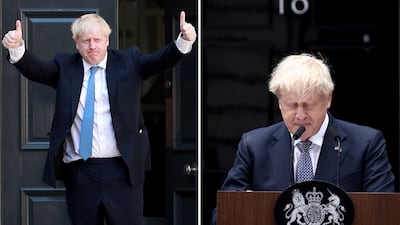
Boris Johnson became UK prime minister in July 2019, left, and resigned three years later in July 2022, right. Here 'The National' looks back at his colourful time as leader of the country. Getty Images / Reuters -
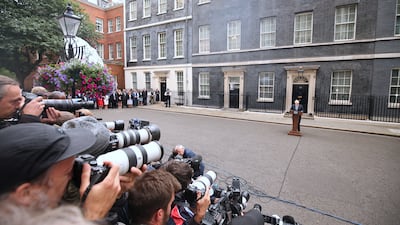
Boris Johnson reads a statement outside 10 Downing Street, formally resigning as Conservative Party leader. PA -
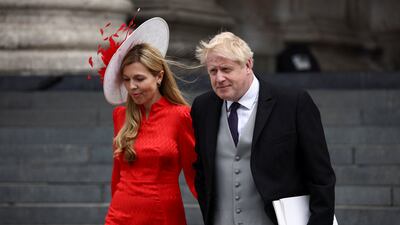
Boris Johnson and his wife Carrie Johnson attend the National Service of Thanksgiving to celebrate the Platinum Jubilee of Queen Elizabeth at St Paul's Cathedral in June 2022. Getty Images -
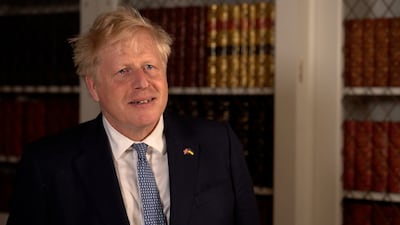
Boris Johnson addresses the media after surviving a confidence vote in his leadership, in June 2022. PA -
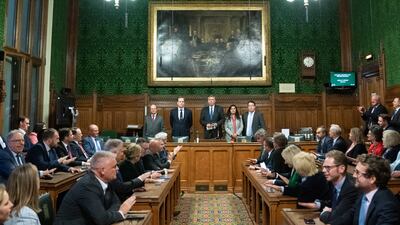
Sir Graham Brady, chairman of the 1922 Committee of Tory backbenchers, announcing that Mr Johnson had survived a confidence vote in his leadership at the Houses of Parliament in June. PA -
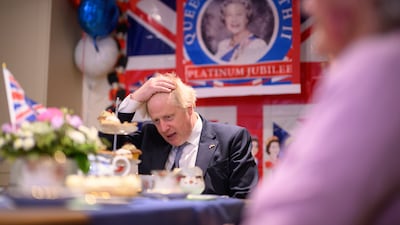
Mr Johnson chats with residents in a Diamond Jubilee-themed room as he makes a constituency visit to Sweetcroft care home in Uxbridge, in May 2022. Getty Images -
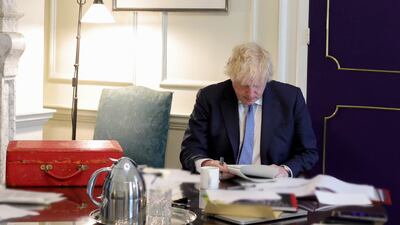
Boris Johnson reads the findings of the Sue Gray report into gatherings on government premises while Covid-19 restrictions were in place, in his office in No 10, Downing Street in May 2022. Photo: Downing Street -
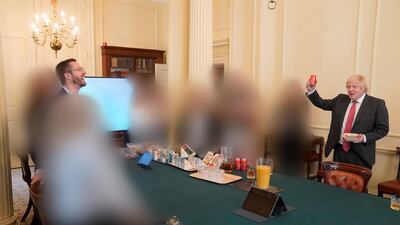
An image of a gathering in the Cabinet Room in No 10, Downing Street in June 2020 on the prime minister's birthday was released alongside the Sue Gray report. Photo: Cabinet Office -
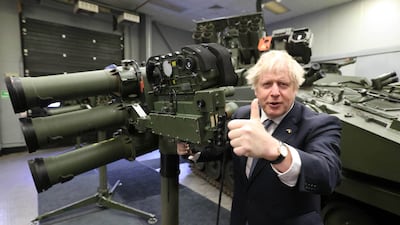
Boris Johnson with a Mark 3 shoulder launch missile system at Thales weapons manufacturer during a visit to Northern Ireland for talks, in May 2022 in Belfast. Getty Images -
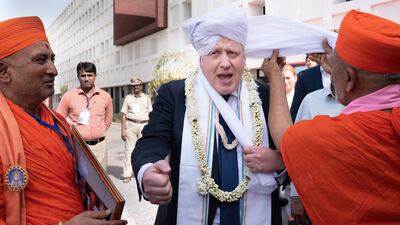
Mr Johnson having a turban placed on his head at Gujarat Bio Technology University, during his two-day trip to India in April. Getty Images -
Mr Johnson after apologising to MPs for the 'partygate' fine he had received, in the House of Commons in April. AFP -
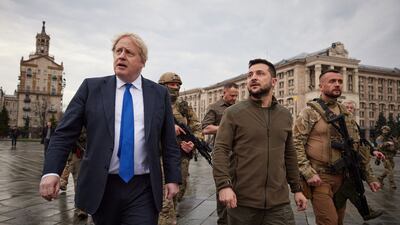
Mr Johnson and Ukrainian President Volodymyr Zelenskyy walking in central Kyiv, in April. AFP -
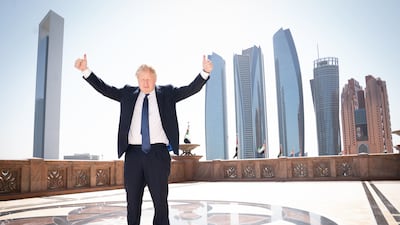
Mr Johnson arrives for a media interview at the Emirates Palace hotel in Abu Dhabi, in March 2022. Getty Images -

Mr Johnson speaks with officers as he makes a constituency visit to Uxbridge police station in December 2021. Getty Images -
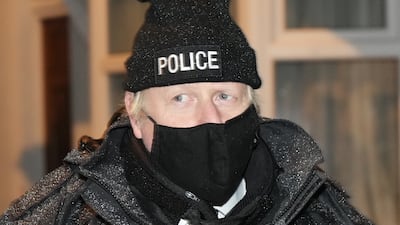
Mr Johnson observes an early morning Merseyside Police raid on a home in Liverpool as part of 'Operation Toxic' to infiltrate county lines drug dealings in December 2021. Getty Images -
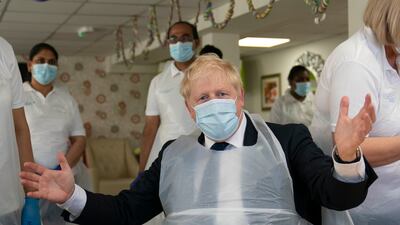
Boris Johnson during a visit to Westport Care Home in Stepney Green, ahead of unveiling his long-awaited plan to fix the social care system, in September 2021. Getty Images -
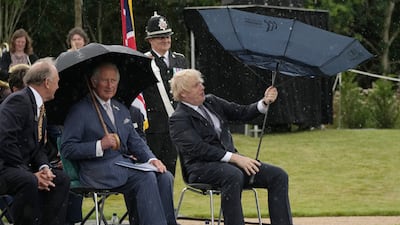
Prince Charles looks on as Boris Johnson attempts to open his umbrella at the National Memorial Arboretum in Stafford, in July 2021. Getty Images -
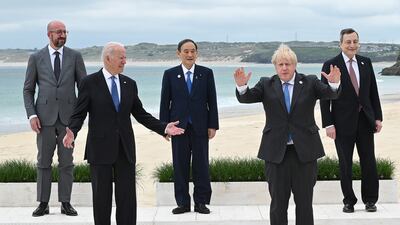
President of the European Council Charles Michel, US President Joe Biden, Japanese Prime Minister Yoshihide Suga, Mr Johnson and Italian PM Mario Draghi pose for the leaders' official photo during the G7 summit in Cornwall, in June 2021. Getty Images -
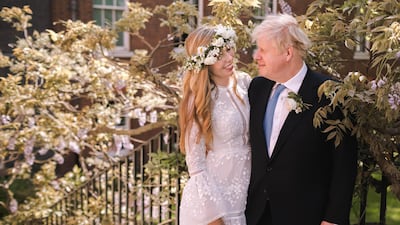
Mr Johnson poses with his wife Carrie in the garden of No 10, Downing Street following their wedding at Westminster Cathedral, in May 2021. Getty Images -
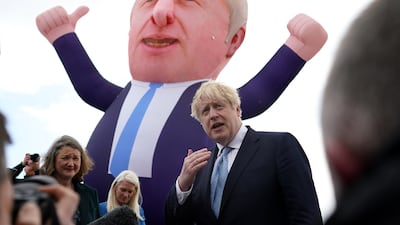
Mr Johnson visits Hartlepool after the Conservative Party candidate Jill Mortimer won the Hartlepool by-election in May 2021. Getty Images -
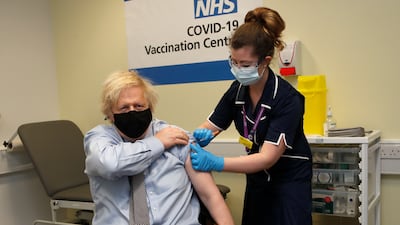
Mr Johnson receives his first dose of the AstraZeneca vaccine at St. Thomas' Hospital in London, in March 2021. Getty Images -
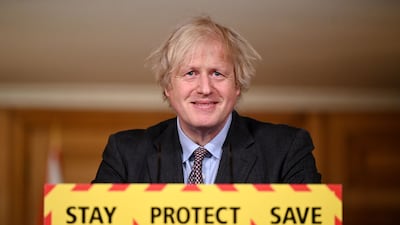
Mr Johnson smiles during a televised press conference at No 10, Downing Street in February 2021, as he announces a phased exit from the country's lockdown measures. Getty Images -

Mr Johnson gives a thumbs-up gesture after signing the Brexit trade deal with the EU in No 10, Downing Street, in December 2020. Getty Images -
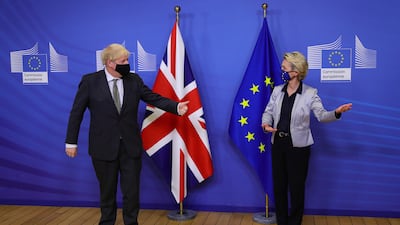
Mr Johnson and European Commission President Ursula von der Leyen meet for a dinner to try to reach a breakthrough on a post-Brexit trade deal, in December 2020 in Brussels. Getty Images -
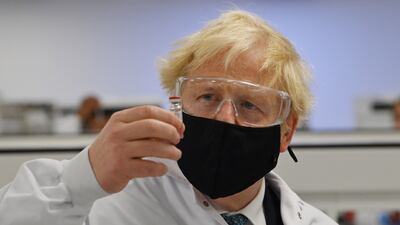
Mr Johnson with a vial of the AstraZeneca Covid-19 candidate vaccine, known as AZD1222, at Wockhardt's pharmaceutical manufacturing facility, in November 2020, in Wrexham, Wales. Getty Images -
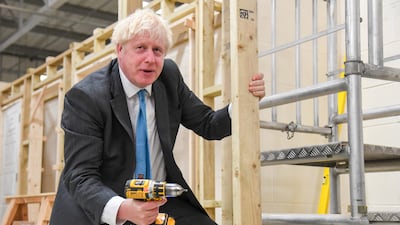
Mr Johnson drills during his visit to Exeter College in September 2020. Getty Images -
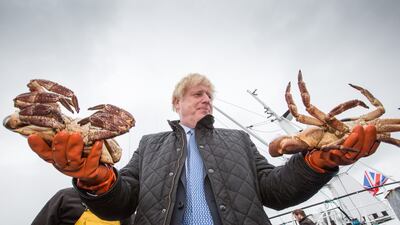
Mr Johnson holds crabs caught on the Carvela at Stromness Harbour in July 2020, during a visit to Scotland. Getty Images -
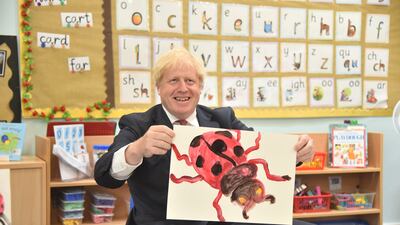
Mr Johnson holds a painting of a ladybird during a visit to The Discovery School in West Malling, in July 2020. Getty Images -
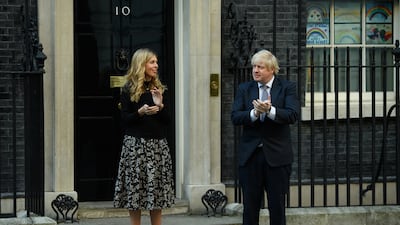
Mr Johnson and his fiancée Carrie Symonds applaud for key workers outside No 10, Downing Street, in May 2020. Getty Images -
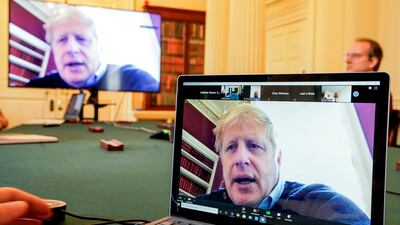
Boris Johnson appears on monitors for a meeting in London. The prime minister chaired the morning update meeting remotely as he was self-isolating after testing positive for Covid-19. Reuters -
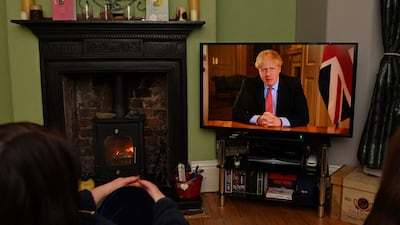
Boris Johnson makes a televised address to the nation from inside No 10, Downing Street, with the latest instructions to stay at home to help contain the Covid-19 pandemic, in March 2020. AFP -
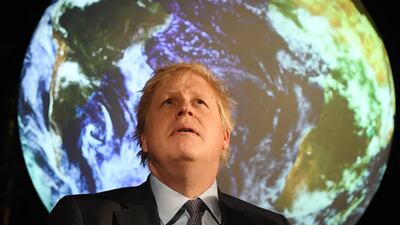
Mr Johnson attends the launch of the UK-hosted COP26 Summit at the Science Museum in London, in February 2020. Getty Images -

Mr Johnson is greeted by staff at No 10, Downing Street, after meeting Queen Elizabeth II and accepting her invitation to form a new government in December 2019. PA -

Mr Johnson and his partner Carrie enter Downing Street as the Conservatives celebrate a sweeping election victory in December 2019. Getty Images -
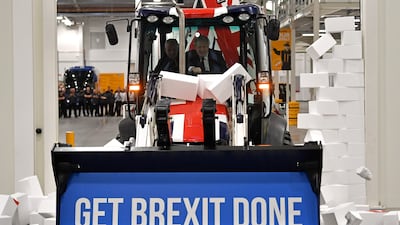
Mr Johnson drives a digger with the words 'Get Brexit Done' inside the digger bucket through a fake wall emblazoned with the word 'GRIDLOCK', during a general election campaign event in December 2019. Getty Images -
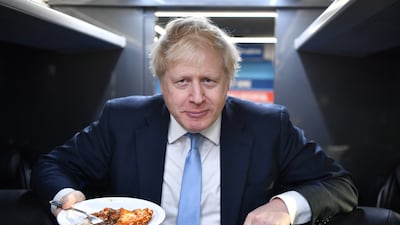
Mr Johnson eats pie on the campaign bus in Derby, on the final day of campaigning before the general election in December 2019. Getty Images -
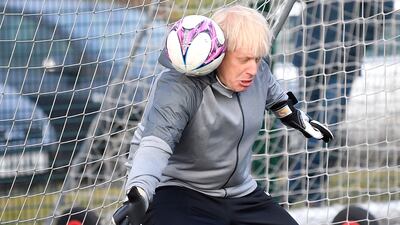
Mr Johnson takes a turn in goal during the warm up before a girls' football match between Hazel Grove United JFC and Poynton Juniors in December 2019. Getty Images -
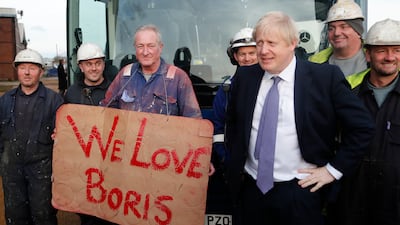
Mr Johnson poses with workers as he is given a tour of Wilton Engineering Services as part of an election campaign trail stop in November 2019, in Middlesbrough. Getty Images -
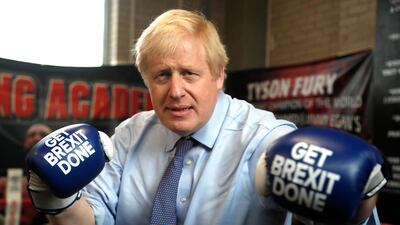
Mr Johnson poses for a photo wearing boxing gloves during a stop on his general election campaign trail in Manchester, in November 2019. Getty Images -

Mr Johnson eats a rock sweet which reads 'Back Boris' during a general election campaign trail stop in Blackpool, in November 2019. Getty Images -
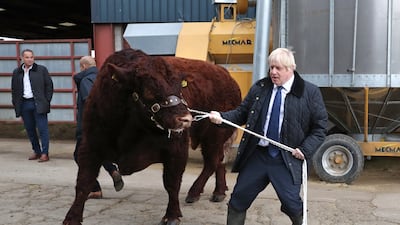
Mr Johnson leads a bull around a pen as he visits Darnford Farm near Aberdeen, Scotland, in September 2019. Getty Images -
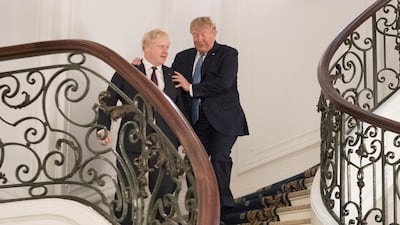
Former US president Donald Trump and Mr Johnson arrive for a bilateral meeting during the G7 summit in August 2019, in Biarritz, France. Getty Images -
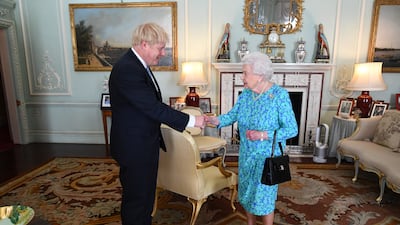
Queen Elizabeth welcomes Mr Johnson as the newly elected leader of the Conservative party and invites him to become prime minister and form a new government, at Buckingham Palace in July 2019. Getty Images


Poor Sunak. He’s not got one but two former leaders to contend with. They both outdo him in terms of personal popularity and they both miss what they had and would like it back. Meanwhile he must run the country while somehow boosting his own rating.
This, against a backdrop of war on mainland Europe, rising energy bills, inflation, a Brexit that has yet to deliver if ever, tensions with China, domestic productivity that refuses to move in the right direction and a swathe of new Northern MPs who constantly demand his devotion to levelling up, a policy dreamt up by Johnson.
Oh, and Sir Keir Starmer and Labour are hounding his every step.
In Johnson’s case, more than 50 members of his government resigned. As for Truss, she was ejected by her own MPs. That should be it for them both.
And yet, it’s the question swirling round Westminster: they couldn’t lead again, could they? The answer ought to be no, but there again, who would have thought Johnson and Truss would have been chosen to lead in the first place?
Nothing is impossible any more.

