


It is early days but a nag is developing where Rishi Sunak’s suitability as prime minister is concerned. Has Britain got itself a chief of finance for a CEO?
In the corporate world it is well-known that the moneymen do not usually make the best chief executives. They require different skill sets. One is a number-cruncher, concerned with figures and spreadsheets, the other is a leader, manager of the big picture, someone who knows how to extract the best from their teams across all areas.
Indeed, often the role of a good finance director is to challenge the chief executive officer, to question the path they wish to embark upon. The former is a number two position.
In Britain’s government hierarchy, that traditionally is the job of the chancellor of exchequer. And in Britain currently, we have two chancellors.
Sunak, a former chancellor, appears to be taking a hands-on interest in the work of the present chancellor, Jeremy Hunt. Which begs the question, what is Hunt for?
Of course, the UK is in poor economic health but it’s the task of the chancellor and their Treasury department to come up with a convincing plan for treatment. That programme would then be presented to the prime minister and the rest of the Cabinet for approval.
Instead, we’re informed that Mr Sunak is engaged constantly on proposals to fill the public spending gap, that he devoted much of this past weekend to that conundrum. It was given as an excuse for him not wishing to attend the Cop27 climate change talks in Egypt. Latterly, the indication is that he has changed his mind and he may now go, but that only appears to be because his nemesis Boris Johnson is said to be going.
The signal his original non-attendance sent, that Britain is pushing climate change down its priorities — unlike the US and France, with their presidents Joe Biden and Emmanuel Macron both going to Cop — was bad enough. This, as well, after Mr Sunak removed the Cabinet status of the Cop minister, Alok Sharma.
Mr Sunak, a banker and hedge fund manager before entering Parliament, may be happiest poring over accounts. It could be his comfort blanket, his default. That is unlikely to make him a successful prime minister.
Inspiration or perspiration
-
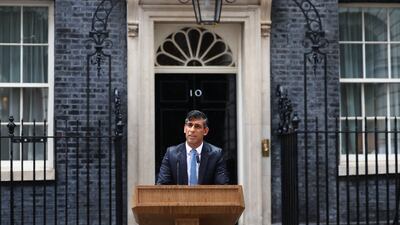
British Prime Minister Rishi Sunak announces July 4 as the date for the 2024 general election at No 10 Downing Street. Here, The National looks back at his political career. Getty Images -
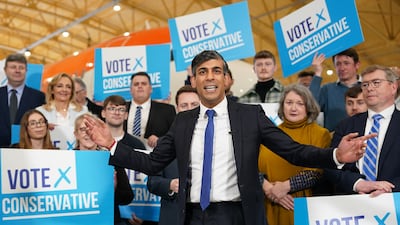
Mr Sunak during local election campaigning in Teesside in May 2024. Getty Images -
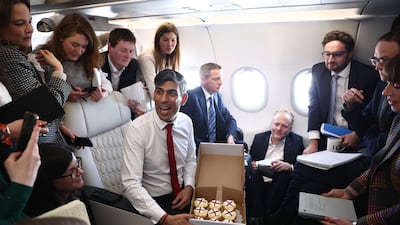
Mr Sunak presents cupcakes to journalists on board a plane on the way to Warsaw in April 2024. Getty Images -
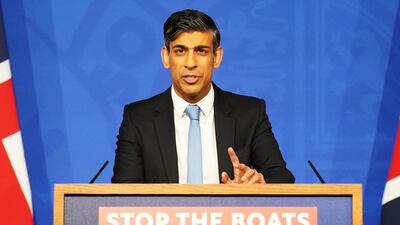
Mr Sunak during a press conference in Downing Street in January after the Safety of Rwanda Bill passed its third reading in the House of Commons. Getty Images -
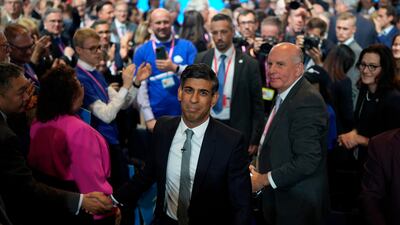
Being applauded after his speech at the Conservative Party conference in October 2023. Getty Images -
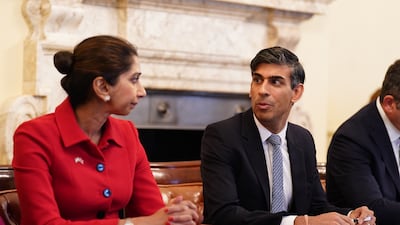
Looking pensive alongside then-home secretary Suella Braverman at No 10 in October 2023. She didn't last much longer in the cabinet. Getty Images -
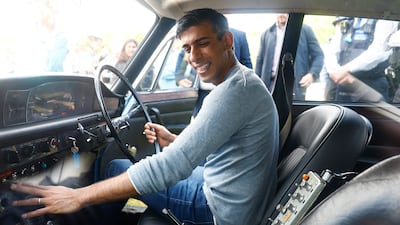
Mr Sunak sits in an old Special Branch police vehicle which was used to transport former prime minister Margaret Thatcher, in July 2023. Getty Images -

On board Border Agency cutter HMC Seeker during a visit to Dover in June 2023. Getty Images -
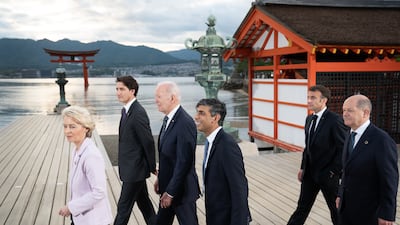
Mr Sunak alongside European Commission President Ursula von der Leyen, Canada's Prime Minister Justin Trudeau, US President Joe Biden, French President Emmanuel Macron and German Chancellor Olaf Scholz during the G7 Summit in May 2023. Getty Images -
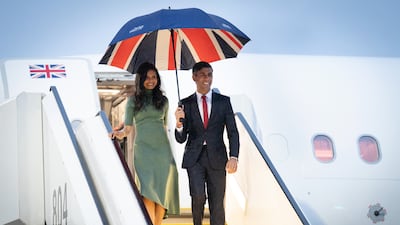
Mr Sunak and his wife Akshata Murty arriving in Japan ahead of the G7 Summit in May 2023. Getty Images -
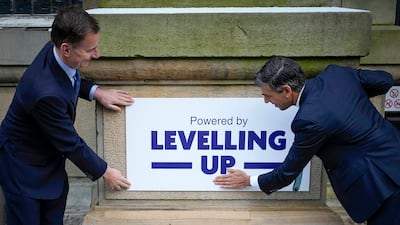
Mr Sunak and Chancellor Jeremy Hunt sending a message at Accrington Market Hall in January 2023. Getty Images -
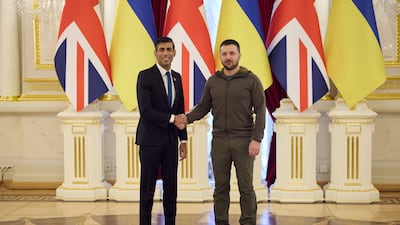
Mr Sunak and Ukrainian President Volodymyr Zelenskyy meet in Ukraine's capital Kyiv in November 2022. Getty Images -

King Charles III welcomes Mr Sunak during an audience at Buckingham Palace, where he invited the newly elected leader of the Conservative Party to become Prime Minister and form a new government in October 2022. Getty Images -
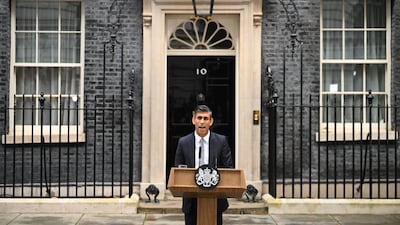
Mr Sunak makes a statement outside No 10 in October 2022 after taking office. Getty Images -
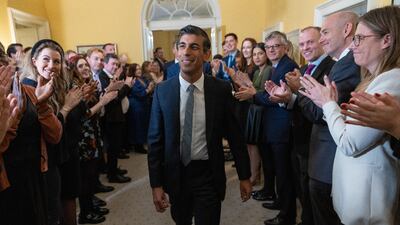
Mr Sunak arrives inside Number 10 in October 2022. Photo: Simon Walker/ No 10 Downing Street -
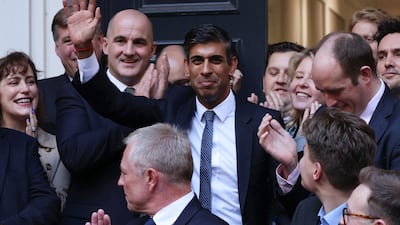
Greeted by colleagues at Conservative Party HQ after having been announced winner of the leadership contest in October 2022. Getty Images -
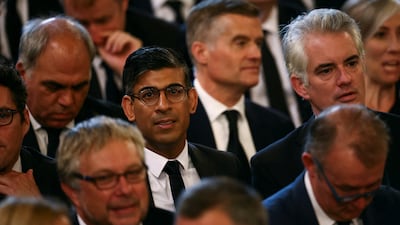
Mr Sunak at Westminster Hall in London following the death of Queen Elizabeth II in September 2022. PA -

Mr Sunak visits his family's old business, Bassett Pharmacy, on the campaign trail in August 2022. Getty Images -
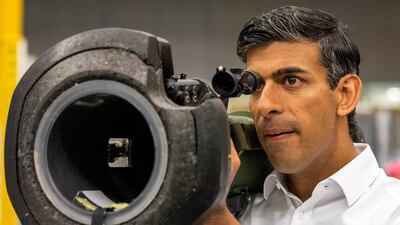
Mr Sunak looks at an NLAW anti-tank launcher during a visit to the Thales Defence System plant in Belfast in August 2022. Getty Images -
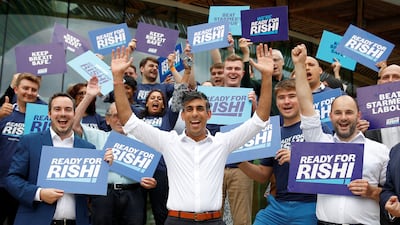
At a hustings event in Exeter in August 2022. Getty Images -
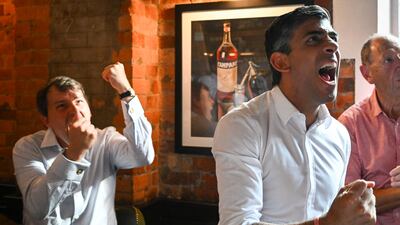
Celebrates England's first goal as he watches the Women's Euro 2022 final in Salisbury in July 2022. Getty Images -
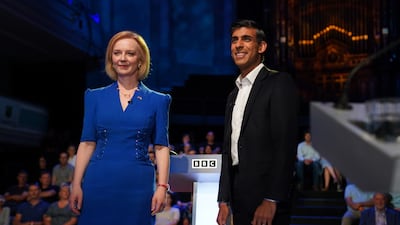
Mr Sunak and Ms Truss take part in the BBC Leadership debate at Victoria Hall, Hanley, in July 2022. Getty Images -
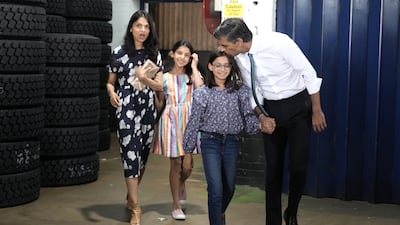
With daughters Krisna and Anoushka and wife Akshata Murthy in July 2022. Getty Images -
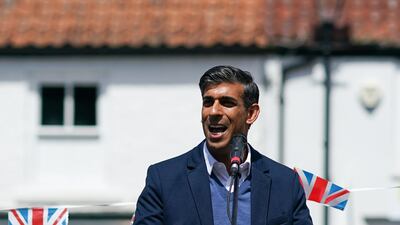
Opening the Great Ayton Village Fete during the queen’s Platinum Jubilee celebrations in June 2022. Getty Images -
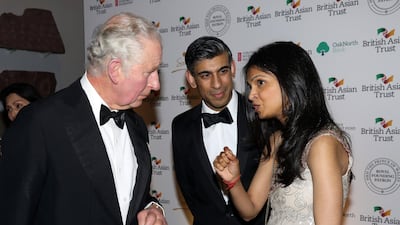
Mr Sunak and Ms Murthy speak to then-Prince Charles at a British Asian Trust event in February 2022. Getty Images -
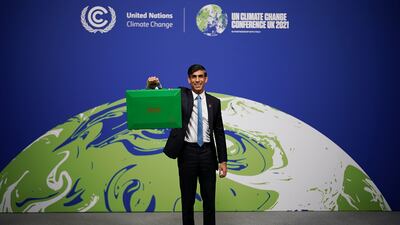
Mr Sunak arrives at COP26 in Glasgow in November 2021 when he was chancellor. Getty Images -
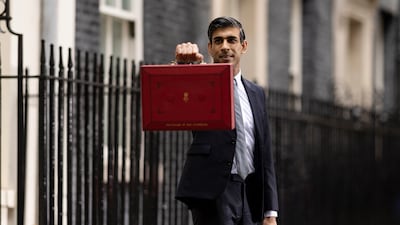
Holding the budget box as he departs 11 Downing Street to deliver his Autumn Budget in October 2021. Getty Images -
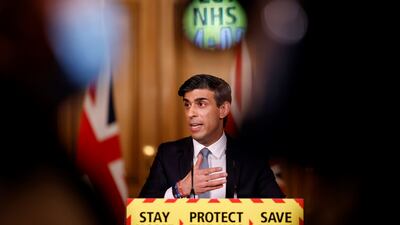
At a press conference on the 2021 Budget in London in March 2021. Getty Images -
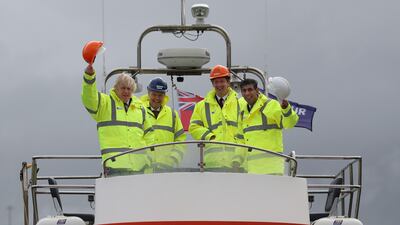
With former prime minister Boris Johnson during a visit to PD Ports on the River Tees in March 2021. Getty Images -
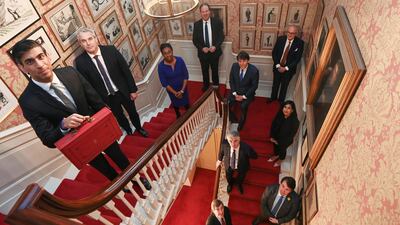
Mr Sunak poses with the budget box at 11 Downing Street in March 2021. Getty Images -
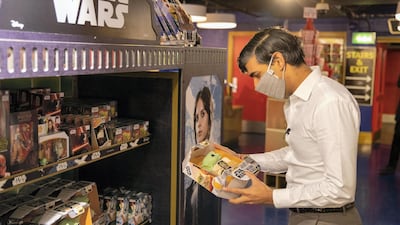
Meeting staff back at work after being furloughed at Hamleys toy shop in London, December 2020. Photo: HM Treasury -
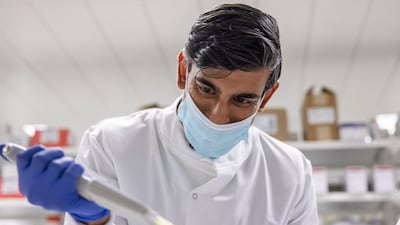
Mr Sunak visits the Imperial Clinic Research Facility at Hammersmith Hospital, London, in November 2020. Getty Images -
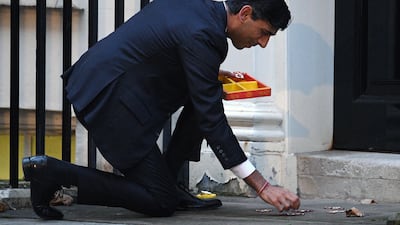
Lighting a candle for Diwali on Downing Street, November 2020. Getty Images -
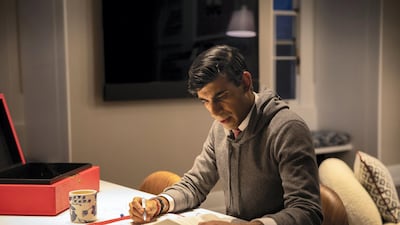
Working on a speech in his flat above 11 Downing Street in November 2020. Photo: HM Treasury -
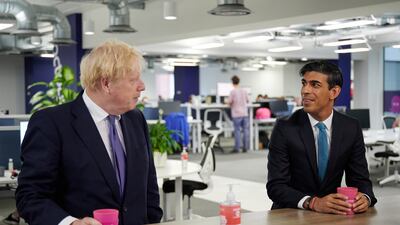
Mr Johnson and Mr Sunak visit the headquarters of Octopus Energy in London in October 2020. Getty Images -
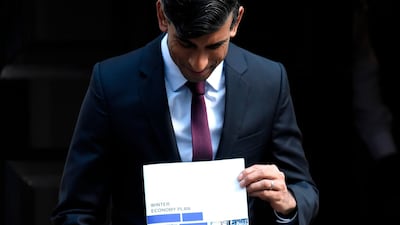
With his 'Winter Economy Plan' outside 11 Downing Street in September 2020. AFP -
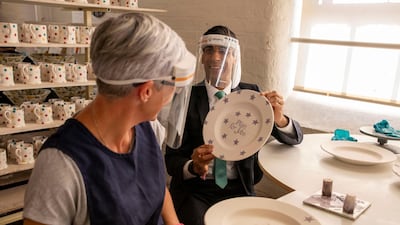
Decorating a plate at Emma Bridgewater pottery in Stoke pottery in September 2020. Getty Images -

Promoting 'eat out to help out' on the Isle of Bute, Scotland, in August 2020. Getty Images -
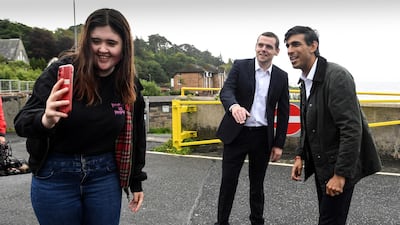
A member of the public takes a selfie with Rishi Sunak during a visit to Scotland in August 2020. AFP -

Visiting a Wagamama restaurant in central London in July 2020. Photo: HM Treasury -
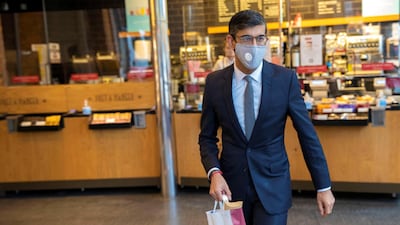
Rishi Sunak visits a Pret A Manger in Westminster in July 2020. HM Treasury -
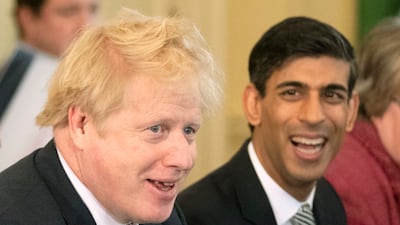
With Mr Johnson at his first Cabinet meeting after a reshuffle at 10 Downing Street in February 2020. Getty Images -
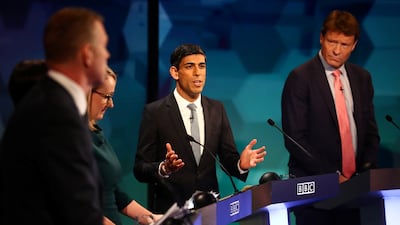
Mr Sunak speaks during a general election debate in Cardiff in November 2019. Getty Images


The consultancy firm McKinsey once conducted a survey on whether chief financial officers make suitable CEOs. Noted McKinsey: “In our informal poll, for every respondent who believed strongly that CFOs make good CEOs, another vehemently opposed the idea.”
Respondents observed that “CFOs are often without leadership skills, are weak at motivating and inspiring teams, and have a propensity to retain rather than delegate control.”
We’ve been here before in the UK, most notably and recently when Gordon Brown took over from Tony Blair in 2007. Mr Brown, the long-time chancellor, was humiliatingly voted out as prime minister in the May 2010 general election.

Mr Brown, too, spent the first part of his period as PM overseeing a financial rescue package, in his case in response to the 2008 banking crash.
Mr Sunak betrays signs of wishing to focus on the narrow task in hand rather than the broader long term. In a comment piece for the Mail on Sunday he went on at length about how he would be tackling the economy. Yet again we were told that “tough decisions” would be made.
Then, at somewhat breathtaking speed we were informed that once immediate issues were dealt with, he would be levelling up, delivering “world-class education”, putting 20,000 more police on the streets, controlling the borders and developing energy security. These and others he cited, were contained in the 2019 Conservative manifesto. But he offered no detail as to how, precisely, they were to be accomplished.

Rather, “we will build an economy that modernises and embraces the opportunities of Brexit, where businesses invest, innovate and create jobs.” This ignores the fact that so far, as even some ardent Brexiteers are beginning to concede, there has been precious sign of the so-called “Brexit dividend”.
The point about this current economic dip is that it’s temporary. Mr Sunak says so himself. We will get over it. “The confidence and determination that are the hallmarks of our great nation will carry us through the tough times and towards a new age of hope and optimism.” So, why does he spend so long dwelling on it? He should be projecting ahead and providing us with his detailed vision for the NHS, state schools, welfare, law and order, and managing climate change.
Also, doesn’t the prediction of a “new age of hope and optimism” smack rather of a wing and a prayer? Put him on to the economic crisis and he speaks of the need to balance the books, of making “difficult choices” to “get our borrowing and our debt back on a sustainable path.” Once that’s achieved, however, it’s back to the same old boosterism and platitudes.
There’s a reason why so few CFOs become CEO and fewer still become a successful CEO. Mr Sunak must stop being chancellor and prove he has what it takes to join that elite few.

