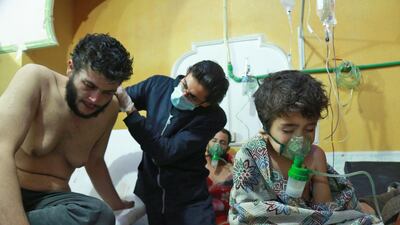
A child receiving oxygen through a respirator following an alleged poison gas attack in Douma on April 8, 2018. Syrian Civil Defense White Helmets via AP

Syrian chemical attacks: there's more to justice than assigning blame


  • English
  • Arabic

Three years ago this week, I met a man called Abdul Hamid Al Yousef. He had endured a tragedy like no other.

Two days earlier, he had buried his wife and two infant children, who had suffocated to death in the Syrian town of Khan Sheikhoun. Nearly 20 members of his immediate and extended family had died in the second deadliest chemical attack of the ongoing Syrian civil war. The atrocity was carried out by the forces of Bashar Al Assad.

I sat next to Al Yousef at his home in the town. He seemed to drift mentally in and out of the room. A visitor told him a hadith by the Prophet Muhammad about Al Sirat, the bridge that all people must cross on the day of judgment, suspended above hell and leading to paradise. The hadith speaks of a reward for those who lose their children at a young age and endure the loss with forbearance – their babies will have wings and will fly them across the bridge to eternal joy. The story seemed to rouse Al Yousef from his stupor.

That was three years ago. Two years ago, another chemical attack took place in the city of Douma, also carried out by Al Assad's forces, which claimed the lives of 40 to 50 people. It appears there may be no justice for Al Yousef nor the other victims of chemical warfare in Syria until the afterlife.

More than half a million people have been killed in nine years of war in Syria, felled by everything from explosive barrels dropped from the sky to the slow death of starvation sieges. But chemical weapons still evoke a particular horror. Perhaps it is the insidiousness of the air you breathe in poisoning you, or the sheer violence and terror of the symptoms but without any blood, as though the victims’ own bodies are betraying them from within. Maybe it is the barbarism and impunity such weaponry evokes, so cruel that they were banned a century ago by the global community of nations.

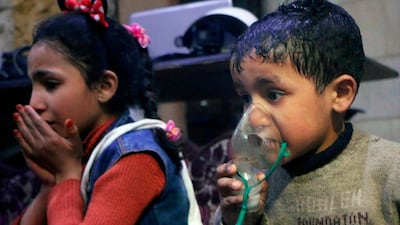
  • Syrian children and adults receive treatment for a suspected chemical attack at a makeshift clinic on the outskirts of Damascus on February 25, 2018. AFP
    Syrian children and adults receive treatment for a suspected chemical attack at a makeshift clinic on the outskirts of Damascus on February 25, 2018. AFP
  • Members of a family from Douma, Syria, who fled after enduring weeks of bombing, near-starvation from a crippling siege and a suspected chemical attack, stand outside a tent in a northern Syrian displaced-persons camp on May 29, 2018. AP
    Members of a family from Douma, Syria, who fled after enduring weeks of bombing, near-starvation from a crippling siege and a suspected chemical attack, stand outside a tent in a northern Syrian displaced-persons camp on May 29, 2018. AP
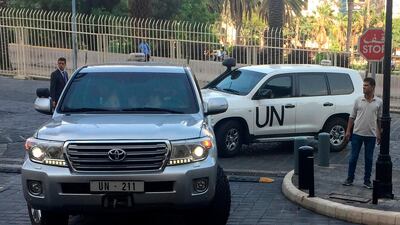
  • UN vehicles carrying the team of the Organization for the Prohibition of Chemical Weapons arrive at a hotel in Damascus on April 14, 2018, hours after the U.S., France and Britian launched an attack on Syrian facilities for suspected chemical attack against civilians. AP
    UN vehicles carrying the team of the Organization for the Prohibition of Chemical Weapons arrive at a hotel in Damascus on April 14, 2018, hours after the U.S., France and Britian launched an attack on Syrian facilities for suspected chemical attack against civilians. AP
  • Syrian authorities distributed bread, vegetables and pasta to residents of Douma, the site of a chemical weapons attack suspected to have been carried out by the Syrian government, on April 16, 2018. AP Photo
    Syrian authorities distributed bread, vegetables and pasta to residents of Douma, the site of a chemical weapons attack suspected to have been carried out by the Syrian government, on April 16, 2018. AP Photo
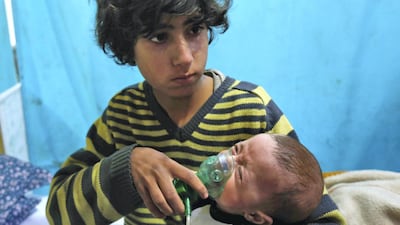
  • A Syrian boy holds an oxygen mask over the face of an infant at a make-shift hospital following a reported gas attack on the town of Douma, Syria, on January 22, 2018. AFP
    A Syrian boy holds an oxygen mask over the face of an infant at a make-shift hospital following a reported gas attack on the town of Douma, Syria, on January 22, 2018. AFP
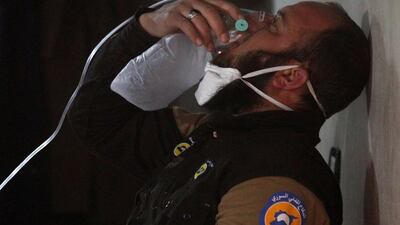
  • A child receiving oxygen through a respirator following an alleged poison gas attack in Douma on April 8, 2018. Syrian Civil Defense White Helmets via AP
    A child receiving oxygen through a respirator following an alleged poison gas attack in Douma on April 8, 2018. Syrian Civil Defense White Helmets via AP
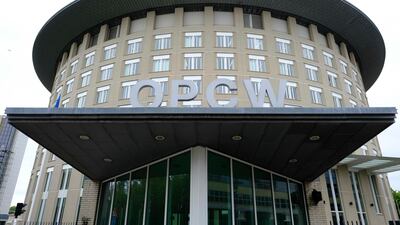
  • The headquarters of the Organisation for the Prohibition of Chemical Weapons, The Hague, Netherlands. AP
    The headquarters of the Organisation for the Prohibition of Chemical Weapons, The Hague, Netherlands. AP
  • A civil defence member breathes through an oxygen mask after the sarin gas attack on Khan Sheikhoun on April 4, 2017. Reuters
    A civil defence member breathes through an oxygen mask after the sarin gas attack on Khan Sheikhoun on April 4, 2017. Reuters

At any rate, it prompted the US administration, under Barack Obama at the time, at the time to infamously draw a red line in the sand, warning that the use of chemical weapons would change its calculus on intervention in the Syrian war. But when Al Assad gassed over a thousand civilians in August 2013 in the suburbs of Damascus, Mr Obama blinked. Instead, a deal was inked to eliminate Syria’s chemical weapons stockpile in order to head off any American assault.

But Damascus, as it transpired, held on to some of its stockpile. And it used it again.

Chemical weapons still evoke a particular horror; the victims' own bodies are betraying them from within

In addition to the deadliest attacks of the war, which used large quantities of the chemicals sarin and chlorine, activists and paramedics have documented dozens of instances in which smaller quantities of chlorine were used. The substance's use is morbidly popular because it causes terror without inflicting the kind of mass casualties that draw international attention. It is also because chlorine has legitimate domestic and industrial uses and so it cannot be proscribed. In total, more than 300 separate chemical attacks have been recorded by independent observers.

The Al Assad regime has now largely reclaimed most of the country, with the aid of Russia and Iran. An assault on one of the last regions outside of its control, the province of Idlib on the Turkish border, is frozen because of a ceasefire deal and the ongoing coronavirus pandemic. The regime is largely shielded from prosecution in the International Criminal Court despite its repeated atrocities because of Russia’s veto in the UN Security Council.

Nevertheless, a report this week by the Organisation for the Prohibition of Chemical Weapons, which investigated chemical attacks in Syria, has found that the Al Assad regime is responsible for a number of chemical attacks in the country, and is continuing to investigate other incidents to attribute responsibility.

Attributing blame for these heinous attacks is an important milestone and an essential step, for posterity, in establishing responsibility. Syria is the most well-documented conflict in modern history. The OPCW’s report is crucial because it further entrenches this truth: we cannot say that we did not know.

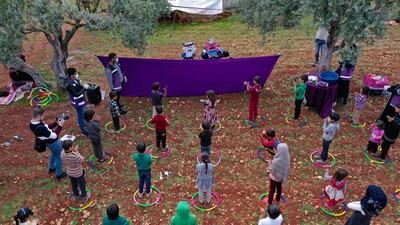
  • Volunteers from the Violet organisation perform a puppet show for children in a camp for displaced Syrians to inform them about coronavirus and the methods used to limit its spread, in the village of Kafr Yahmul, Idlib, Syria, on April 7, 2020. AFP
    Volunteers from the Violet organisation perform a puppet show for children in a camp for displaced Syrians to inform them about coronavirus and the methods used to limit its spread, in the village of Kafr Yahmul, Idlib, Syria, on April 7, 2020. AFP
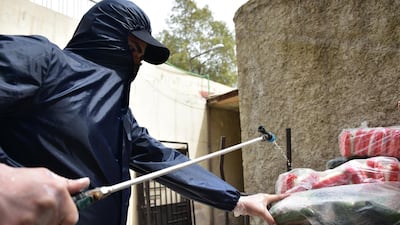
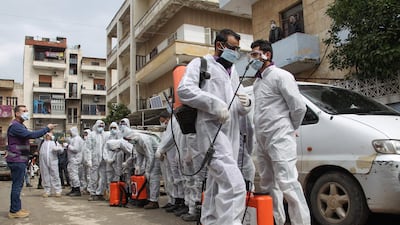
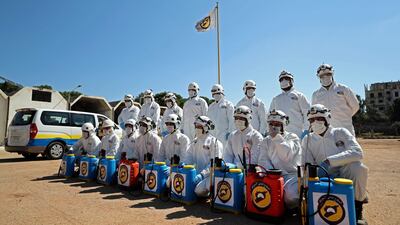
  • A member of an NGO in a protective suit disinfects bags containing foods in Damascus, Syria, on 6, April 2020. EPA
    A member of an NGO in a protective suit disinfects bags containing foods in Damascus, Syria, on 6, April 2020. EPA
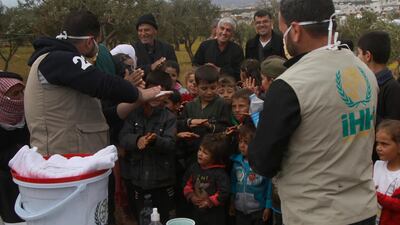
  • Aid workers from Turkish humanitarian group IHH show Syrian children how to properly wash their hands, at a camp for internally displaced persons in norther Syria, on Monday, April 6, 2020. IHH via AP
    Aid workers from Turkish humanitarian group IHH show Syrian children how to properly wash their hands, at a camp for internally displaced persons in norther Syria, on Monday, April 6, 2020. IHH via AP
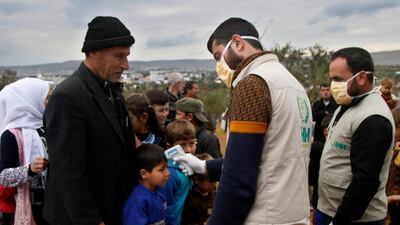
  • In this undated photo released by the Turkish humanitarian group IHH on Monday, April 6, 2020, aid workers of the group check the temperature of Syrian children at a camp for internally displaced persons in northern Syria. IHH via AP
    In this undated photo released by the Turkish humanitarian group IHH on Monday, April 6, 2020, aid workers of the group check the temperature of Syrian children at a camp for internally displaced persons in northern Syria. IHH via AP
  • Members of the Syrian Violet NGO prepare to disinfect the Ibn Sina Hospital in Idlib on March 19, 2020. AFP
    Members of the Syrian Violet NGO prepare to disinfect the Ibn Sina Hospital in Idlib on March 19, 2020. AFP
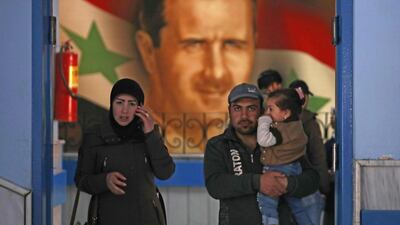
  • A family stand in the doorway of a ward at a hospital in the Syrian capital Damascus on March 19, 2020, as it is being prepared to quarantine possible cases of coronavirus, on March 19, 2020. AFP
    A family stand in the doorway of a ward at a hospital in the Syrian capital Damascus on March 19, 2020, as it is being prepared to quarantine possible cases of coronavirus, on March 19, 2020. AFP
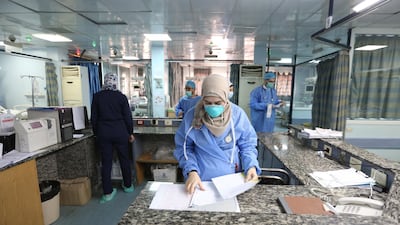
  • Health personnel prepare quarantine rooms at the government-run Al Mojtahed hospital in Damascus, Syria, on March 19, 2020. EPA
    Health personnel prepare quarantine rooms at the government-run Al Mojtahed hospital in Damascus, Syria, on March 19, 2020. EPA
  • Members of the Syrian Civil Defence, also known as the "White Helmets", prepare their equipment before sterilising a hospital in Idlib on March 22, 2020. AFP
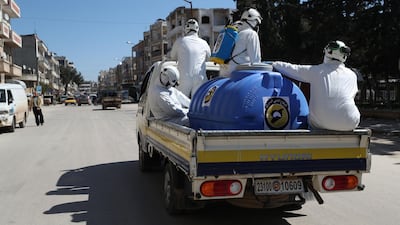
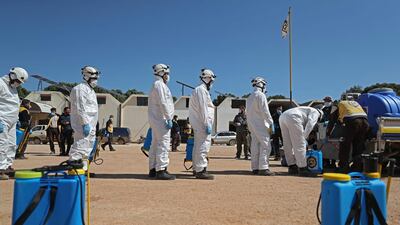
    Members of the Syrian Civil Defence, also known as the "White Helmets", prepare their equipment before sterilising a hospital in Idlib on March 22, 2020. AFP
  • Members of the Syrian Civil Defence, also known as the "White Helmets", prepare their equipment before sterilising a hospital in Idlib on March 22, 2020. AFP
    Members of the Syrian Civil Defence, also known as the "White Helmets", prepare their equipment before sterilising a hospital in Idlib on March 22, 2020. AFP
  • A member of the Syrian Civil Defence known as the "White Helmets" disinfects a hospital room in Dana, Syria, on March 22, 2020. AFP
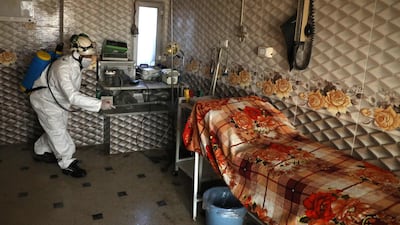
    A member of the Syrian Civil Defence known as the "White Helmets" disinfects a hospital room in Dana, Syria, on March 22, 2020. AFP
  • Members of the Syrian Civil Defence, also known as the "White Helmets", prepare their equipment before sterilising a hospital in Idlib on March 22, 2020. AFP
    Members of the Syrian Civil Defence, also known as the "White Helmets", prepare their equipment before sterilising a hospital in Idlib on March 22, 2020. AFP
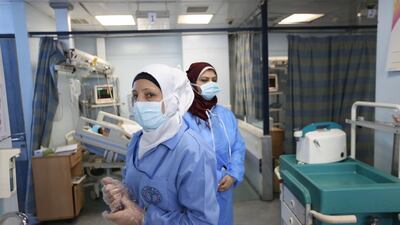
  • Nurses work in the intensive care unit at the government-run Al Mojtahed hospital in Damascus, Syria, on March 19, 2020. EPA
    Nurses work in the intensive care unit at the government-run Al Mojtahed hospital in Damascus, Syria, on March 19, 2020. EPA

But it is not enough. Attribution of blame does not equal justice for the victims. The international community must move heaven and earth to ensure that the perpetrators of the gravest crimes in Syria–  whether they are chemical attacks, the bombing of hospitals, the massacring of ethnic and religious minorities, indiscriminate attacks on civilians, or the starvation sieges – are held accountable.

The costs are enormous otherwise. It would mean that the worst excesses of violence in Syria can be enshrined as the normal conduct of warfare. Bombing hospitals becomes normal; starving people to death becomes normal; ethnic cleansing becomes normal and chemical weapons become normal again. It means the empowerment of inhumanity among people. It means taking 100 years' worth of steps backwards.

Justice must be done, for Abdul Hamid Al Yousef and others. If not today, then one day. They should not have to wait until the afterlife.

Kareem Shaheen is a former Middle East correspondent based in Canada

Skoda Superb Specs

Engine: 2-litre TSI petrol

Power: 190hp

Torque: 320Nm

Price: From Dh147,000

Available: Now

The rules on fostering in the UAE

A foster couple or family must:

  • be Muslim, Emirati and be residing in the UAE
  • not be younger than 25 years old
  • not have been convicted of offences or crimes involving moral turpitude
  • be free of infectious diseases or psychological and mental disorders
  • have the ability to support its members and the foster child financially
  • undertake to treat and raise the child in a proper manner and take care of his or her health and well-being
  • A single, divorced or widowed Muslim Emirati female, residing in the UAE may apply to foster a child if she is at least 30 years old and able to support the child financially
The specs: 2018 Honda City

Price, base: From Dh57,000
Engine: 1.5L, in-line four-cylinder
Transmission: Continuously variable transmission
Power: 118hp @ 6,600rpm
Torque: 146Nm @ 4,600rpm
Fuel economy, combined: 5.8L / 100km


SQUADS

Pakistan: Sarfraz Ahmed (capt), Azhar Ali, Shan Masood, Sami Aslam, Babar Azam, Asad Shafiq, Haris Sohail, Usman Salahuddin, Yasir Shah, Mohammad Asghar, Bilal Asif, Mir Hamza, Mohammad Amir, Hasan Ali, Mohammad Abbas, Wahab Riaz

Sri Lanka: Dinesh Chandimal (capt), Lahiru Thirimanne (vice-capt), Dimuth Karunaratne, Kaushal Silva, Kusal Mendis, Sadeera Samarawickrama, Roshen Silva, Niroshan Dickwella, Rangana Herath, Lakshan Sandakan, Dilruwan Perera, Suranga Lakmal, Nuwan Pradeep, Vishwa Fernando, Lahiru Gamage

Umpires: Ian Gould (ENG) and Nigel Llong (ENG)
TV umpire: Richard Kettleborough (ENG)
ICC match referee: Andy Pycroft (ZIM)

Infiniti QX80 specs

Engine: twin-turbocharged 3.5-liter V6

Power: 450hp

Torque: 700Nm

Price: From Dh450,000, Autograph model from Dh510,000

Available: Now

THE SPECS

Engine: 1.5-litre turbocharged four-cylinder

Transmission: Constant Variable (CVT)

Power: 141bhp 

Torque: 250Nm 

Price: Dh64,500

On sale: Now

%E2%80%98FSO%20Safer%E2%80%99%20-%20a%20ticking%20bomb
%3Cp%3EThe%20%3Cem%3ESafer%3C%2Fem%3E%20has%20been%20moored%20off%20the%20Yemeni%20coast%20of%20Ras%20Issa%20since%201988.%3Cbr%3EThe%20Houthis%20have%20been%20blockading%20UN%20efforts%20to%20inspect%20and%20maintain%20the%20vessel%20since%202015%2C%20when%20the%20war%20between%20the%20group%20and%20the%20Yemen%20government%2C%20backed%20by%20the%20Saudi-led%20coalition%20began.%3Cbr%3ESince%20then%2C%20a%20handful%20of%20people%20acting%20as%20a%20%3Ca%20href%3D%22https%3A%2F%2Fwww.google.ae%2Furl%3Fsa%3Dt%26rct%3Dj%26q%3D%26esrc%3Ds%26source%3Dweb%26cd%3D%26ved%3D2ahUKEwiw2OfUuKr4AhVBuKQKHTTzB7cQFnoECB4QAQ%26url%3Dhttps%253A%252F%252Fwww.thenationalnews.com%252Fworld%252Fmena%252Fyemen-s-floating-bomb-tanker-millions-kept-safe-by-skeleton-crew-1.1104713%26usg%3DAOvVaw0t9FPiRsx7zK7aEYgc65Ad%22%20target%3D%22_self%22%3Eskeleton%20crew%3C%2Fa%3E%2C%20have%20performed%20rudimentary%20maintenance%20work%20to%20keep%20the%20%3Cem%3ESafer%3C%2Fem%3E%20intact.%3Cbr%3EThe%20%3Cem%3ESafer%3C%2Fem%3E%20is%20connected%20to%20a%20pipeline%20from%20the%20oil-rich%20city%20of%20Marib%2C%20and%20was%20once%20a%20hub%20for%20the%20storage%20and%20export%20of%20crude%20oil.%26nbsp%3B%3C%2Fp%3E%0A%3Cp%3EThe%20%3Cem%3ESafer%3C%2Fem%3E%E2%80%99s%20environmental%20and%20humanitarian%20impact%20may%20extend%20well%20beyond%20Yemen%2C%20experts%20believe%2C%20into%20the%20surrounding%20waters%20of%20Saudi%20Arabia%2C%20Djibouti%20and%20Eritrea%2C%20impacting%20marine-life%20and%20vital%20infrastructure%20like%20desalination%20plans%20and%20fishing%20ports.%C2%A0%3C%2Fp%3E%0A
Tamkeen's offering
  • Option 1: 70% in year 1, 50% in year 2, 30% in year 3
  • Option 2: 50% across three years
  • Option 3: 30% across five years 
Company%20profile
%3Cp%3E%3Cstrong%3EName%3A%3C%2Fstrong%3E%20Yabi%20by%20Souqalmal%C2%A0%3C%2Fp%3E%0A%3Cp%3E%3Cstrong%3EStarted%3A%20%3C%2Fstrong%3EMay%202022%2C%20launched%20June%202023%3C%2Fp%3E%0A%3Cp%3E%3Cstrong%3EFounder%3A%20%3C%2Fstrong%3EAmbareen%20Musa%3C%2Fp%3E%0A%3Cp%3E%3Cstrong%3EBased%3A%20%3C%2Fstrong%3EDubai%C2%A0%3C%2Fp%3E%0A%3Cp%3E%3Cstrong%3ESector%3A%20%3C%2Fstrong%3EFinTech%C2%A0%3C%2Fp%3E%0A%3Cp%3E%3Cstrong%3EInitial%20investment%3A%20u%3C%2Fstrong%3Endisclosed%20but%20soon%20to%20be%20announced%C2%A0%3C%2Fp%3E%0A%3Cp%3E%3Cstrong%3ENumber%20of%20staff%3A%20%3C%2Fstrong%3E12%C2%A0%3C%2Fp%3E%0A%3Cp%3E%3Cstrong%3EInvestment%20stage%3A%20%3C%2Fstrong%3Eseed%C2%A0%C2%A0%3C%2Fp%3E%0A%3Cp%3E%3Cstrong%3EInvestors%3A%20%3C%2Fstrong%3EShuaa%20Capital%3C%2Fp%3E%0A
The National Archives, Abu Dhabi

Founded over 50 years ago, the National Archives collects valuable historical material relating to the UAE, and is the oldest and richest archive relating to the Arabian Gulf.

Much of the material can be viewed on line at the Arabian Gulf Digital Archive - https://www.agda.ae/en

Calls

Directed by: Fede Alvarez

Starring: Pedro Pascal, Karen Gillian, Aaron Taylor-Johnson

4/5

Queen

Nicki Minaj

(Young Money/Cash Money)

Top tips

Create and maintain a strong bond between yourself and your child, through sensitivity, responsiveness, touch, talk and play. “The bond you have with your kids is the blueprint for the relationships they will have later on in life,” says Dr Sarah Rasmi, a psychologist.
Set a good example. Practise what you preach, so if you want to raise kind children, they need to see you being kind and hear you explaining to them what kindness is. So, “narrate your behaviour”.
Praise the positive rather than focusing on the negative. Catch them when they’re being good and acknowledge it.
Show empathy towards your child’s needs as well as your own. Take care of yourself so that you can be calm, loving and respectful, rather than angry and frustrated.
Be open to communication, goal-setting and problem-solving, says Dr Thoraiya Kanafani. “It is important to recognise that there is a fine line between positive parenting and becoming parents who overanalyse their children and provide more emotional context than what is in the child’s emotional development to understand.”
 

Liverpool 4-1 Shrewsbury

Liverpool
Gordon (34'), Fabinho (44' pen, 90' 3), Firmino (78')

Shrewsbury
Udoh (27'minutes)

Man of the Match: Kaide Gordon (Liverpool)

ICC Intercontinental Cup

UAE squad Rohan Mustafa (captain), Chirag Suri, Shaiman Anwar, Rameez Shahzad, Mohammed Usman, Adnan Mufti, Saqlain Haider, Ahmed Raza, Mohammed Naveed, Imran Haider, Qadeer Ahmed, Mohammed Boota, Amir Hayat, Ashfaq Ahmed

Fixtures Nov 29-Dec 2

UAE v Afghanistan, Zayed Cricket Stadium, Abu Dhabi

Hong Kong v Papua New Guinea, Sharjah Cricket Stadium

Ireland v Scotland, Dubai International Stadium

Namibia v Netherlands, ICC Academy, Dubai

The biog

Name: Shamsa Hassan Safar

Nationality: Emirati

Education: Degree in emergency medical services at Higher Colleges of Technology

Favourite book: Between two hearts- Arabic novels

Favourite music: Mohammed Abdu and modern Arabic songs

Favourite way to spend time off: Family visits and spending time with friends