

Pope Francis, leader of the Catholic Church since 2013, has died at the age of 88 in his residence in the Vatican. Jorge Mario Bergoglio took his papal name from St Francis of Assisi on account of the latter's endorsement of chastity and poverty as the bedrock of life.
As Pope, Francis impressed his own ideology on the church, seeking to promote individual religious observance, help for the poor and the nurturing of basic gospel tenets such as charity and humility. An ascetic approach led him to eschew the luxury accommodation and trappings of the Vatican in favour of a simpler, humble lifestyle.
It was a mark of his papacy that the Vatican joined with Muslim leaders to fashion the 2019 Document on Human Fraternity – which was signed in Abu Dhabi – to promote dialogue, coexistence, understanding and mutual respect in an elevated Christian-Islamic dialogue. His visit to the UAE was the first such visit by a Catholic Pope to the Arabian Peninsula. A historic trip marked stronger ties with the Muslim and Arab worlds.
He was eager to spread his message to far parts of the globe and to the Middle East, epitomised by the first papal visits to the UAE, Bahrain and Iraq. Francis toured areas of Iraq, not long after it was held by ISIS, over four days in 2021, in his first overseas visit since the coronavirus outbreak the year before.
-
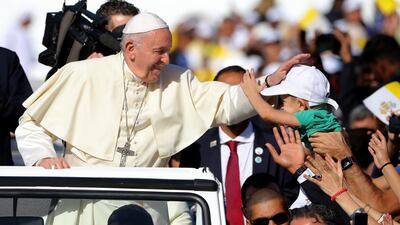
Jorge Mario Bergoglio, who became Pope Francis and leader of the Catholic Church in 2013, has died at the age of 88. Getty Images -

Pope Francis attends the funeral Mass for Pope Emeritus Benedict XVI in January 2023 at St Peter's Square in Vatican City. Getty Images -

Pope Francis with Sheikh Mohamed bin Zayed and Sheikh Mohammed bin Rashid at the Presidential Palace in Abu Dhabi in February 2019. Photo: Presidential Court -

Pope Francis with King Hamad of Bahrain at Sakhir Palace, south of Manama, in November 2022. Reuters -

Pope Francis leads Mass with the new cardinals in August 2022 in Vatican City. Getty -
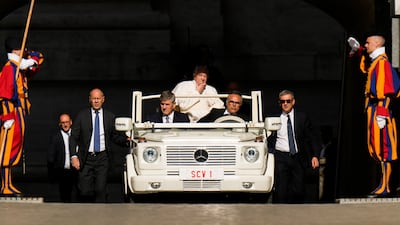
Pope Francis is driven in his specially designed vehicle to present his weekly address in June 2022. AP -
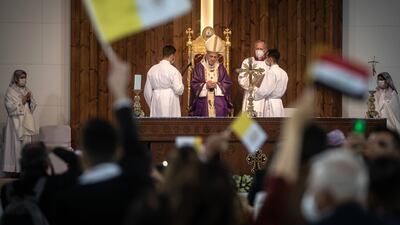
Pope Francis conducts Mass at Franso Hariri Stadium in March 2021 in Erbil, Iraq. Getty Images -
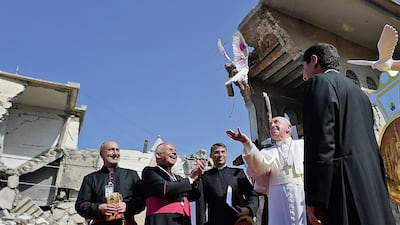
Pope Francis releases a white dove near the ruins of the Syriac Catholic Church of the Immaculate Conception in the old city of Mosul, Iraq, in March 2021. AFP -

Pope Francis arrives at the Franso Hariri Stadium in Erbil in March 2021. Getty Images -

Pope Francis celebrates Mass at Zayed Sport City, Abu Dhabi, in February 2019. Getty Images -

Pope Francis during the Stations of the Cross at the Colosseum in March 2018 in Rome. Getty Images -

Pope Francis at Easter Mass in St Peter's Square, Vatican City, in April 2017. Getty Images -

Pope Francis meets migrants at the Moria detention centre in Lesbos, Greece, in April 2016. Getty Images -

Pope Francis washes the feet of 12 migrants during Easter celebrations in Rome in 2016. Getty Images -
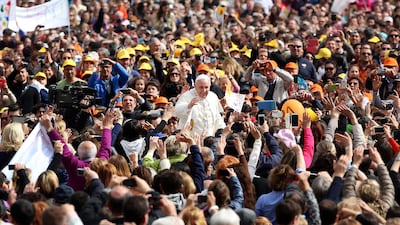
Pope Francis greets the faithful as he holds his weekly audience in St Peter's Square in 2014. Getty Images -

Pope Francis prays by the Western Wall in Jerusalem in May 2014. Getty Images -
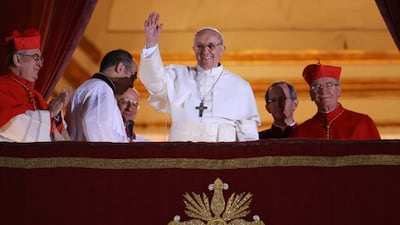
A newly elected Pope Francis waves from the balcony of St Peter's Basilica in Vatican City in March 2013. Getty Images -
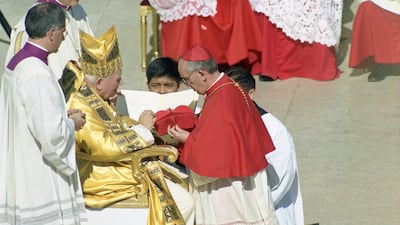
Pope John Paul II names Jorge Mario Bergoglio as cardinal in St Peter's Square in February 2001. Getty Images -
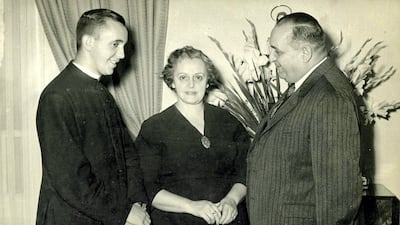
Jorge Bergoglio, before he became known as Pope Francis, with his mother Maria Regina Sivori and father Mario Jose Bergoglio in Buenos Aires in 1958. AFP -
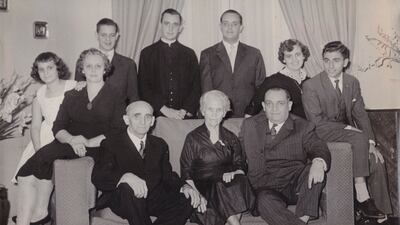
Jorge Bergoglio with his family. AP


Surrounded by a broken society and the destroyed churches of Mosul, he led public prayers and held a mass at Francois Hariri Stadium in Erbil, attended by 10,000 faithful. Reflecting on the displacement and killings wrought by the terrorists in what he called “the cradle of civilisation”, Pope Francis conveyed a message of hope: “Today, we reaffirm our conviction that fraternity is more durable than fratricide, that hope is more powerful than hatred, that peace is more powerful than war.” En route to Iraq, he sent messages to Israel, Palestine and Jordan as he flew overhead.
Born and raised in the sprawling barrio of Flores on the outskirts of Buenos Aires on December 17, 1936, his middle-class upbringing included a modest education. He left school with a diploma in chemistry and worked in a food laboratory. He joined the Jesuits aged 20, studied humanities, and taught psychology and literature in the 1960s. The decade culminated in his ordainment to the priesthood and a spell as a professor of theology was followed by a difficult period throughout much of the 1970s under Argentina’s junta.
in 2021
His rise through the ranks of the church continued as Auxiliary Bishop of Buenos Aires, then Archbishop, when he doubled the number of priests working in the Argentinian capital’s shanty towns and was committed to the ritual of washing the feet of the poor, whether in their homes, or in the city's streets, jails or hospitals.
Despite having been overlooked as replacement for Pope John Paul II in favour of Cardinal Ratzinger – who became Pope Benedict in 2005 – and having been stood down as Archbishop of Buenos Aires in 2011 under church law because he had turned 75, he was elected pontiff on March 13, 2013, after Benedict’s sudden resignation shocked the world.
Muslim leaders in his native Argentina welcomed the appointment, saying he had “always showed himself as a friend of the Islamic community”. Throughout this leadership he became known for his sincerity and frequently espoused the virtues of family devotion, prayer, generosity, temperance, serenity, a respect for nature, a positive attitude and, of course, peace.
Without turning the Catholic church on its head – and even while maintaining much of its deep-rooted traditions, such as upholding the ban on female clergy members – his leadership still veered away from the conservatism of his predecessor, whose own tenure had been dogged by scandal and discoloured by claims of covering up abuse.
To resist extremism and intolerance, Pope Francis made historic fraternity one of the hallmarks of his papacy. The decision was made over an impromptu lunch with the Grand Imam of Al Azhar, Dr Ahmed Al Tayeb, and sealed on the visit to the UAE, during which he visited Sheikh Zayed Grand Mosque and celebrated a papal mass at Zayed Sport City Stadium, attended by thousands of Catholics living in the UAE and visiting from other Gulf states.
The document made clear the threat from bigotry, racism and discrimination to global stability and security. After it was signed, the UN General Assembly adopted a resolution to establish an International Day of Human Fraternity.

The Higher Committee of Human Fraternity – which independently promotes human fraternity values – was also set up, based in Abu Dhabi, and includes religious scholars and international appointees from the fields of culture and education. The Zayed Award for Human Fraternity was also established in 2019 and awarded to Pope Francis and the Grand Imam.
Pope Francis spoke regularly against conflict around the globe and in December 2024 used his Christmas address to highlight the grim plight of the Palestinian people in the besieged Gaza Strip, describing the humanitarian situation as "extremely grave". Throughout much of the war between Israel and Hamas, he made frequent phone calls to the Holy Family Church in Gaza city to ask after the welfare of Christians taking refuge there. Father Carlos Ferrero, the priest in Gaza’s only Catholic parish, said: “The Pope tells us to have faith, says the whole church is praying for peace. He is always encouraging us.”
The Francis papacy was not without its troubles, imbued by a form of liberalism borne from a deep awareness of what he regarded as past shortcomings of the church. His bid to overturn the need for celibacy within the priesthood failed after a clash with traditionalists but he continued to speak out against perceived, long-standing corruption within the establishment, compelled to right previous wrongs. In January 2018 in Santiago, Chile, he met survivors of sexual abuse at the hands of Catholic priests and apologised for the “irreparable damage” wrought as together they shed tears. “I am one with my brother bishops, for it is right to ask forgiveness and make every effort to support the victims, even as we commit ourselves to ensuring that such things do not happen again,” he said at the time.
He also demanded an end to the persecution of religious, indigenous and ethnic minorities. On an official visit in July 2022, the Pope apologised to Canada's indigenous communities for the Catholic church's role in the abuse of native children at residential schools, describing the forced cultural assimilation as “evil” and a “disastrous error”.
A lover of nature, the pontiff was an outspoken proponent of the environment and often used public platforms to spread his desire to tackle climate change. In the run-up to the Cop26 conference in Glasgow in 2021, Pope Francis called for an urgent response to the “unprecedented threat” of climate change, while he incurred the wrath of then-Brazilian president Jair Bolsonaro after urging Catholic outrage at the destruction of the Amazonian rainforest and calling for protection of the habitat. He told religious leaders in 2021: “Future generations will never forgive us if we miss the opportunity to protect our common home.”
He called attention to the plight of refugees and insisted the world should be a place where “everyone can live in peace and prosperity”. Ultimately, his appetite to reach out to people, no matter who, and spread warmth among humanity was conspicuous and a quality for which he will be remembered. As he said in 2016: “I see clearly that the thing the church needs most today is the ability to heal wounds and to warm the hearts of the faithful; it needs nearness, proximity.”

