

Jimmy Carter, the 39th president of the US who was awarded the Nobel Peace Prize in 2002, has died at 100.
Mr Carter’s presidency, which began in 1977 after he defeated incumbent Gerald Ford in the previous November's election, offers contrasting lessons in US engagement with the Middle East.
He was praised for negotiating a breakthrough peace deal between Egypt and Israel in 1978, a piece of hard-won diplomacy that alone deserved the Nobel Prize in the eyes of many. Two years later, he lost a bid for re-election as Americans were held hostage by Iranian revolutionaries.
"Today, America and the world lost an extraordinary leader, statesman and humanitarian," President Joe Biden and first lady Jill Biden said. "He was a man of great character and courage, hope and optimism ... To the entire Carter family, we send our gratitude for sharing them with America and the world."
Even when out of office, Mr Carter continued to take a close interest in the region. He ran a global charity, supported Palestinians and was critical of what he called America’s pro-Israel bias.
Randall Balmer, author of Redeemer: The Life of Jimmy Carter, described him as perhaps the “foremost humanitarian of his generation”.
Mr Carter was born in Georgia, the son of James Earl Carter, a farmer, and Lillian, a nurse. He served in the US Navy and gained prominence as Georgia’s governor in the 1970s.
The Democrat won the 1976 presidential election by selling himself as an outsider in Washington, which had been sullied by the Watergate scandal and the Vietnam War.
As president, he faced slow economic growth, stagflation and an energy crisis. Mr Carter’s progressive policies stumbled in Congress. His effort to reduce US reliance on foreign oil was quashed.
Still, he scored wins overseas. He reached an agreement with the Soviets on nuclear arms curbs and won Congressional approval for treaties with Panama to hand over US control of the Panama Canal.
Jimmy Carter's life - in pictures
-
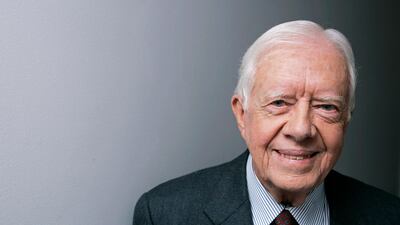
Former US president Jimmy Carter at the Toronto International Film Festival, September 10, 2007, in Toronto. AP -
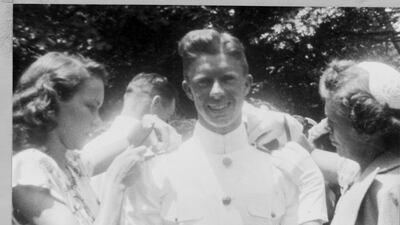
Jimmy Carter's mother, Miss Lillian, right, and his fiancée, Rosalynn Smith, left, at his graduation from the Naval Academy in Annapolis, Maryland, US, on June 5, 1946. EPA -
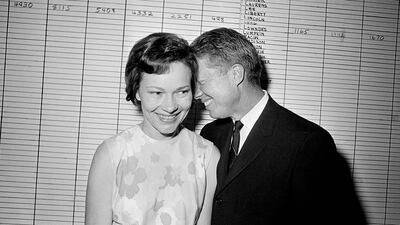
Mr Carter hugs his wife, Rosalynn, at his Atlanta campaign headquarters, September 15, 1966. AP -
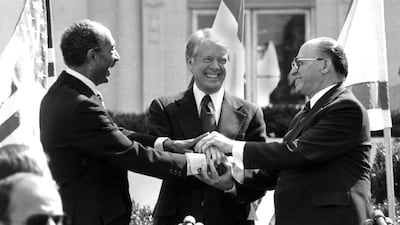
Egyptian President Anwar Sadat, left, Mr Carter, centre, and Israeli Prime Minister Menachem Begin at the White House after signing the peace treaty between Egypt and Israel, March 26, 1979, in Washington. AP -
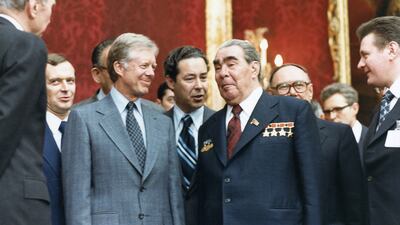
Mr Carter, left, and USSR Secretary General Leonid Brezhnev during a meeting before the signing the SALT II nuclear arms treaty in Vienna, Austria, 15 June 1979. EPA -
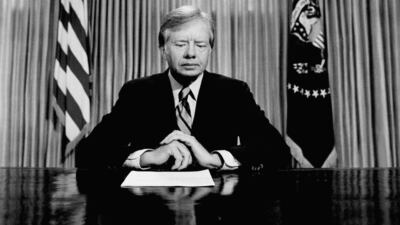
Mr Carter prepares to make a national television address from the Oval Office at the White House, April 25, 1980, in Washington. AP -
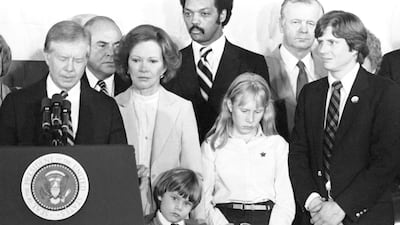
Mr Carter, with his wife Rosalynn, daughter Amy and grandson Jason tells supporters at a Washington hotel that he has conceded the election to challenger Ronald Reagan, November 4, 1980. AP -
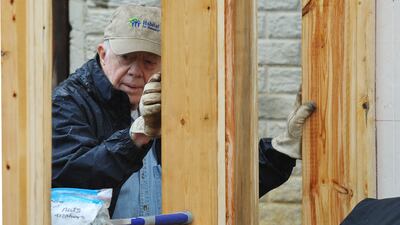
Mr Carter helps erect a frame during a Habitat for Humanity project October 4, 2010 in Washington, DC. AFP


His top foreign policy triumph involved hosting Egyptian president Anwar Sadat and Israeli prime minister Menachem Begin at Camp David, Maryland, in 1978, for 13 days of gruelling talks.
Negotiations hit an impasse on the third day. Mr Carter switched to shuttle diplomacy, separating Mr Begin and Mr Sadat and ferrying back and forth a document until they agreed to a joint text.
The Camp David accords led to full diplomatic and economic relations between the two countries. Egypt regained the Sinai Peninsula, which it had lost to Israel in the 1967 Arab-Israeli war.
Gerald Rafshoon, Mr Carter’s former communications director, said the president was a “tough” negotiator but won his guests’ trust by being “even-handed”.
“They knew he would do what he said he would do,” said Mr Rafshoon. It is the “only Middle East peace treaty to stand the test of time”, he added.
The deal is lauded for avoiding repeats of the 1967 and 1973 Arab-Israeli wars.
Carter's legacy
- Jimmy Carter's devotion to the Middle East
- Tributes pour in after death of former US president Jimmy Carter
- Jimmy Carter: The green energy pioneer
- Why Jimmy Carter was the rock 'n' roll feminist president
- Comment: Jimmy Carter's presidency was prelude to one of the great second acts in US history
Steven Hochman, research director at the Carter Centre, said that “more and more people have come to recognise the great achievements of the White House years".
It was a political win for Mr Carter, but the Middle East was not done with the US president. Iranian students stormed the US embassy in Tehran soon after the 1979 Islamic Revolution and took 52 Americans captive for 444 days. Mr Carter could not secure their release and mounted a botched US rescue mission in April 1980.
Gary Sick, one of Mr Carter’s White House aides, said it was a public relations disaster, but insisted the president played it right. He “resisted taking a jingoistic approach and using military force, which would have gotten the hostages killed”, said Mr Sick.
Mr Carter eventually “got them all home, alive, safely”, but not in time to win re-election in November 1980, he said.
Voters delivered a landslide win to Republican nominee Ronald Reagan, a former actor and California governor.
Mr Reagan’s pledge to “make America great again” drowned out Mr Carter’s talk of a “crisis of spirit”.
Mr Carter remained a diplomatic master despite losing office, and also mediated in Central America and Africa.
The father of four and his wife Rosalynn founded the Carter Centre charity in 1982. It has fought disease, run health programmes and monitored elections around the world for four decades.
In 2002, Mr Carter was awarded the Nobel Peace Prize for his “decades of untiring effort to find peaceful solutions to international conflicts, to advance democracy and human rights, and to promote economic and social development”.

