

In succeeding his father Sheikh Zayed, the revered Founding Father of the UAE, as Ruler of Abu Dhabi and President of the UAE Federation, Sheikh Khalifa bin Zayed was following in a giant’s footsteps.
Not only did he have the reputation and achievements of Sheikh Zayed to live up to and preserve, he also had to develop his own style of leadership and, if the country was to continue to prosper, to find a way to build on the solid foundations of the past.
His father was a superb teacher. As Sheikh Khalifa noted in an interview in 1990: “I learn something from him every day, follow his path and absorb from him his values and the need for patience and prudence in all things.”
He would, he said, “continue with the 'open door' policy and with the practice of holding regular consultations with the country's citizens, so that I may become aware of, and follow up on, their needs and concerns.”
It was a promise he was to keep time and again.
Sheikh Khalifa was born in 1948 in Al Muwaiji fort, which had been built two years earlier in the date-palm groves of Al Ain on the instructions of Sheikh Zayed following his appointment as Ruler’s Representative in the Eastern Region.
Sheikh Khalifa was educated at the first local school in Al Ain, which had also been established by his father.
Although he was not to be called to the highest office until his 57th year, responsibility came early to Sheikh Khalifa.
He entered public service on September 18, 1966, aged 18, when Sheikh Zayed became Ruler and moved to the capital. As his father was before him, he was appointed Ruler’s Representative in the Eastern Region.
The young sheikh’s workload grew rapidly. Three years later, on February 1, 1969, he was appointed Crown Prince. The following day, the Royal Military College Sandhurst-trained Sheikh Khalifa assumed the chairmanship of the Abu Dhabi Department of Defence, in which capacity he oversaw the development of the Abu Dhabi Defence Force, forerunner of the UAE’s modern military.
-
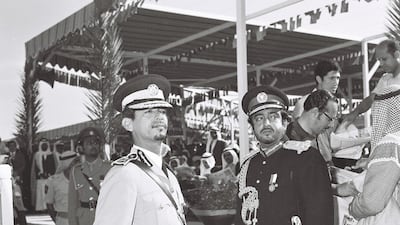
Sheikh Khalifa, right, and dignitaries watch a parade on Abu Dhabi Corniche to celebrate Accession Day, on November 28 1971. Photo: Al Ittihad -
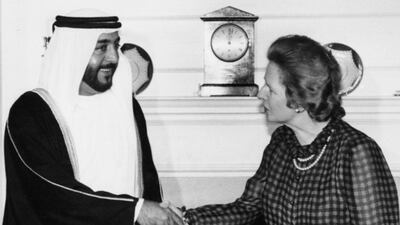
British Prime Minister Margaret Thatcher greets Sheikh Khalifa, Crown Prince of Abu Dhabi, at 10 Downing Street in London, on July 18, 1984. Keystone / Hulton Archive -
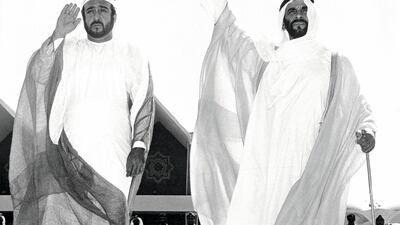
UAE Founding Father, the late Sheikh Zayed bin Sultan Al Nahyan, and Sheikh Khalifa. Photo: Al Ittihad -
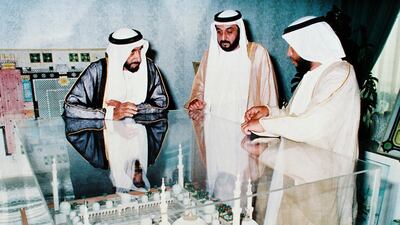
Sheikh Zayed inspects plans for the Sheikh Zayed Grand Mosque in Abu Dhabi, with his sons Sheikh Khalifa and Sheikh Sultan. Photo: Al Ittihad -
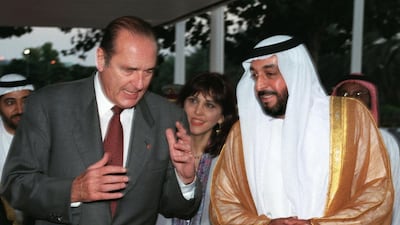
French President Jacques Chirac speaks to Sheikh Khalifa, Crown Prince of Abu Dhabi, at the end of his visit to the UAE on December 16, 1997. Reuters -
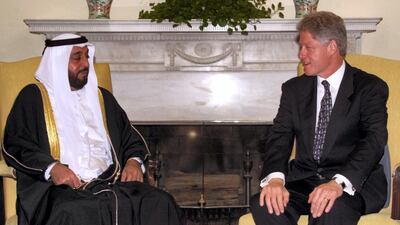
US President Bill Clinton meets Sheikh Khalifa, Crown Prince of Abu Dhabi, in the Oval Office of the White House on May 12, 1998. Reuters -
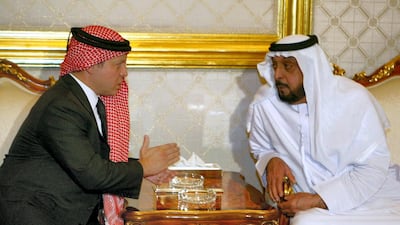
Jordan's King Abdullah II speaks to President Sheikh Khalifa, on the sidelines Sheikh Zayed's funeral in Abu Dhabi on November 3, 2004. AFP -

President Sheikh Khalifa stands for a photo with the UAE national football team at the Presidential Palace in Abu Dhabi on January 31, 2007, after the team beat Oman to win the Gulf Cup for the first time. AFP -
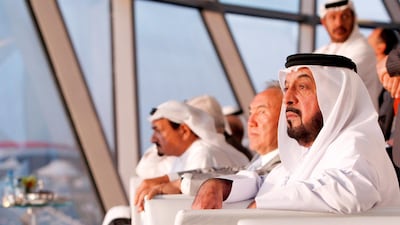
President Sheikh Khalifa watches the first Abu Dhabi Grand Prix at Yas Marina Circuit on November 1, 2009, with Nursultan Nazarbayev, President of Kazakstan, and Sheikh Humaid bin Rashid Al Nuaimi, Ruler of Ajman. Ryan Carter / The National -
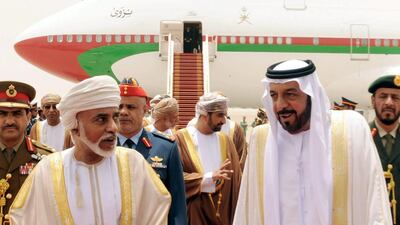
President Sheikh Khalifa greets Oman's leader, Sultan Qaboos, at Al Ain airport on July 11, 2011. Wam -
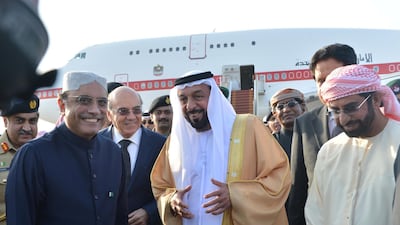
President Sheikh Khalifa leaves Al Ain on December 30, 2012, for a private visit to Pakistan. Wam -
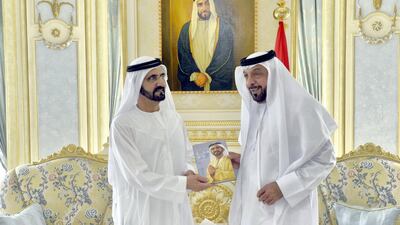
Sheikh Mohammed bin Rashid, Vice President and Ruler of Dubai, presents the first copy of his new book 'Flashes of Thought' to President Sheikh Khalifa in 2013. Wam -
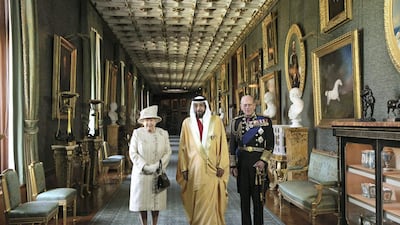
Britain's Queen Elizabeth II and Prince Philip with President Sheikh Khalifa at Windsor Castle in southern England on April 30, 2013. Reuters -
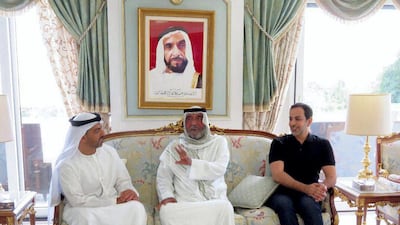
President Sheikh Khalifa meets family members at his home in Evian, France, in 2014. Wam -
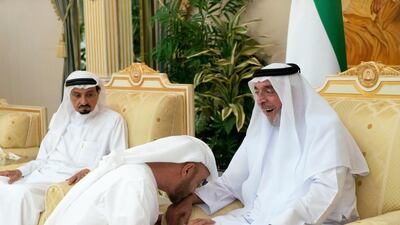
President Sheikh Khalifa receives Sheikh Mohamed bin Zayed, Crown Prince of Abu Dhabi and Deputy Supreme Commander of the UAE Armed Forces, at the Presidential Palace in Al Bateen, Abu Dhabi, on May 8, 2019. Also present is Sheikh Humaid bin Rashid Al Nuaimi, Ruler of Ajman. Ministry of Presidential Affairs -
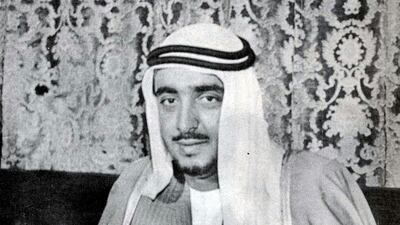
Sheikh Khalifa. Wam -

President Sheikh Khalifa. Wam -
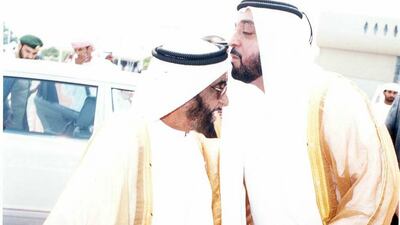
Sheikh Zayed and Sheikh Khalifa. Wam -
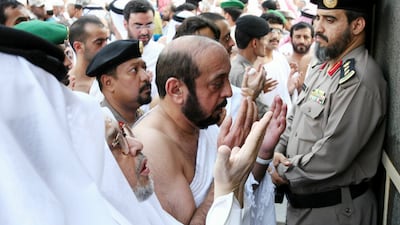
Sheikh Khalifa performing Umrah. Wam -
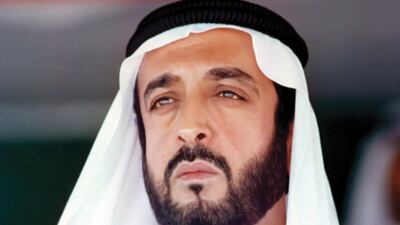
Sheikh Khalifa. Wam -

President Sheikh Khalifa receives Sheikh Dr Sultan bin Muhammad Al Qasimi, Ruler of Sharjah; Sheikh Humaid bin Rashid Al Nuaimi, Ruler of Ajman; Sheikh Hamad bin Mohammed Al Sharqi, Ruler of Fujairah; Sheikh Saud bin Rashid Al Mualla, Ruler of Umm Al Quwain; and Sheikh Saud bin Saqr Al Qasimi, Ruler of Ras Al Khaimah. Wam


As his father worked towards the unity of the nation, which would come into being on December 2, 1971, Sheikh Khalifa was given more responsibility as Prime Minister of Abu Dhabi, while also being called to serve as the Emirate’s Defence and Finance Minister.
Chairmanship of the Abu Dhabi Executive Council followed on January 20, 1974, and on December 23 of that year, he took on his first nationwide role as Deputy Prime Minister in the second Federal Cabinet.
In 1976, following the decision by the Federal Supreme Council to create a unified military force for the UAE, he was appointed as Deputy Supreme Commander of the Armed Forces, with responsibility for training and the introduction of modern equipment.
Perhaps Sheikh Khalifa’s most important roles were his chairmanships of Abu Dhabi’s Supreme Petroleum Council, founded in 1988, and the Abu Dhabi Investment Authority, which he was instrumental in creating in 1976.
Separated from the government as an independent organisation in 1977, Adia quickly grew to become the largest sovereign wealth fund in the world.
Its mission was a simple if vital one — “to invest funds on behalf of the government of the emirate of Abu Dhabi, to make available the necessary financial resources to secure and maintain the future welfare of the emirate”.

Sheikh Khalifa recognised the essential nature of Adia’s work. “The future of the country,” he once said, “is linked to its ability to manage its wealth in the interests of future generations” — and he would remain its chairman until the end of his life.
The mark of any great leader is foresight, particularly the ability to anticipate the often subtle yet important changes in the needs and expectations of their people. In this, Sheikh Khalifa never forgot one of the lessons he learnt at the side of his father: how to listen.
He was also lucky to have benefited from the wisdom of his maternal grandfather, Sheikh Mohammed bin Khalifa, the senior member of the Al Nahyan family, in whose majlis Sheikh Khalifa learnt much about leadership as a young man, and he felt the loss of Sheikh Mohammed in 1979 deeply.
His saddest moment, though, shared by the entire nation, came with the death of his father, at the age of 86, on November 2, 2004.
Yet it was, as Sheikh Khalifa recognised, also a moment in which to take pride in the achievements of the past and to set a course for the future.
On November 3, the Federal Supreme Council elected Sheikh Khalifa as his father’s successor. One month later, in a moving speech on his first National Day as President, he spoke of the “deep sense of sadness and bereavement that has filled our hearts over the passing of our father, leader and Founding Father of our nation”.
Sheikh Zayed, he said, had “cherished a dream and devoted his life to achieving that dream, using the oil wealth to build a modern state in which both Emiratis and residents from overseas enjoy a good living.
“His deep sense of commitment to the welfare of his people enabled him to overcome the hurdles that stood in his way, ultimately succeeding in bringing the country to where it is today."
One measure of that progress, said Sheikh Khalifa, could be found in the UAE’s “economic miracle”, which had resulted in its gross domestic product rising from Dh6.5 billion in 1972 to more than Dh293.12bn in 2003 — a phenomenal growth rate of about 13 per cent a year since the birth of the nation.

Sheikh Zayed, he said, had died “but his spirit and impressive legacy are immortal”.
“His values and style of leadership will remain the beacon which will continue to guide us as we strengthen our federation and maintain the achievements and gains that the country has made in various spheres of developments,” he said.
“As for us, we remain committed to serving this nation and to ensuring that even greater prosperity is achieved. Despite our bereavement, I would like to say that Zayed has not left us. He has immortalised himself in our hearts through his noble deeds. He will remain among us for ever.”
Then, Sheikh Khalifa set his mind to the tasks ahead. Now, he said, “the training of all capable Emiratis, so that they may go into productive ventures, is the country's major objective, and the one to which we give all our attention and concentrate all our efforts”.
The government was determined “to enable women to play their role in serving society … side by side with their male compatriots in every area of national assignment, within the framework that protects our Islamic identity and Arab tradition and culture”.
This last remark encapsulated the creed at the heart of Sheikh Khalifa’s ambition for the nation: progress, but without compromise of the nation’s core beliefs and sense of self.
True to his father’s example, President Sheikh Khalifa quickly became known — and loved — for his regular tours of the regions and other emirates, listening to requests and complaints, and taking swift steps to answer them.
Examples of this proactive engagement included the Dh1.5bn he ordered to be spent in January 2007 as the first phase of a programme to bring additional health, education, housing, electricity, transport and water services to remote areas in the Northern Emirates.
Other tours of the country resulted in similar initiatives, such as hospitals for Ras Al Khaimah and Umm Al Quwain, and new homes for citizens in Fujairah.
From his earliest days in office, in fact, Sheikh Khalifa “maintained close links with the country’s citizens, winning their trust and affection because of the way in which he has taken pains to meet them to ascertain their needs and concerns”, as an official tribute put it in 2010, issued during celebrations to mark the 39th National Day.
That bond was celebrated a year later, with the 40th anniversary of the nation’s founding, in the slogan “kullunna Khalifa” — we are all Khalifa.
Above all, Sheikh Khalifa understood implicitly the importance of the social contract between the ruling family and the people, and sought always to find ways of honouring and developing it.

In 1979, for example, he established the Khalifa Housing Fund to provide cheap finance for the construction of residential and commercial buildings for nationals — an initiative that was widely credited with having started the construction boom in Abu Dhabi.
Two years later, he created the Abu Dhabi Department of Social Services and Commercial Buildings, popularly known as the Sheikh Khalifa Committee, to provide loans to citizens for yet more construction projects.
To date, more than Dh35bn has been lent, helping to create more than 6,000 major buildings in the emirate.
As Chairman of the Executive Council, he ordered the creation of thousands of free homes for citizens, both in the major cities and in rural areas, while the Housing Loans Authority for UAE citizens, which he established in 1991, has helped more than 15,000 people.
When Sheikh Khalifa succeeded his father in November 2004, first as Ruler of Abu Dhabi and shortly after as President of the UAE, the nation’s role on the international stage naturally demanded more of his attention.
In his National Day speech in 2009, Sheikh Khalifa spoke about the fundamental objectives of the nation’s foreign policy — protecting the country’s sovereignty and strengthening ties with the GCC states, other Arab and Muslim countries and the world’s major economic powers.
The UAE, said an official communique, “would continue to support efforts to eradicate terrorism and to settle conflict” and “to support the Palestinian people in their efforts to establish their own state, and to back the Middle East Peace process”.
Certainly, under Sheikh Khalifa’s leadership the UAE continued the tradition, initiated during his time as Deputy Supreme Commander of the Armed Forces, of deployment overseas for both tactical and humanitarian missions.
In 1991, the UAE’s 15-year-old Army joined units from its GCC partners to play their part in Desert Storm, the US-led offensive to drive Iraqi troops from Kuwait, and suffered losses in the process. The experience was at the heart of an extensive reshaping and rearming of the UAE’s Armed Forces, overseen by Sheikh Khalifa.

“We are a country which is building up its army, not for aggression against any one,” he said at the time. “But experiences have taught us that building our own force is an imperative need to counter those who have designs against us.”
In 1999, the UAE committed more than 1,500 of its troops to the UN’s peacekeeping mission in Kosovo and the long-term commitment, backed by extensive aid to the region through the Red Crescent, led to the first stationing of UAE Forces outside the Middle East.
In May 2008, Sheikh Khalifa, as Supreme Commander of the Armed Forces, praised the performance of UAE Forces in Afghanistan, where they were the only Arab soldiers undertaking full-scale operations in support of the UN mission.
Their role, he said, was “maintaining world peace and security”, and the stationing of UAE Forces overseas was an “important arm by which the UAE can apply its humanitarian principles”.
By helping in “disaster-hit and war-torn regions”, they were “setting a great example [that] boosted the UAE's good reputation and strengthened its relationship with the world community”.
The following month, Sheikh Khalifa pledged $250 million (Dh918m) towards the rebuilding of Afghanistan. The donation, part of a $20bn aid package put together by more than 65 countries, was announced by Sheikh Abdullah bin Zayed, Minister of Foreign Affairs and International Co-operation, at a Paris conference of concerned nations.
In July 2008, Sheikh Khalifa welcomed Nouri Al Maliki, prime minister of Iraq at the time, to Abu Dhabi and announced that the UAE would write off $7bn in debts accrued by Iraq under Saddam Hussein, primarily to support the long war against Iran.
The announcement prompted a telephone call from US president George Bush, who expressed his thanks to Sheikh Khalifa for the initiative, which was “in the best interest of the region”, and earned the praise of the UN.

Iraq and the UAE, said Sheikh Khalifa, shared close ties and he promised the Emirates would do everything it could to help with the rebuilding of the war-torn country.
“The decision is meant to express the friendship and solidarity that exists between our two countries,” Sheikh Khalifa said, “and to help the Iraqi government carry on its plans and projects for the reconstruction of Iraq and the rehabilitation of its public services”.
Three years later, it was the turn of Pakistan to receive aid after disastrous floods that led to the President ordering the Pakistan Assistance Programme for the Swat Valley, which included hospitals, schools and two new bridges, one named in Sheikh Khalifa’s honour.
In the emerging landscape that followed the Arab uprisings, the UAE offered both political and financial support, with Sheikh Khalifa ordering the Egypt In Our Hearts campaign to provide food, medicines and educational assistance through the Red Crescent.
In 2011, the Khalifa bin Zayed Al Nahyan Foundation provided urgent relief to the Libyan people.
As the conflict in Syria intensified, so did the President’s commitment to relieve the suffering of its people, with millions of dirhams provided for refugees fleeing to Jordan.
His stature as a world leader was again emphasised in 2013, with a state visit to Britain that followed the hospitality extended to Queen Elizabeth II during her second visit to the UAE in 2010.
But despite the constant call of world affairs, and the successful extension of the UAE’s influence out into the world community, Sheikh Khalifa never lost sight of his overriding commitment, to the happiness, welfare and future of his people as he had pledged during his very first National Day address.
“The position attained by our country is a fruit of long perseverance and efforts of our late leader and founder of the country, Sheikh Zayed bin Sultan Al Nahyan,” he had said in December 2004.
“He directed all the resources and devoted his life to build the country and to provide good living conditions to both Emiratis and residents.”

Sheikh Zayed’s principles “guide us to strengthen the process of the federation and we have pledged ourselves to safeguard his achievements”.
At the same time, Sheikh Khalifa kept himself occupied with building upon those achievements.
Although his reign was sadly a relatively short one, it is a mark of how much he achieved in more than 15 years as Ruler that choosing his single greatest achievement is no easy task.
Was it, for instance, the decision made in 2008 that Abu Dhabi would seek to meet its predicted shortfall in electricity by pursuing what was then seen as the radical path of nuclear generation?
It was a huge task to persuade the world, especially America, that the introduction of the first nuclear power plants in the Arab world was not only a safe but a vital step for a world determined to rely less on fossil fuels for its energy.
The first step was the publication on April 1, 2008, of the UAE Policy on the Peaceful Use of Nuclear Energy, a document that addressed concerns and demonstrated that the UAE would be a responsible member of the global nuclear community, committed to transparency, safety and security as part of its nuclear ambitions.
This pledge was underscored by a personal contribution from Sheikh Khalifa.
“Talking about peace in this vital area of the world requires intensified efforts to remove all causes of tension,” he said. “Therefore, establishing an effective balance of power in the region will be achieved only if all Middle East countries undertake to ban the use of nuclear and other mass destruction weapons.”

The tenets of the policy were reinforced at home on October 5, 2009, when Sheikh Khalifa issued a law forming the Federal Authority of Nuclear Regulation, a fully independent nuclear safety regulator, tasked with overseeing the nuclear energy sector and promoting the highest standards of safety and security.
This was followed in December the same year by the historic agreement on nuclear energy co-operation between the US and the UAE, known as the 123 Agreement, and signed after an exhaustive review of the UAE’s plans by the US government.
In his 2009 National Day speech, Sheikh Khalifa gave a glimpse of the complex, layered thinking behind the project.
“Our interest in renewable energy is inseparable from our project to develop a peaceful programme of nuclear energy to meet our growing energy requirements, based on the highest standards of transparency, safety and nuclear security,” he said.
The model adopted by the UAE, “in accordance with international laws, and in full co-operation with the International Atomic Energy Agency”, was “consistent with our support of and conformity with the Non-Proliferation Treaty, and our rejection, in principle, to the existence of weapons of mass destruction in the Middle East”.
He also took the opportunity to call on Israel to “dismantle its military nuclear facilities and join the Non-Proliferation Treaty and subject its nuclear facilities to international inspections”.
At the same time, “we also urge Iran to continue co-operation with the international community to allay fears and doubts about the nature of its nuclear programme”.
It was vital, he said, that all parties reached “peaceful agreement on this to ensure the security and stability in the region and its peoples”.
With the way to a nuclear future cleared, that same month Sheikh Khalifa established, by decree, the Emirates Nuclear Energy Corporation. Commercial power generation began at the Barakah Nuclear Energy Plant in April 2021.
Nuclear energy aside, another candidate for Sheikh Khalifa’s greatest contribution is his early recognition that Abu Dhabi, despite its vast oil reserves, had a responsibility not only to its future prosperity, but also to the world, to seek a way of diversifying away from reliance on fossil fuels and to lead the way in developing alternative, green energy sources.

Under this overarching vision, Abu Dhabi has invested in tomorrow’s world, both through direct investment in pioneering green companies overseas and in the grand green experiment that is Masdar, the home-grown but world-renowned hothouse of alternative development and experimentation.
Each year since 2008, the capital has hosted the increasingly important World Future Energy Summit, drawing experts, companies and political leaders from around the world to tackle some of the most important environmental issues of our time.
And it was in recognition of Abu Dhabi’s obvious commitment to alternative energy that the International Renewable Energy Agency, founded in Bonn in January 2009, chose the capital as the home for its headquarters.
Yet other initiatives launched during Sheikh Khalifa’s reign will also have long-term benefits for the people of the UAE — such as the increasing profile on the world map enjoyed by Abu Dhabi, thanks to developments such as Yas Island, the coming of Formula One, Saadiyat Island, where growing numbers of visitors are drawn by its many resort hotels, and Louvre Abu Dhabi.
Emiratisation was another of Sheikh Khalifa’s passions — his belief that the future welfare of the country and its people depended on equipping Emiratis with the intellectual and practical tools they would need.
This strategy lay at the heart of many of his government’s initiatives, from Masdar to nuclear energy, adventures in which Emiratis are encouraged to participate through numerous scholarship and training programmes.

“The strategy for the future,” as Sheikh Khalifa said in his 2007 address to the nation, “will not depend on visions and ideas nor financial resources, but rather on the ability and commitment to implement the principles therein”.
This, he said, could not be achieved “without a real programme to develop local young people who are able to shoulder responsibilities” — and it could not, he recognised, be achieved by government alone. The process would be complete “only when the private sector works as a full partner in the national development process”.
The development of the UAE’s human capital, he said, was nothing less than a national necessity.
“We will boost the role of knowledge and human capital in the progress of the economy and make a link between the educational process and the development and security requirements so as to prepare the appropriate environment for talent able to contribute effectively in creating a good future for the country.”
But, in the long run, perhaps the initiative for which Sheikh Khalifa will be most remembered was one that sprang from the lessons in listening that he learnt in his father’s majlis, all those years ago in Al Ain.
In December 2005, during his second National Day address, Sheikh Khalifa outlined plans to reform the government and the role of the Federal National Council.
“We want to make the FNC more effective so that it can deal effectively with issues that concern the country, and to introduce our citizens to the concept of shura [democracy],” he said.
As part of this process, he announced, half of the members of the Council would be elected.
In 2005, 6,595 voters were eligible to elect members of the FNC. The second nationwide FNC elections, in 2011, introduced even more citizens to the concept of democracy, when 130,000 Emiratis were given the right to vote.

But while reaching for the fruits of tomorrow, Sheikh Khalifa never lost sight of the treasure of the past, nor of concerns that — outnumbered more than six to one in their own country and constantly exposed to the influence of western culture — Emiratis might lose sight of their essential self.
At the inaugural session of a new Federal National Council on February 12, 2007, he spoke of the importance of empowering Emiratis — a vision that had to be transformed into reality.
“Our national visions and principles have been endorsed by the Supreme Federal Council and the Council of Ministers,” he said. “These are the road map on the path of shura, the sovereignty of law, accountability, prevalence of justice and the empowerment of all individuals in the community so that they may contribute effectively in building our future.”
In a speech the following year, Sheikh Khalifa echoed a sentiment often expressed by his father when he said: “He who has no identity has no present nor future.”
Perhaps the crowning result of that sentiment was the widespread introduction of Emiratisation, the process by which citizens would be equipped and encouraged to take on many of the essential tasks of nation-building that previously had been tackled by outsiders.
And the year 2008, he announced, would be the Year of National Identity.
In July of that same year, Sheikh Khalifa stressed his determination to see the more remote parts of the UAE afforded the same level of benefits enjoyed by the capital.

The government, he said, was “keen to achieve balanced development in all emirates and deliver services at best standards to all regions in the country”.
Services in the far-flung regions were integral to the overall development plan, he said.
“The final goal is to turn these remote areas into attractive populated centres and incubators for productive and services projects at equal footing with high-densely populated cities,” Sheikh Khalifa said.
It was, he said, the responsibility of government bodies to “assume their responsibility as services providers interacting with the needs of citizens away from the routine and at par with the highest standards”.
That same month, Sheikh Khalifa embarked on a listening tour of the vast desert region of Al Dhafra, which had benefited from government investment worth hundreds of millions of dirhams.
He held an open diwan and hundreds lined up to see and speak to him — with some reading poetry they had written for the occasion.
In 2008, the UAE was more able than most countries to face the challenges of the financial upheaval that shook the entire world — and Abu Dhabi was better placed than many of its neighbours to withstand the storm that blew through the Gulf region.
Two years later, in an address to mark the 39th anniversary of the federation, Sheikh Khalifa was delighted to be able to announce that the UAE economy had “fully recovered” from the effects of the global economic turmoil.
In his address to the people, for National Day 2013, Sheikh Khalifa returned to the theme of the country’s true worth — its people.
“We have recognised the true value of the human being in the building of the nation,” he said. “We are also committed to safeguarding his rights, ensuring his welfare, empowering him and diversifying his options and realising his aspirations.”
In 2009, Sheikh Khalifa had been unanimously re-elected by his fellow members of the Federal Supreme Council to his second five-year term of office.
Fears for his health surfaced in 2010 when Wam, the state news agency, announced that he had returned home after receiving treatment in Switzerland for an undisclosed medical condition.
He was back in time to chair a meeting of the GCC.

The President resumed his workload, although he was less visible in the public eye as he continued to recuperate, making a private visit to Pakistan at the end of 2012 and meeting several world leaders, including the Chinese prime minister.
Then on January 25, 2014, came the news that the President had suffered a severe stroke.
The news was broken by the Ministry of Presidential Affairs, which also announced he had undergone surgery and that “his health was now stable”.
The news was greeted with an outpouring of prayers and good wishes on social media, from members of his family, to other senior government figures and ordinary Emiratis.
It was a reflection of the widespread respect and affection for President Khalifa, that those prayers were repeated across many religious denominations in the UAE.
Within a few days, Sheikh Mohamed bin Zayed, Crown Prince of Abu Dhabi and Deputy Supreme Commander of the Armed Forces, was able to announce on Twitter that while there had been “difficult moments”, the President was “fine” and his health “stable and reassuring”.
The road to recovery this time was long, with the President spending much of his time recuperating but also maintaining his role as leader of the country.
In September 2015, it was his sad duty to express condolences for the deaths of about 50 members of the UAE Armed forces in a Houthi rocket attack in Yemen.
Sheikh Khalifa said the men were defending the oppressed during the performance of their sacred duty within the Arab Coalition forces.
There was more joyful news for Eid, July 2017, with the release of the first official photographs in more than three years as Sheikh Khalifa received Supreme Council members and Rulers of the emirates at Al Bateen Palace in Abu Dhabi.
His continuing recovery was shown again in May 2019, as a smiling Sheikh Khalifa received the Rulers and Crown Princes of the UAE during Ramadan.

During the final years of his life, Sheikh Khalifa was a calm figure at the ship of state as the country registered many moments of historic progress, including the visit of Pope Francis in 2019, the launch of the first UAE astronaut into space later that year and the signing of the Abraham Accords that normalised relations with Israel in 2020.
Sheikh Khalifa was re-elected in November 2019 as President of the UAE by the Supreme Council of the Union for a fourth five-year term, wishing him “good luck to continue the journey of development and prosperity”.
He was seen again in February 2020 touring an environment forest area on the outskirts of Abu Dhabi and speaking of teaching young people to care for the environment, a subject also dear to the heart of his father.
In July that year, Sheikh Khalifa also established a Frontline Heroes Office to recognise the efforts of frontline workers during the Covid-19 pandemic. He was also able to celebrate the success of the UAE’s first mission to Mars, which he described as a “glorious day”.
Supported by members of the government, he continued his duties as President, until the announcement of his death on May 13.
But, as a nation mourns the loss of its second President, its people can take comfort and pride in the knowledge that he, and they, rose as one to the challenge he laid down during his first National Day address in 2004.
“Dear nationals,” he said. “We hereby renew our allegiance to our leader and maker of our modern UAE the late Sheikh Zayed, may God rest his soul in peace, that we shall work diligently in all domains to preserve our national gains and make more achievements in terms of progress and prosperity.
“We are looking forward to you as an active, dynamic driving force in the national work. We are confident that you will spare no effort to usher into a new era of national development in order to give more strength to our federation, make more progress to ensure promising future for our next generation.
“We pray Almighty God to bless our drive for success and guide us to the right path of good for our country and its people.”
It was a prayer that has been answered in full.

