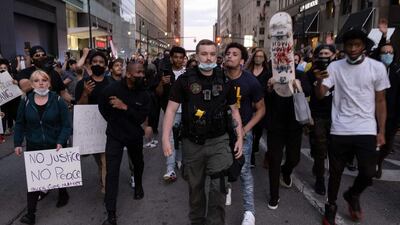
For five days, Americans have risen up against the killingof George Floyd, a 46-year-old black man, by a white police officer in the city of Minneapolis while he was in custody. The tragedy was filmed by passersby and shared online for the world to see. In the video, Floyd can be seen pleading for his life as one policeman continues to choke him with his knee while others hold him down.
The brutality seen in the footage has shocked the world and, understandably, driven thousands to the streets across the US to demand justice, equality and fair treatment of minorities by law enforcement officials.
Floyd’s death has revealed deep fractures within American society, putting the spotlight on instances of police brutality against marginalised communities.
Yet it is only the latest in a series of widely reported killings of black persons in custody. Time and again, excessive force has been used against marginalised communities, sparking protests, and eventually riots, in a never-ending cycle of violence. In 2014, the fatal shooting by a white officer of 18-year-old Michael Brown, another black man, sparked protests in the city of Ferguson and served as a catalyst for the "Black Lives Matter" movement. That same year in New York, Eric Garner, yet another black person, was choked to death in police custody for selling cigarettes illegally. The officer who killed him was dismissed from the force, but not indicted. And this February, Ahmaud Arbery, an unarmed jogger, was lynched by white men. His death was also filmed and widely shared online.
In Ferguson, just as in Minneapolis, there have been reports of looting and violence by some demonstrators, while the police has, in turn, responded with force to protesters. Violence cannot be condoned, whether it is perpetrated by protesters, who are angry at the state’s inability to protect its most vulnerable people, or by police officers using excessive force on unarmed civilians. This cycle must be broken once and for all.
An investigation is under way into Arbery’s death, and the officer who killed Floyd has been arrested and charged with third-degree murder. For America to heal its wounds, justice must be served in a fair manner, and this arrest is a positive first step.
Floyd's death has revealed deep fractures within American society
The year 2020 has brought about trials and tribulations all over the world, and particularly in the US. This is an election year, a time when politicians often entrench themselves in divisive rhetoric instead of bringing people together – a tactic President Donald Trump has already employed in light of recent events. Then, there is the coronavirus pandemic. The US has recorded nearly one-third of all Covid-19 cases and more than 105,000 deaths. That people were compelled to take to the streets instead of staying safely indoors speaks to the gravity of the situation.
All people regardless of race and social status must receive fair treatment when apprehended by police forces. No one should die for $20 in counterfeit money, or for selling cigarettes.

A widely accepted definition was made by the All Party Parliamentary Group on British Muslims in 2019: “Islamophobia is rooted in racism and is a type of racism that targets expressions of Muslimness or perceived Muslimness.” It further defines it as “inciting hatred or violence against Muslims”.
Houthis: Iran-backed rebels who occupy Sanaa and run unrecognised government
Yemeni government: Exiled government in Aden led by eight-member Presidential Leadership Council
Southern Transitional Council: Faction in Yemeni government that seeks autonomy for the south
Habrish 'rebels': Tribal-backed forces feuding with STC over control of oil in government territory
23-man shortlist for next six Hall of Fame inductees
Tony Adams, David Beckham, Dennis Bergkamp, Sol Campbell, Eric Cantona, Andrew Cole, Ashley Cole, Didier Drogba, Les Ferdinand, Rio Ferdinand, Robbie Fowler, Steven Gerrard, Roy Keane, Frank Lampard, Matt Le Tissier, Michael Owen, Peter Schmeichel, Paul Scholes, John Terry, Robin van Persie, Nemanja Vidic, Patrick Viera, Ian Wright.
Founded over 50 years ago, the National Archives collects valuable historical material relating to the UAE, and is the oldest and richest archive relating to the Arabian Gulf.
Much of the material can be viewed on line at the Arabian Gulf Digital Archive - https://www.agda.ae/en
The company offers payments/bribes to win key contracts in the Middle East
May 2017
The UK SFO officially opens investigation into Petrofac’s use of agents, corruption, and potential bribery to secure contracts
September 2021
Petrofac pleads guilty to seven counts of failing to prevent bribery under the UK Bribery Act
October 2021
Court fines Petrofac £77 million for bribery. Former executive receives a two-year suspended sentence
December 2024
Petrofac enters into comprehensive restructuring to strengthen the financial position of the group
May 2025
The High Court of England and Wales approves the company’s restructuring plan
July 2025
The Court of Appeal issues a judgment challenging parts of the restructuring plan
August 2025
Petrofac issues a business update to execute the restructuring and confirms it will appeal the Court of Appeal decision
October 2025
Petrofac loses a major TenneT offshore wind contract worth €13 billion. Holding company files for administration in the UK. Petrofac delisted from the London Stock Exchange
November 2025
180 Petrofac employees laid off in the UAE
About Tenderd
Started: May 2018
Founder: Arjun Mohan
Based: Dubai
Size: 23 employees
Funding: Raised $5.8m in a seed fund round in December 2018. Backers include Y Combinator, Beco Capital, Venturesouq, Paul Graham, Peter Thiel, Paul Buchheit, Justin Mateen, Matt Mickiewicz, SOMA, Dynamo and Global Founders Capital
This article is part of a guide on where to live in the UAE. Our reporters will profile some of the country’s most desirable districts, provide an estimate of rental prices and introduce you to some of the residents who call each area home.
Mercer, the investment consulting arm of US services company Marsh & McLennan, expects its wealth division to at least double its assets under management (AUM) in the Middle East as wealth in the region continues to grow despite economic headwinds, a company official said.
Mercer Wealth, which globally has $160 billion in AUM, plans to boost its AUM in the region to $2-$3bn in the next 2-3 years from the present $1bn, said Yasir AbuShaban, a Dubai-based principal with Mercer Wealth.
“Within the next two to three years, we are looking at reaching $2 to $3 billion as a conservative estimate and we do see an opportunity to do so,” said Mr AbuShaban.
Mercer does not directly make investments, but allocates clients’ money they have discretion to, to professional asset managers. They also provide advice to clients.
“We have buying power. We can negotiate on their (client’s) behalf with asset managers to provide them lower fees than they otherwise would have to get on their own,” he added.
Mercer Wealth’s clients include sovereign wealth funds, family offices, and insurance companies among others.
From its office in Dubai, Mercer also looks after Africa, India and Turkey, where they also see opportunity for growth.
Wealth creation in Middle East and Africa (MEA) grew 8.5 per cent to $8.1 trillion last year from $7.5tn in 2015, higher than last year’s global average of 6 per cent and the second-highest growth in a region after Asia-Pacific which grew 9.9 per cent, according to consultancy Boston Consulting Group (BCG). In the region, where wealth grew just 1.9 per cent in 2015 compared with 2014, a pickup in oil prices has helped in wealth generation.
BCG is forecasting MEA wealth will rise to $12tn by 2021, growing at an annual average of 8 per cent.
Drivers of wealth generation in the region will be split evenly between new wealth creation and growth of performance of existing assets, according to BCG.
Another general trend in the region is clients’ looking for a comprehensive approach to investing, according to Mr AbuShaban.
“Institutional investors or some of the families are seeing a slowdown in the available capital they have to invest and in that sense they are looking at optimizing the way they manage their portfolios and making sure they are not investing haphazardly and different parts of their investment are working together,” said Mr AbuShaban.
Some clients also have a higher appetite for risk, given the low interest-rate environment that does not provide enough yield for some institutional investors. These clients are keen to invest in illiquid assets, such as private equity and infrastructure.
“What we have seen is a desire for higher returns in what has been a low-return environment specifically in various fixed income or bonds,” he said.
“In this environment, we have seen a de facto increase in the risk that clients are taking in things like illiquid investments, private equity investments, infrastructure and private debt, those kind of investments were higher illiquidity results in incrementally higher returns.”
The Abu Dhabi Investment Authority, one of the largest sovereign wealth funds, said in its 2016 report that has gradually increased its exposure in direct private equity and private credit transactions, mainly in Asian markets and especially in China and India. The authority’s private equity department focused on structured equities owing to “their defensive characteristics.”
Brolliology: A History of the Umbrella in Life and Literature
By Marion Rankine
Melville House
Who is Tim-Berners Lee?
Sir Tim Berners-Lee was born in London in a household of mathematicians and computer scientists. Both his mother, Mary Lee, and father, Conway, were early computer scientists who worked on the Ferranti 1 - the world's first commercially-available, general purpose digital computer. Sir Tim studied Physics at the University of Oxford and held a series of roles developing code and building software before moving to Switzerland to work for Cern, the European Particle Physics laboratory. He developed the worldwide web code as a side project in 1989 as a global information-sharing system. After releasing the first web code in 1991, Cern made it open and free for all to use. Sir Tim now campaigns for initiatives to make sure the web remains open and accessible to all.
