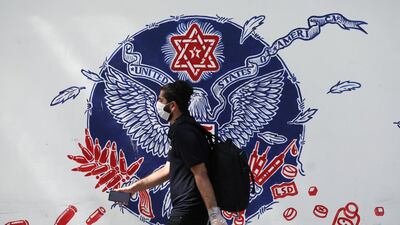
In an exclusive interview with The National, the US Special Representative for Iran Brian Hook described Iran as "a failed model". Since Iran's revolution in 1979, the government in Tehran has consistently propagated an image of victimhood, all the while rejecting the rule of law and imposing a state of perpetual crisis on its population.
Today, as the world struggles with the economic downturn brought on by the coronavirus pandemic, the flaws in Iran’s governance model have become glaring. Iran's inflation rate is among the worst in the world. They have pushed the so-called axis of resistance, which consists of Iran and its allies, further towards the brink.
Since October of last year, a wave of protests have taken Iraq by storm, forcing government change in Baghdad, with similar protests in Lebanon and spreading even Iran itself. The movements driving the protests share in common a rejection of the corruption, sectarian politics and violence that ultimately emanate from Tehran. In Iraq, for instance, the country has long suffered from the reign of Iran-aligned militias that undermine the authority of the state.
Despite its large web of proxies throughout the Middle East, in its forty years of existence, Iran’s regime has failed to fully export its revolution to any other country, as their model is increasingly problematic. Instead, it has isolated itself from the international community, and is now the country with the tenth-highest number of Covid-19 cases in the world. The shock to the Iranian economy, already enfeebled by sanctions, pushed Tehran to seek assistance from the International Monetary Fund in the form of a $5bn loan in April.
Iran’s failed model is deployed elsewhere in its “axis of resistance”, too. The Syrian regime, which has long been backed by Iran and associated foreign militias, similarly shuns co-operation with the international community. It promotes terrorism and thrives on revenue generated by criminal networks. Nine years on from the start of a civil war that he started, President Bashar Al Assad refuses to step down or negotiate a political settlement with the opposition.
There are similar patterns in Yemen, where the Houthi rebels who control the capital have caused the world’s worst humanitarian crisis, trapping a country with a wealth of potential into the deepest recesses of poverty.
International sanctions are an essential diplomatic tool to deprive Iran’s regional allies and proxy groups of funding, and to exert pressure on Tehran. Renewing the UN arms embargo on Iran would help to achieve this, too. But sanctions must be complemented with positive efforts to promote change. This means advocating multilateralism, protecting the rule of international law and discouraging others from taking a path of violence and exclusion.
In its forty years of existence, Iran's regime has failed to fully export its revolution to any other country
Lebanon, for instance, is at a crossroads. Last week, in a televised interview, UAE Minister of State for Foreign Affairs, Dr Anwar Gargash said that the influence of Hezbollah on Lebanese politics has burnt many bridges with Gulf nations, jeopardising “the huge reservoir of goodwill and the huge reservoir of financial support that Lebanon needs”.
Fragile nations in the region must look more to countries that have applied successful models of governance, including the UAE. In the words of Mr Hook, Abu Dhabi is “setting the example for the region”. No model is perfect, and Gulf nations have had their own setbacks, but they have managed to adopt long-term strategies to promote international co-operation and growth. This includes actively working on initiatives to diversify revenue and putting security and stability first. By working together and building bridges instead of burning them, the Arab world’s diverse countries can overcome their challenges and carve a path that rises above sectarianism and violence.

Emirates have direct flights from Dubai to Glasgow from Dh3,115. Alternatively, if you want to see a bit of Edinburgh first, then you can fly there direct with Etihad from Abu Dhabi.
The hotel
Located in the heart of Mackintosh's Glasgow, the Dakota Deluxe is perhaps the most refined hotel anywhere in the city. Doubles from Dh850
Events and tours
There are various Mackintosh specific events throughout 2018 – for more details and to see a map of his surviving designs see glasgowmackintosh.com
For walking tours focussing on the Glasgow Style, see the website of the Glasgow School of Art.
Mercer, the investment consulting arm of US services company Marsh & McLennan, expects its wealth division to at least double its assets under management (AUM) in the Middle East as wealth in the region continues to grow despite economic headwinds, a company official said.
Mercer Wealth, which globally has $160 billion in AUM, plans to boost its AUM in the region to $2-$3bn in the next 2-3 years from the present $1bn, said Yasir AbuShaban, a Dubai-based principal with Mercer Wealth.
“Within the next two to three years, we are looking at reaching $2 to $3 billion as a conservative estimate and we do see an opportunity to do so,” said Mr AbuShaban.
Mercer does not directly make investments, but allocates clients’ money they have discretion to, to professional asset managers. They also provide advice to clients.
“We have buying power. We can negotiate on their (client’s) behalf with asset managers to provide them lower fees than they otherwise would have to get on their own,” he added.
Mercer Wealth’s clients include sovereign wealth funds, family offices, and insurance companies among others.
From its office in Dubai, Mercer also looks after Africa, India and Turkey, where they also see opportunity for growth.
Wealth creation in Middle East and Africa (MEA) grew 8.5 per cent to $8.1 trillion last year from $7.5tn in 2015, higher than last year’s global average of 6 per cent and the second-highest growth in a region after Asia-Pacific which grew 9.9 per cent, according to consultancy Boston Consulting Group (BCG). In the region, where wealth grew just 1.9 per cent in 2015 compared with 2014, a pickup in oil prices has helped in wealth generation.
BCG is forecasting MEA wealth will rise to $12tn by 2021, growing at an annual average of 8 per cent.
Drivers of wealth generation in the region will be split evenly between new wealth creation and growth of performance of existing assets, according to BCG.
Another general trend in the region is clients’ looking for a comprehensive approach to investing, according to Mr AbuShaban.
“Institutional investors or some of the families are seeing a slowdown in the available capital they have to invest and in that sense they are looking at optimizing the way they manage their portfolios and making sure they are not investing haphazardly and different parts of their investment are working together,” said Mr AbuShaban.
Some clients also have a higher appetite for risk, given the low interest-rate environment that does not provide enough yield for some institutional investors. These clients are keen to invest in illiquid assets, such as private equity and infrastructure.
“What we have seen is a desire for higher returns in what has been a low-return environment specifically in various fixed income or bonds,” he said.
“In this environment, we have seen a de facto increase in the risk that clients are taking in things like illiquid investments, private equity investments, infrastructure and private debt, those kind of investments were higher illiquidity results in incrementally higher returns.”
The Abu Dhabi Investment Authority, one of the largest sovereign wealth funds, said in its 2016 report that has gradually increased its exposure in direct private equity and private credit transactions, mainly in Asian markets and especially in China and India. The authority’s private equity department focused on structured equities owing to “their defensive characteristics.”
The Al Ghaf tree is a local desert tree which bears the harsh summers with drought and high temperatures. From the rich flowers, bees that pollinate this tree can produce delicious red colour honey in June and July each year
Sidr Honey
The Sidr tree is an evergreen tree with long and strong forked branches. The blossom from this tree is called Yabyab, which provides rich food for bees to produce honey in October and November. This honey is the most expensive, but tastiest
Samar Honey
The Samar tree trunk, leaves and blossom contains Barm which is the secret of healing. You can enjoy the best types of honey from this tree every year in May and June. It is an historical witness to the life of the Emirati nation which represents the harsh desert and mountain environments
Children who witnessed blood bath want to help others
Aged just 11, Khulood Al Najjar’s daughter, Nora, bravely attempted to fight off Philip Spence. Her finger was injured when she put her hand in between the claw hammer and her mother’s head.
As a vital witness, she was forced to relive the ordeal by police who needed to identify the attacker and ensure he was found guilty.
Now aged 16, Nora has decided she wants to dedicate her career to helping other victims of crime.
“It was very horrible for her. She saw her mum, dying, just next to her eyes. But now she just wants to go forward,” said Khulood, speaking about how her eldest daughter was dealing with the trauma of the incident five years ago. “She is saying, 'mama, I want to be a lawyer, I want to help people achieve justice'.”
Khulood’s youngest daughter, Fatima, was seven at the time of the attack and attempted to help paramedics responding to the incident.
“Now she wants to be a maxillofacial doctor,” Khulood said. “She said to me ‘it is because a maxillofacial doctor returned your face, mama’. Now she wants to help people see themselves in the mirror again.”
Khulood’s son, Saeed, was nine in 2014 and slept through the attack. While he did not witness the trauma, this made it more difficult for him to understand what had happened. He has ambitions to become an engineer.
Western Region Asia Cup T20 Qualifier
Sun Feb 23 – Thu Feb 27, Al Amerat, Oman
The two finalists advance to the Asia qualifier in Malaysia in August
