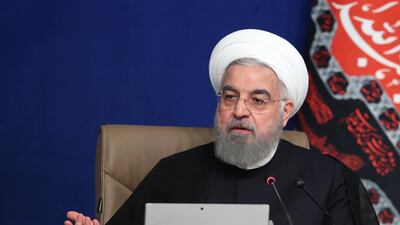
President Hassan Rouhani said the US was "heartless and evil" for failing to lift sanctions on Iran amid the coronavirus pandemic. AFP

Iran plays dangerous game with uranium enrichment


  • English
  • Arabic

On Friday, the International Atomic Energy Agency (IAEA), a UN body, reported that Iran's stock of enriched uranium has reached 2,105 kilograms.  This is a figure 10 times higher than what it agreed to under a 2015 agreement – the Joint Comprehensive Plan of Action (JCPOA). The US and Iran both withdrew from the agreement, in 2018 and 2020, respectively.

The IAEA warned that Iran is also exceeding the permitted level of enrichment, which determines whether uranium is suitable for use in civilian nuclear energy  or, at if it is high enough, as a critical component of a nuclear bomb. Limiting the proliferation of uranium and the capability to enrich it to weapons grade is fundamental to minimising the threat of global nuclear war. It is also part of the raison d'etre of the IAEA.

In matters of non-proliferation, however, Iran has long been opaque. For months, authorities in Tehran declined to  allow access for the IAEA, which acts as the world's nuclear watchdog, to two Iranian nuclear  centres for inspections. Even without access to these facilities, the agency had already surmised that Iran had committed a string of JCPOA violations.

Late last month, in an effort to boost its diplomatic standing, Iran relented. Inspectors attended to the first of the two facilities last week. Friday's report was released after that visit.

While American officials have repeatedly invited Iran to renegotiate the terms of the JCPOA, Tehran has refused to participate in any talks, demanding the US lifts sanctions it has imposed. In response to these sanctions and other elements of the US's maximum-pressure campaign, Iran has systematically reduced its compliance with the JCPOA. Since it announced its intention to scale up its enrichment dramatically back in January, Iran has been openly in defiance of its international obligations.

On October 18, a UN conventional arms embargo on Iran is set to expire, and the US has pursued, complicated procedural avenues within the Security Council to activate a "snapback", in which the embargo would be renewed and the JCPOA would, in effect, be terminated. The UK and France – normally US allies – have pushed back at the American efforts in a bid to keep the JCPOA alive.

The key point of contention within the Security Council over the last month has been whether or not the US – now that it has exited the agreement – still has any right to trigger a snapback. The US and Iran have each submitted opposing legal arguments on this and other questions, and the outcome remains uncertain.

In matters of non-proliferation, however, Iran has long been opaque

Regardless of whether or not the snapback is imposed, however, the accelerated transformation of Iran's "reduced compliance" into outright noncompliance ought to be alarming. For one thing, it provides Iran greater influence  in any future negotiation – a fact that, to some extent, can motivate  Tehran's strategy. For another, it diminishes the force of future agreements by showing Iran's government that it can engage in noncompliance without serious consequences.

Iran has withstood US sanctions, which have taken a toll on its economy, for years by largely relying on its regional proxies. But the headwinds that rock Iran’s establishment are particularly strong now. The pandemic has worsened existing disillusionment, in Iran and elsewhere in the region, with Tehran and its militias in other states. If European countries do not wish to support the US’s maximum-pressure campaign, whatever solution arrives must emphasise to the Iranians that destabilising moves and the defiance of international law will get them nowhere.


Mercer, the investment consulting arm of US services company Marsh & McLennan, expects its wealth division to at least double its assets under management (AUM) in the Middle East as wealth in the region continues to grow despite economic headwinds, a company official said.

Mercer Wealth, which globally has $160 billion in AUM, plans to boost its AUM in the region to $2-$3bn in the next 2-3 years from the present $1bn, said Yasir AbuShaban, a Dubai-based principal with Mercer Wealth.

Within the next two to three years, we are looking at reaching $2 to $3 billion as a conservative estimate and we do see an opportunity to do so,” said Mr AbuShaban.

Mercer does not directly make investments, but allocates clients’ money they have discretion to, to professional asset managers. They also provide advice to clients.

“We have buying power. We can negotiate on their (client’s) behalf with asset managers to provide them lower fees than they otherwise would have to get on their own,” he added.

Mercer Wealth’s clients include sovereign wealth funds, family offices, and insurance companies among others.

From its office in Dubai, Mercer also looks after Africa, India and Turkey, where they also see opportunity for growth.

Wealth creation in Middle East and Africa (MEA) grew 8.5 per cent to $8.1 trillion last year from $7.5tn in 2015, higher than last year’s global average of 6 per cent and the second-highest growth in a region after Asia-Pacific which grew 9.9 per cent, according to consultancy Boston Consulting Group (BCG). In the region, where wealth grew just 1.9 per cent in 2015 compared with 2014, a pickup in oil prices has helped in wealth generation.

BCG is forecasting MEA wealth will rise to $12tn by 2021, growing at an annual average of 8 per cent.

Drivers of wealth generation in the region will be split evenly between new wealth creation and growth of performance of existing assets, according to BCG.

Another general trend in the region is clients’ looking for a comprehensive approach to investing, according to Mr AbuShaban.

“Institutional investors or some of the families are seeing a slowdown in the available capital they have to invest and in that sense they are looking at optimizing the way they manage their portfolios and making sure they are not investing haphazardly and different parts of their investment are working together,” said Mr AbuShaban.

Some clients also have a higher appetite for risk, given the low interest-rate environment that does not provide enough yield for some institutional investors. These clients are keen to invest in illiquid assets, such as private equity and infrastructure.

“What we have seen is a desire for higher returns in what has been a low-return environment specifically in various fixed income or bonds,” he said.

“In this environment, we have seen a de facto increase in the risk that clients are taking in things like illiquid investments, private equity investments, infrastructure and private debt, those kind of investments were higher illiquidity results in incrementally higher returns.”

The Abu Dhabi Investment Authority, one of the largest sovereign wealth funds, said in its 2016 report that has gradually increased its exposure in direct private equity and private credit transactions, mainly in Asian markets and especially in China and India. The authority’s private equity department focused on structured equities owing to “their defensive characteristics.”

Global state-owned investor ranking by size

1.

United States

2.

China

3.

UAE

4.

Japan

5

Norway

6.

Canada

7.

Singapore

8.

Australia

9.

Saudi Arabia

10.

South Korea

Why seagrass matters
  • Carbon sink: Seagrass sequesters carbon up to 35X faster than tropical rainforests
  • Marine nursery: Crucial habitat for juvenile fish, crustations, and invertebrates
  • Biodiversity: Support species like sea turtles, dugongs, and seabirds
  • Coastal protection: Reduce erosion and improve water quality