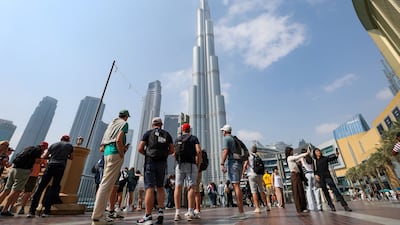

Confidence, as it relates to countries, has a certain “je ne sais quoi” quality about it. It is difficult to quantify and challenging to cultivate but it is vital for tourism, investment, aviation, hospitality and events. As Dubai hosts the Arabian Travel Market this week, it is worth examining how the emirate and the UAE maintained international confidence in some very challenging times.
A little more than six months ago, the US and Israeli attack on Iran, and Tehran’s subsequent lashing out at its Gulf neighbours, were ominous developments for the region's tourism and events industry. However, as more and more details come to light, the resilience of the UAE comes through once again.
According to official figures, nearly 900,000 visitors arrived in Dubai last month, a sign that the emirate’s tourism sector is recovering. Such numbers matter, but so too does the approach behind them. Critically, Dubai did not wait for the region to become calm before deciding to resume business as usual. In a volatile neighbourhood, waiting for the perfect geopolitical conditions would mean putting businesses and livelihoods on hold indefinitely.
What Dubai and the rest of the UAE did was operate and market itself even though circumstances were difficult. One example was a Dubai tourism initiative that delivered up to Dh3,000 ($816) in discounts to residents who invited friends and family to visit the emirate. The scheme closed in early September after receiving more than 90,000 applications. Domestically, the announced return of Global Village, a popular family-friendly park in Dubai, is another welcome sign of normality.
This week’s Arabian Travel Market is another illustration of the UAE approach. The event is enabling people to build partnerships and promote destinations. Reassuring potential travellers that the UAE remains open feeds into the important but intangible quality of confidence.
A traveller must believe that a destination is safe enough to visit. An airline has to believe there will be passengers. A hotel has to believe that it can fill its rooms. An events company must believe people will turn up. An investor has to believe that disruption will not be allowed to overwhelm the market. These decisions reinforce one another, creating a cascade effect in which confidence in one sector becomes confidence in a whole economy.
Looking at the UAE’s response to current events, it is evident that the country is not denying that risk exists nor is it being cavalier about the possibility of disruption. The Emirates’ geography and location are unchangeable, and the conflict can have immediate consequences for aviation, hospitality and business.
Nevertheless, Dubai’s visitor numbers and the return of tourism events offer a useful lesson about the need to keep building and moving forward, even amid disruption. It is vital to know when caution is necessary but a refusal to accept inertia or paralysis is also important.
The UAE has spent decades building an economy around its ability to connect people, capital and ideas. That has created a foundation of confidence in the country. Maintaining that belief going forward is now more important than ever.

