


Since the Gaza ceasefire talks collapsed four months ago, Israel has had a total blockade in place that has prevented food and aid supplies from entering the Palestinian enclave. As a result, the 2.2 million Palestinians confined there have had inflicted on them constant hunger, malnutrition and, as the situation has worsened, a mounting death toll from an entirely avoidable, man-made famine.
This is quite apart from the Palestinians still dying and being injured by Israeli aerial attacks and gunfire – Palestinian authorities say more than 59,821 people have been killed since the Gaza war began – and several dozen lives routinely being taken at aid distribution sites, where the clamouring and desperation for food is tragically clear.
In response to the crisis and after several countries appear to have convinced Israel to allow alternative methods of aid distribution, the UAE on Saturday said it is resuming aid air drops to Gaza. Sheikh Abdullah bin Zayed, Deputy Prime Minister and Minister of Foreign Affairs noted: "We will ensure essential aid reaches those most in need, whether through land, air or sea. Air drops are resuming once more, immediately. Our commitment to alleviating suffering and providing support is resolute and unwavering."
Up until last year, the UAE dropped thousands of tonnes of humanitarian aid, food and relief supplies into Gaza. Its other relief operations have also continued. Just last month, the UAE sent a ship with 2100 tonnes of aid to Gaza.
For the first time since the war began, Israel has also air dropped packages of supplies for Palestinians. And it has permitted Jordan (along with the UAE) to do so as well. Countries such as the UK are also in the process of facilitating the parachuting of aid.
Given the context of starvation and the urgent need for food in Gaza, aid air drops at this time are necessary. But they are also inadequate and cannot be viewed as a long-term solution. The much more effective way to deliver aid, much of which is lying in warehouses ready to be delivered, is by road, access to which has been systematically denied by the Israeli government.
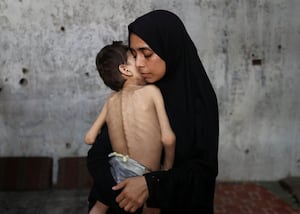
The images of emaciated babies and skeletal helpless frames of their guardians speak for themselves. The death toll so far from malnutrition and starvation in Gaza over the past 20 months of war has risen to 133, including the deaths of 87 children.
An Israeli concern frequently repeated is that the aid, were it to be allowed thorough the road checkpoints – as aid trucks from Egypt were let in from Rafah on Sunday – would likely be intercepted by Hamas, and looted. However, no proof has been presented of this. Some gangs have reportedly attacked convoys and without the UN, aid distribution is greatly disrupted. But even with these challenges, the logic doesn't stand up to scrutiny when on the other hand is the strategic starvation of Palestinians. UN Secretary General Antonio Guterres last week said: “The last lifelines keeping people alive are collapsing."
Teams of the UN's World Food Program delivered 350 truckloads of food aid into Gaza last week. The millions of impoverished people in the enclave need much more than what they are set to receive in the coming days. WFP says more than 62,000 tons of food assistance is needed monthly to cover the entire Palestinian population.
And they need a constant supply through aid corridors that are allowed to stay open and not just when international stakeholders decide to turn up the heat on Israel.
The Gaza ceasefire appears to have stalled. But just because the killings continue doesn't mean that the starvation campaign cannot be brought to an immediate and permanent end.

