A drone image shows massive fires in Qastal Maaf, Latakia countryside, western Syria, on July 10, 2025. Ahmad Fallaha for The National


Syria's wildfires show the urgent need for a regional conversation on climate change


  • English
  • Arabic

July 15, 2025

In the years leading up to Syria’s revolution, in 2011, more than a million people in the Syrian countryside had fled to its cities as a result of climate-induced drought, creating crises in the agricultural sector and the cost of living. How much this contributed to the revolution and the ensuing 14-year civil war remains a subject of considerable debate. Syrians had many reasons to rise up against the Assad regime, which maintained power for decades through systematic oppression and mass torture. But there is little doubt that the drought had exacerbated an already-combustible situation.

Syria’s new government is proving to be entirely different from its predecessor. Its leader, Ahmad Al Shara, speaks of a tolerant and inclusive new chapter, and his popularity shows most Syrians believe him. But wholesale political change does not make the country’s environmental problems – nor their consequences for stability – go away, as evidenced by a series of wildfires that ravaged Syria’s coastal forests last week.

Thanks to the dedication of the local civil defence workers and volunteers, the fires were contained in 10 days. But, as several of them told The National, the task was arduous – made harder by the sorry state of the country’s post-war infrastructure and the presence of landmines in the area.
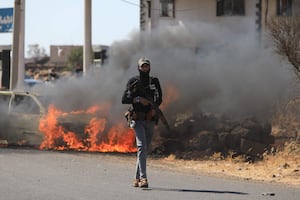
Wildfires are becoming a perennial problem for Syrian authorities, worsened by the persistence of drought. The current drought, ongoing since 2021, is even worse than the one in the late 2000s. In the absence of sufficient rainfall, wheat production has declined, this year meeting less than 20 per cent of national demand. Bread prices, as a result, have soared. The lack of rainfall has also contributed to a water crisis in Damascus, the Syrian capital, where authorities have urged residents to reduce consumption.

At the same time, the country’s authorities are struggling to keep a tight lid on sectarian violence. Clashes last weekend between rival factions in the southern city of Sweida left 30 people dead. Since March, violence in the south as well as the north-west has killed more than 1,000 people. The overall level of danger remains a far cry from the civil war years, but one of the chief lessons of that period is that any emergent combination of deadly violence, environmental crisis and economic strain should not be ignored.

Wholesale political change does not make the country’s environmental problems go away

Syria’s regional neighbours have pledged to do much to help its fledgling government stabilise the country – in terms of infrastructure, investment and, where needed, diplomatic support. Co-operation should be expanded more vigorously to the realm of the environment. Some countries, like Iraq and Turkey, sent support to battle the recent wildfires but there is a need to act more firmly to confront desertification and all aspects of climate change.

The governments of the Middle East, to be sure, have many other issues to contend with just now. But climate change and its consequences do not wait for wars to wind down or political disputes to be resolved. Co-ordination in this area could be an avenue for building trust and strengthening ties, rather than something to be explored when it is already too late.

Syria’s crisis is particularly acute, but it is not unique to that country. Across much of the Arab world, droughts, wildfires and other environmental threats are proliferating. With them comes a greater risk of volatility. Conversations about how to deal with these issues together should be included in efforts to resolve the region’s other challenges, and the time to have them is now.


The President's Cake

Director: Hasan Hadi

Starring: Baneen Ahmad Nayyef, Waheed Thabet Khreibat, Sajad Mohamad Qasem 

Rating: 4/5

The specs

  Engine: 2-litre or 3-litre 4Motion all-wheel-drive Power: 250Nm (2-litre); 340 (3-litre) Torque: 450Nm Transmission: 8-speed automatic Starting price: From Dh212,000 On sale: Now

Guardians%20of%20the%20Galaxy%20Vol%203
%3Cp%3E%3Cstrong%3EDirector%3A%20%3C%2Fstrong%3EJames%20Gunn%3C%2Fp%3E%0A%3Cp%3E%3Cstrong%3EStars%3A%3C%2Fstrong%3E%20Chris%20Pratt%2C%20Zoe%20Saldana%2C%20Dave%20Bautista%2C%20Vin%20Diesel%2C%20Bradley%20Cooper%3C%2Fp%3E%0A%3Cp%3E%3Cstrong%3ERating%3A%3C%2Fstrong%3E%204%2F5%3C%2Fp%3E%0A
Who's who in Yemen conflict

Houthis: Iran-backed rebels who occupy Sanaa and run unrecognised government

Yemeni government: Exiled government in Aden led by eight-member Presidential Leadership Council

Southern Transitional Council: Faction in Yemeni government that seeks autonomy for the south

Habrish 'rebels': Tribal-backed forces feuding with STC over control of oil in government territory

Specs
Engine: Electric motor generating 54.2kWh (Cooper SE and Aceman SE), 64.6kW (Countryman All4 SE)
Power: 218hp (Cooper and Aceman), 313hp (Countryman)
Torque: 330Nm (Cooper and Aceman), 494Nm (Countryman)
On sale: Now
Price: From Dh158,000 (Cooper), Dh168,000 (Aceman), Dh190,000 (Countryman)
UPI facts

More than 2.2 million Indian tourists arrived in UAE in 2023
More than 3.5 million Indians reside in UAE
Indian tourists can make purchases in UAE using rupee accounts in India through QR-code-based UPI real-time payment systems
Indian residents in UAE can use their non-resident NRO and NRE accounts held in Indian banks linked to a UAE mobile number for UPI transactions

Dunki
%3Cp%3E%3Cstrong%3EDirector%3A%3C%2Fstrong%3E%20Rajkumar%20Hirani%C2%A0%3C%2Fp%3E%0A%3Cp%3E%3Cstrong%3EStarring%3A%3C%2Fstrong%3E%20Shah%20Rukh%20Khan%2C%20Taapsee%20Pannu%2C%20Vikram%20Kochhar%20and%20Anil%20Grover%3C%2Fp%3E%0A%3Cp%3E%3Cstrong%3ERating%3A%3C%2Fstrong%3E%204%2F5%3C%2Fp%3E%0A
Avatar: Fire and Ash

Director: James Cameron

Starring: Sam Worthington, Sigourney Weaver, Zoe Saldana

Rating: 4.5/5

Our legal consultant

Name: Hassan Mohsen Elhais

Position: legal consultant with Al Rowaad Advocates and Legal Consultants.

Tightening the screw on rogue recruiters

The UAE overhauled the procedure to recruit housemaids and domestic workers with a law in 2017 to protect low-income labour from being exploited.

 Only recruitment companies authorised by the government are permitted as part of Tadbeer, a network of labour ministry-regulated centres.

A contract must be drawn up for domestic workers, the wages and job offer clearly stating the nature of work.

The contract stating the wages, work entailed and accommodation must be sent to the employee in their home country before they depart for the UAE.

The contract will be signed by the employer and employee when the domestic worker arrives in the UAE.

Only recruitment agencies registered with the ministry can undertake recruitment and employment applications for domestic workers.

Penalties for illegal recruitment in the UAE include fines of up to Dh100,000 and imprisonment

But agents not authorised by the government sidestep the law by illegally getting women into the country on visit visas.

Updated: July 17, 2025, 7:02 AM