


A century ago, the Swiss city of Davos was most famous for its sanatoriums. Nowadays, it is synonymous with the World Economic Forum (WEF), an annual gathering of the world’s politicians, business magnates and other decision makers. Davos is no longer a place where the ill go searching for a cure, but where the powerful try to cure the planet’s ills, through panel discussions, guest lectures, working groups and networking events. The hope is that gathering in an intimate setting can help build much-needed consensus for a better world.
This year’s edition of WEF, which began on Monday, gets under way amid a swiftly changing international political landscape. Consensus-building is becoming an increasingly fraught affair.
-
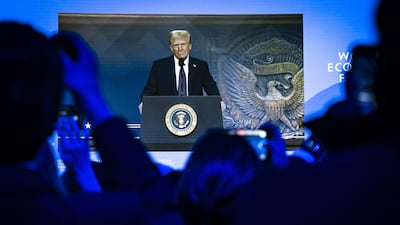
US President Donald Trump is shown on screen as he addresses a plenary session remotely in Davos, Switzerland. EPA -
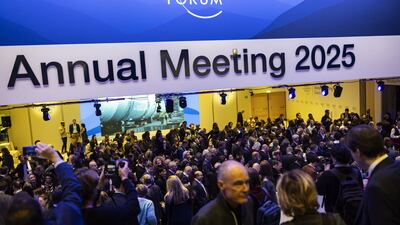
Participants queue to enter the Congress Hall. EPA -
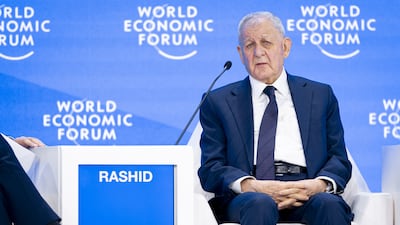
Iraqi President Abdul Latif Rashid. EPA -
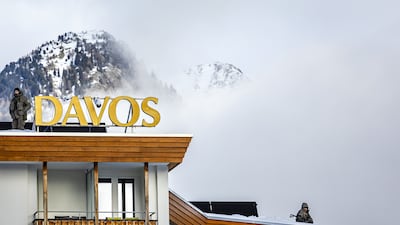
Special police stationed on the roof of the Congress Hotel in Davos. EPA -

Former UK prime minister Tony Blair and Syrian Foreign Minister Asaad Al Shibani at the Annual Meeting of World Economic Forum in Davos. AP -
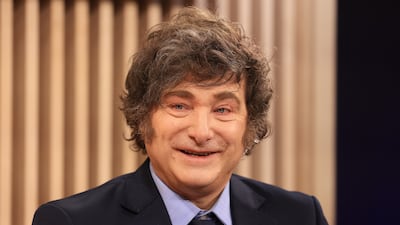
Javier Milei, Argentina's President, during an interview at Bloomberg House at the event. Bloomberg -
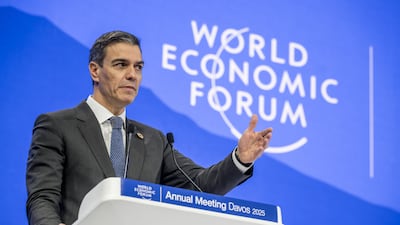
Spain's Prime Minister Pedro Sanchez on the podium. AFP -
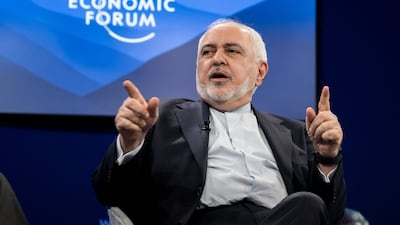
Iran's Vice President for Strategic Affairs Mohammad Zarif addresses the audience. AFP -
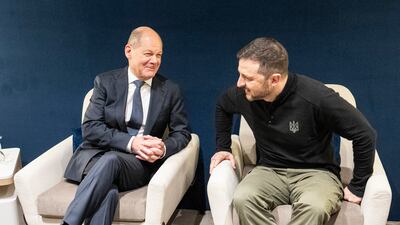
German Chancellor Olaf Scholz, left, and Ukrainian President Volodymyr Zelenskyy. Getty Images -
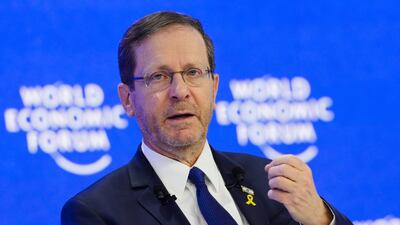
Israel's President Isaac Herzog at the annual meeting in Davos. AP -
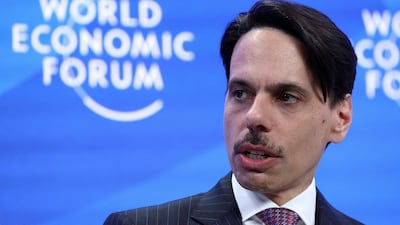
Saudi Arabia's Minister of Foreign Affairs Prince Faisal bin Farhan, during the 55th annual meeting of the World Economic Forum in Davos. Reuters -

The Prime Minister and Foreign Minister of Qatar, Sheikh Mohammed bin Abdulrahman, attends the Annual Meeting of the World Economic Forum in Davos. Reuters -
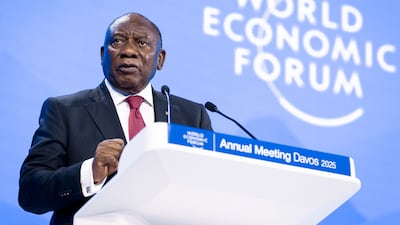
President of South Africa Cyril Ramaphosa speaks at a plenary session. EPA -
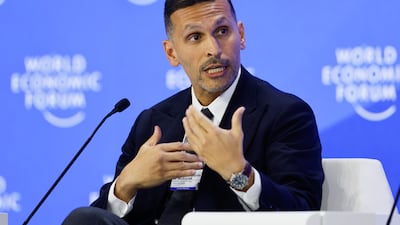
Khaldoon Al Mubarak, chief executive of Mubadala Investment Co, during a panel session in Davos. Bloomberg -
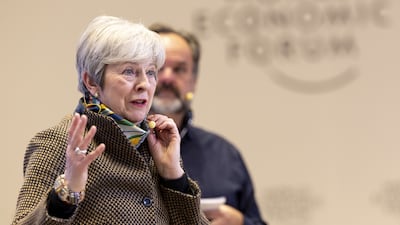
Former British prime minister Theresa May at the 55th annual World Economic Forum. EPA -
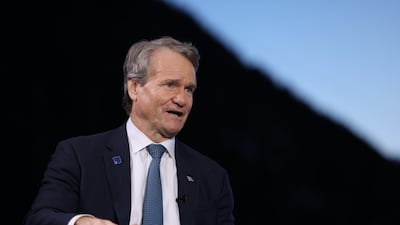
Brian Moynihan, chief executive officer of Bank of America Corp, at the forum. Bloomberg -

Ruth Porat, chief financial officer of Alphabet Inc, at Bloomberg House. Bloomberg -
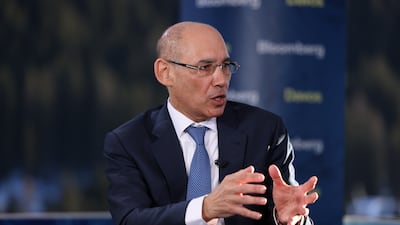
Amir Yaron, governor of Israel's central bank, at the WEF in Davos. Bloomberg -
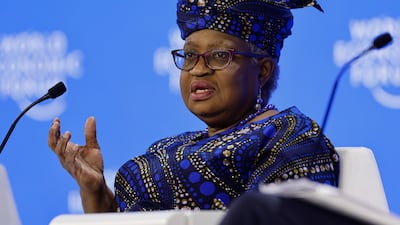
Ngozi Okonjo-Iweala, director general of the World Trade Organisation in Davos. Bloomberg -
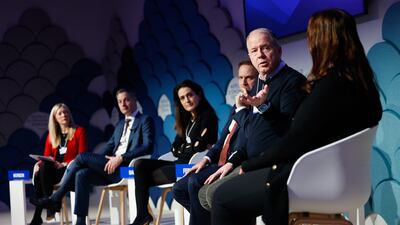
From left, Rachel Morison, editor at Bloomberg News, Belgium's Prime Minister Alexander De Croo, Ester Baiget, chief executive of Novozymes, Marc Ferracci, France's Industry and Energy Minister, Martin Lundstedt, chief executive of Volvo, and Anna Borg, chief executive of Vattenfall AB, during a panel session at the World Economic Forum. Bloomberg -
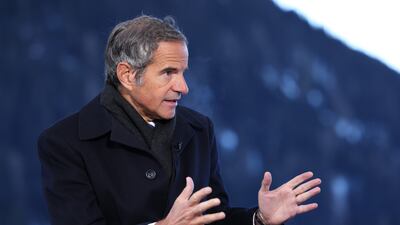
Rafael Grossi, director general of International Atomic Energy Agency, speaks at the WEF. Bloomberg -
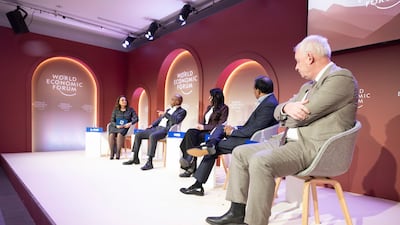
Mina Al-Oraibi, editor-in-chief of The National, left, Mohamed Kande, global chairman of PwC, second left, Ravi Kumar S, chief executive of Cognizant, second right, and Luc Triangle, general secretary of the International Trade Union Confederation, right, during the panel session titled, Who Benefits from Augmentation? Photo: WEF -

Filippo Grandi, UN High Commissioner for Refugees, speaks during the Refugees and Their Olympian Spirit session. Photo: WEF -
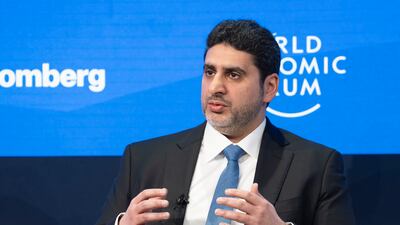
Bandar Bin Mohammed Al Thani, Governor of the Qatar Central Bank, during the session called Banks: Change on All Fronts? Photo: WEF -
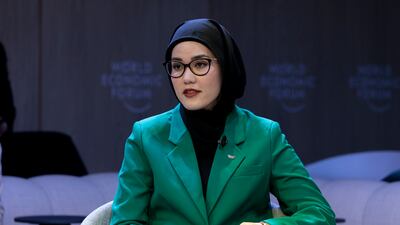
Masomah Ali Zada, chef de mission of the Refugee Olympic Team, France, speaks during the Refugees and Their Olympian Spirit session. Photo: WEF -
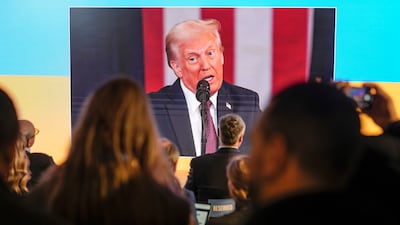
Watching the inauguration of Donald Trump as US President on screens, at the Ukraine House, during the World Economic Forum in Davos. AP -

Waleed Al Muhairi, deputy group chief executive of Mubadala Investment Company, during a Bloomberg Television interview before the WEF. Bloomberg


Coinciding with the first day of this year’s Forum, Donald Trump was sworn into the US presidency and the world’s biggest economy took a sudden, protectionist turn. Within hours of his inauguration, Mr Trump withdrew the US from the World Health Organisation. The past year has seen heightened tensions and economic rivalry between China and the US, and the exacerbation of existing conflicts in Ukraine and the Middle East. For those who believe in a more open, interconnected international community, there is much cause for concern about the direction in which things may be headed.
It is no surprise then that many are asking themselves whether the spirit of multilateralism that gave rise to WEF more than 50 years ago remains viable. But optimists still have many examples of global co-operation to point to.
Recent global climate summits in Dubai and Baku were held in the backdrop of global polarisation but ultimately achieved robust consensus – the of getting there perhaps proving the point. In much of the developing world, regionalism and trade co-operation has overtaken nationalism; the past year saw the expansion of the Brics club of nations to five new members, as well as a flurry of free trade deals in the Global South. Perhaps the real trend is not the disaggregation of the international community, but a shift in its centre of gravity.
And while Trumpism (along with other populist movements in Europe) appears to stand in direct opposition to globalism, it may end up strengthening it further, perhaps by chastening its excesses. Populists are often not entirely wrong when they speak of an out-of-touch global elite – that’s why their words resonate with so many. All over the world, people are worried about their livelihoods, the cost of living and the proliferation of conflict driven by the interests of the few. The gap between rich and poor societies, moreover, is only growing.
The challenge for WEF is to hear the wake-up call and keep apace. If you want to cure the world’s ills, you need to be attuned to its suffering.

