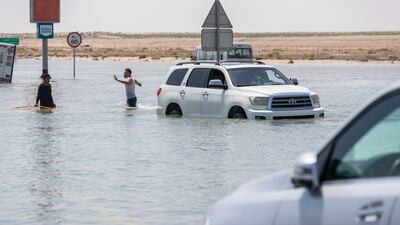
People push a stalled vehicle on a flooded Dubai motorway in Dubai last Thursday. Since then, the vast majority of the country’s roads have reopened, flights are arriving and departing as normal, employees are back at work and the school year has resumed. Getty
People push a stalled vehicle on a flooded Dubai motorway in Dubai last Thursday. Since then, the vast majority of the country’s roads have reopened, flights are arriving and departing as normal, empl


How people power helped the UAE weather the storm


  • English
  • Arabic

April 23, 2024

Exactly one week ago, the people of the UAE went through a collective experience that was truly unprecedented. When the heaviest rainfall in more than seven decades arrived with gale-force winds, the extreme weather not only challenged the infrastructure, but it also disrupted the daily routine of millions. Seven days later, as the clean-up operation continues, we can say that despite the hardships this was a challenge that was met head-on with determination and brilliant community spirit.

The intensity of the weather that struck the Emirates and neighbouring Gulf countries will linger in people’s memories for years to come. At least twenty people lost their lives in Oman, and four died in the UAE. The volume of rain that hit the country was the highest since official records began in 1949.

More than 250 millimetres fell on Al Ain – the equivalent of two years’ average rainfall. In Dubai, many flights at the emirate’s main international airport – a global aviation hub – were cancelled, delayed or diverted. Flooding caused severe traffic disruption, schools shut their doors and many businesses told their staff to work from home.

Sheikh Hamdan bin Mohammed, the Crown Prince of Dubai, has directed developers and management companies to provide alternative housing, food and free cleaning services for people affected by the flooding. Photo: Dubai Media Office

And yet, less than seven days later, the vast majority of the country’s roads have reopened, flights are arriving and departing as normal, employees are back at work and the school year has resumed. The violence of last week’s wind and rain would have overwhelmed many countries, particularly those that unfortunately lack the resources to prepare or rebuild. The UAE has shown what a focused and joined-up effort can achieve, and the swift recovery led by the authorities’ response was augmented by a strong personal response from people throughout the country.

There have been countless accounts of residents pulling together. Many were moved by the story of Ryan Cayamanda and Joshua Aldrin De Vera, two Filipino veterinary nurses in Dubai who worked for more than 72 hours through the storms to care for sick and injured animals.

Several UAE restaurants also stepped up, pledging to support people affected by the storm by giving them free meals. Some people took in others who could not reach their homes as they got cut out in the storm. But as the flood waters recede, there are longer-term challenges to confront.

There is a need for a full review of climate preparedness, which UAE President Sheikh Mohamed has called for. Sheikh Hamdan bin Mohammed, the Crown Prince of Dubai, also issued a directive to developers and management companies to provide alternative housing, food and free cleaning services timely and important. In an example of the government’s co-ordinated approach, the Dubai Land Department and the Real Estate Regulatory Agency will work with property developers to help get communities back on their feet.

The floods of 2024 also provide a salutary lesson for the future. No-one can be in doubt now that a changing climate does not only mean rising temperatures, but increased storms and rainfall too. The UAE is certain to feel more effects from global warming – yesterday, climate experts told The National that record melting of the world’s glaciers has led to sea level rises globally, putting the Middle East under threat from storm surges.

The authorities will plan accordingly, but it is incumbent on individuals and private businesses to display common sense and adapt to these changing times. People will hopefully think twice before disregarding weather warnings in future, and companies that offer non-essential services would be advised to close when extreme weather poses a risk of death and injury. The communal spirit that we have seen in the UAE over the past seven days will be needed again in the future.

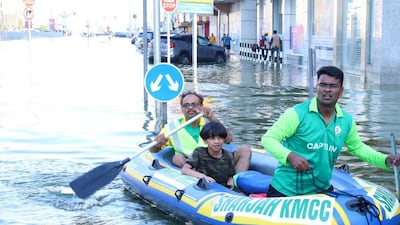
  • Volunteers from the Kerala Muslim Cultural Centre transport residents in Sharjah to safety. Photo: Kerala Muslim Cultural Centre
    Volunteers from the Kerala Muslim Cultural Centre transport residents in Sharjah to safety. Photo: Kerala Muslim Cultural Centre
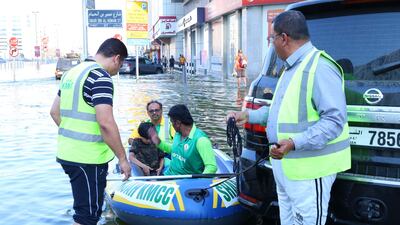
  • Boats have become the safest mode of transport as authorities continue to pump out floodwater from waterlogged streets in Sharjah. Photo: Kerala Muslim Cultural Centre
    Boats have become the safest mode of transport as authorities continue to pump out floodwater from waterlogged streets in Sharjah. Photo: Kerala Muslim Cultural Centre
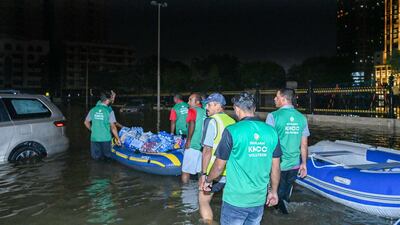
  • Drinking water is among the top requirements of people in flood-affected areas in Sharjah. Photo: Kerala Muslim Cultural Centre
    Drinking water is among the top requirements of people in flood-affected areas in Sharjah. Photo: Kerala Muslim Cultural Centre
  • Volunteers from the Indian People’s Forum deliver essential supplies to people in need in flood-affected communities. Photo: Indian People’s Forum
    Volunteers from the Indian People’s Forum deliver essential supplies to people in need in flood-affected communities. Photo: Indian People’s Forum
  • Volunteers use a makeshift raft to transport water and food to flood-hit areas. Photo: Volunteer handouts
    Volunteers use a makeshift raft to transport water and food to flood-hit areas. Photo: Volunteer handouts
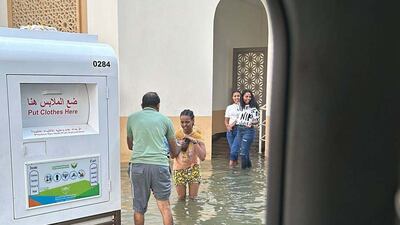
  • UAE residents rallied together to help people left reeling by the country's worst storm on record. Photo: Volunteer handouts
    UAE residents rallied together to help people left reeling by the country's worst storm on record. Photo: Volunteer handouts
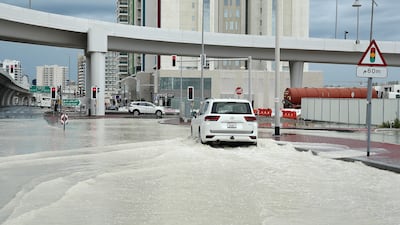
  • A flooded section near the D65 exit from Sheikh Zayed Road in Al Quoz, Dubai. Antonie Robertson / The National
    A flooded section near the D65 exit from Sheikh Zayed Road in Al Quoz, Dubai. Antonie Robertson / The National
  • Marooned vehicles near Al Maktoum Airport turn-off, along the 311 motorway in Dubai. Antonie Robertson / The National
    Marooned vehicles near Al Maktoum Airport turn-off, along the 311 motorway in Dubai. Antonie Robertson / The National
  • A car drives through a waterlogged roads in Dubai. Pawan Singh / The National
    A car drives through a waterlogged roads in Dubai. Pawan Singh / The National
  • Sharjah resident Aziza Hakeem needs formula milk, food for her young children and nappies. The family was forced to flee from their villa in the Al Sabkha area when the water gushed in the day after the rains last week. Photo: Hakeem family
    Sharjah resident Aziza Hakeem needs formula milk, food for her young children and nappies. The family was forced to flee from their villa in the Al Sabkha area when the water gushed in the day after the rains last week. Photo: Hakeem family
Seven tips from Emirates NBD

1. Never respond to e-mails, calls or messages asking for account, card or internet banking details

2. Never store a card PIN (personal identification number) in your mobile or in your wallet

3. Ensure online shopping websites are secure and verified before providing card details

4. Change passwords periodically as a precautionary measure

5. Never share authentication data such as passwords, card PINs and OTPs  (one-time passwords) with third parties

6. Track bank notifications regarding transaction discrepancies

7. Report lost or stolen debit and credit cards immediately

ESSENTIALS

The flights 
Fly Etihad or Emirates from the UAE to Moscow from 2,763 return per person return including taxes. 
Where to stay 
Trips on the Golden Eagle Trans-Siberian cost from US$16,995 (Dh62,414) per person, based on two sharing.

Ten tax points to be aware of in 2026

1. Domestic VAT refund amendments: request your refund within five years

If a business does not apply for the refund on time, they lose their credit.

2. E-invoicing in the UAE

Businesses should continue preparing for the implementation of e-invoicing in the UAE, with 2026 a preparation and transition period ahead of phased mandatory adoption. 

3. More tax audits

Tax authorities are increasingly using data already available across multiple filings to identify audit risks. 

4. More beneficial VAT and excise tax penalty regime

Tax disputes are expected to become more frequent and more structured, with clearer administrative objection and appeal processes. The UAE has adopted a new penalty regime for VAT and excise disputes, which now mirrors the penalty regime for corporate tax.

5. Greater emphasis on statutory audit

There is a greater need for the accuracy of financial statements. The International Financial Reporting Standards standards need to be strictly adhered to and, as a result, the quality of the audits will need to increase.

6. Further transfer pricing enforcement

Transfer pricing enforcement, which refers to the practice of establishing prices for internal transactions between related entities, is expected to broaden in scope. The UAE will shortly open the possibility to negotiate advance pricing agreements, or essentially rulings for transfer pricing purposes. 

7. Limited time periods for audits

Recent amendments also introduce a default five-year limitation period for tax audits and assessments, subject to specific statutory exceptions. While the standard audit and assessment period is five years, this may be extended to up to 15 years in cases involving fraud or tax evasion. 

8. Pillar 2 implementation 

Many multinational groups will begin to feel the practical effect of the Domestic Minimum Top-Up Tax (DMTT), the UAE's implementation of the OECD’s global minimum tax under Pillar 2. While the rules apply for financial years starting on or after January 1, 2025, it is 2026 that marks the transition to an operational phase.

9. Reduced compliance obligations for imported goods and services

Businesses that apply the reverse-charge mechanism for VAT purposes in the UAE may benefit from reduced compliance obligations. 

10. Substance and CbC reporting focus

Tax authorities are expected to continue strengthening the enforcement of economic substance and Country-by-Country (CbC) reporting frameworks. In the UAE, these regimes are increasingly being used as risk-assessment tools, providing tax authorities with a comprehensive view of multinational groups’ global footprints and enabling them to assess whether profits are aligned with real economic activity. 

Contributed by Thomas Vanhee and Hend Rashwan, Aurifer

Updated: April 23, 2024, 6:22 AM